“The Faith of the Wings”
I am not yet what I could be,
But I was never what they called me.
I hide in silence, soft and low,
Afraid to fly, but still I grow.
They say I crawl, but I prepare,
My wings are folded in the air.
And though they say I won’t survive,
The whisper in me stays alive.
I ask no proof. I seek no fame.
I just want someone to know my name.
Not as broken. Not as pain,
But as the one who flew again.
What am I?
Answer ylfrettub reveileb
Butterfly Mondays | April 21, 2025
Theme: “Believing in Butterflies: What the Research Reveals”
Healing Station Zoom
6:00 PM EST
Join Here https://us02web.zoom.us/j/88324556318?pwd=QlNsT3lLWnc0alo3K09nN0JoaFNxQT09
What does it mean to believe in butterflies?
In this special research-based Butterfly Mondays session, we’ll dive into the key findings from over 7,500 voices – youth and adults who participated in Dr. Bruce Purnell’s ongoing study: What It Means to Believe in Butterflies. Most people believe in pain before they believe in purpose. That’s the heart of the Butterfly Scale research, which asked thousands a simple question: Do you believe enough in transformation to begin it? What we learned was both sobering and sacred:
• People will kill a caterpillar unless it’s called a butterfly.
• People will avoid healing unless they believe it leads to beauty.
• People will hold onto pain because hope feels too risky.
Belief is the gate.
And if we want to help people heal, we must help them believe again.
This Buildshop is about naming what we’ve lost and reclaiming what’s still possible.
In this Buildshop, we’ll explore:
• Why only 12% believe joy loves company
• Why most people know their trauma but not their gifts
• Why 90% say love hurts, but only 50% believe it wins
• What these data mean for healing, transformation, and cocooning
We’ll unpack The Butterfly Scale, learn what keeps us from entering transformation, and reclaim our faith in flight.
In This Buildshop, We Will:
✅ Examine the beliefs that keep us stuck in survival
✅ Review powerful survey data and its implications
✅ Take the Butterfly Scale together
✅ Practice a transformative journaling exercise
✅ Explore how to shift from fear to faith
This exploration dives deeply into our past, present, and future. Stay for the healing, and leave with your wings.
Join the Blog: https://welovemoredrbruce.com/
Take the Quiz: https://welovemore.typeform.com/butterflyscale
The Butterfly Scale – Understanding the Belief in Transformation
As we navigate The Caterpillar’s Journey of the Heart, we explore many metaphors, frameworks, and spiritual truths. But at the center of it all lies one powerful question: Do we believe in transformation enough to surrender to it? This transformation and healing platform captures the soul of an ongoing research study by Dr. Bruce Purnell. It explores the mindsets, belief systems, and narratives that shape whether individuals are open to healing and willing to enter the cocoon for their transformation. Over 7,500 adults and youth have participated in this unique examination of our “Beings” in this study titled “The Butterfly Scale.”
The Butterfly Scale is a groundbreaking tool designed to measure belief, the subtle but powerful inner sense of whether someone is willing to surrender to the cocoon and trust the promise of flight. This chapter combines years of research, narrative truth, and lived experience to explore what it truly means to believe in butterflies and how that belief (or lack thereof) shapes every step of our path.
The Power of Belief: Where the Journey Begins
This research was sparked by a decisive and revealing classroom moment. A young man, with sincerity and pain in his voice, asked:
“Doc, why would I sacrifice the present for a future I don’t believe in?”
His vulnerability struck a nerve, and what followed was even more telling: the entire class agreed without hesitation. As we unpacked the moment, it revealed a universal truth not only among youth but also echoed across all age groups:
People are far less likely to enter a complex process if they don’t believe the outcome is possible or worth the effort.
What we believe determines how we move. If we think that joy is fleeting, we avoid vulnerability. If we believe that love always hurts, we build walls. We rarely enter the cocoon if we don’t believe in transformation. This examination confirms and continues to reveal one foundational truth: If we do not believe in flying, we will not surrender to the cocoon. Human nature is wired for energy conservation. When we perceive that an emotional, physical, or spiritual investment has a low chance of return, we instinctively pull back. This is not laziness; it’s protection, a trauma response, and survival.
We see this everywhere:
• A student who stops studying because they believe they’ll fail no matter what.
• A person in recovery who relapses, not out of weakness but because healing feels like a dream others achieve, not them.
• A parent who no longer sets boundaries, believing the child is too far gone to change.
• Someone who stops going to therapy because progress feels invisible and they fear they’re just broken.
• A dreamer who gives up on starting a business, not because they lack the skill but because they lack the belief that people like them succeed.
• An employee who loses motivation and productivity because they see no chance of advancement.
“If we understand the level of uncertainty that indoctrination into a traumatic narrative generates automatically, we will rethink our positioning surrounding healing and transformation.”
Trauma isn’t just something that happens; it’s something that teaches.
It teaches us:
• To expect loss.
• To anticipate pain.
• To distrust peace.
• To fear vulnerability.
When someone has been indoctrinated into a traumatic narrative, especially over years or generations, that trauma doesn’t just influence how they feel; it shapes how they calculate risk, how they interpret possibility, and how they relate to hope itself.
This indoctrination produces an automatic sense of uncertainty, a baseline assumption that:
• Joy is temporary.
• Love Hurts.
• Trust is dangerous.
• Change is betrayal.
• Healing is a setup for disappointment.
This level of internalized uncertainty is not a conscious choice. It’s a conditioned survival response. So when we ask people to “do the work” of healing, to “believe in transformation,” or to “take a leap of faith,” we’re often asking them to move against a deeply embedded program that equates hope with threat.
Healing, then, cannot begin with expectation. It must start with compassion.
Transformation cannot begin with strategy. It must start with understanding.
Suppose we recognize the neurological, emotional, and spiritual residue of trauma that breeds automatic doubt, shaky self-worth, and resistance to trust. In that case, we must rethink how we invite people into healing.
We offer more than just tools: safety and a home base (Brave Affirming Secure Environment).
We don’t just ask questions; we rebuild belief.
We don’t just present the cocoon; we validate why it looks terrifying.
When we adjust our positioning to meet people where their nervous systems and life experience have conditioned them to stand, we become more than practitioners or educators; we become social alchemists.
Until someone feels safe and brave enough to believe, they will not feel safe and brave enough to transform. This healing paradox is why our young people grow frustrated when we rush into the “how” and “what” of healing without ever addressing the “why.”
Why should I care?
Why would I believe in joy if trauma shaped my entire worldview?
Why enter a cocoon if I’m convinced I’ll never fly?
These aren’t rhetorical questions but survival filters determining whether we will ultimately begin the transformation process.
And so, the core truth emerged:
Healing and transformation don’t begin with effort. They begin with belief.
Research Foundation: From Survival to Self-Actualization
In 2024, Dr. Purnell launched an expansive research study titled “What It Means to Believe in Butterflies.” Over 7,500 youth and adults responded to a 10-question survey that explored mindsets, trauma narratives, joy orientation, and transformation readiness.
The findings revealed that:
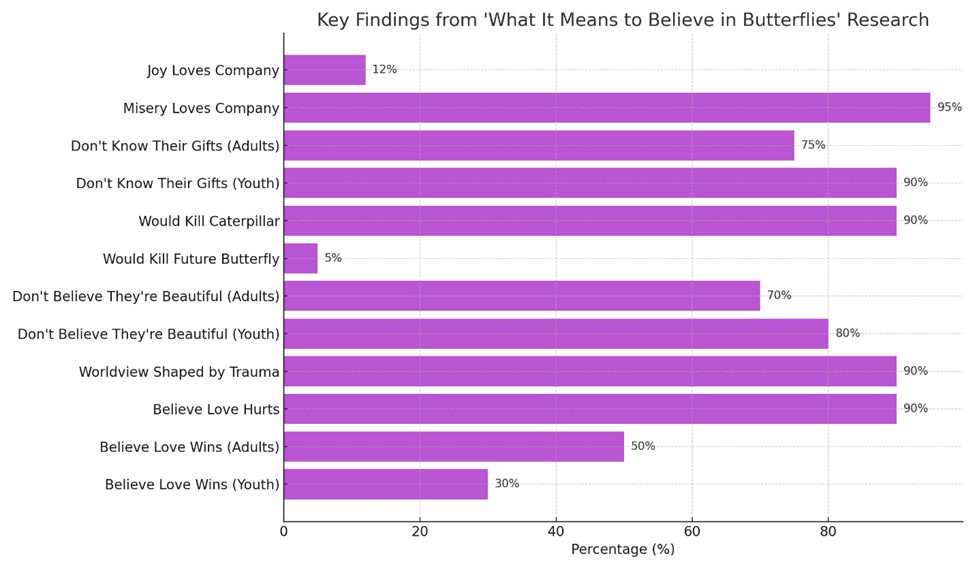
• 95% believe misery loves company, but only 12% believe joy does.
• A majority cannot name their gifts, with 90% of youth and 75% of adults answering “No.”
• Most people will kill a caterpillar but won’t if it’s called a “future butterfly.”
• While 90% of participants say “Love Hurts,” only 50% of adults and 30% of youth say “Love Wins.”
This data was transformational in its own right; it exposed a cultural and emotional disconnection from Love, hope, identity, and healing.
These insights inspired Version 1 of the Butterfly Scale, a 10-question tool for identifying people’s positions on the journey toward transformation.
From Version 1 to Version 2: Deepening the Insight
After reviewing thousands of responses, Dr. Purnell developed Version 2 of the Butterfly Scale, an expanded 20-question framework informed by:
• Qualitative interviews with trauma survivors
• Analysis of narrative identity formation (McAdams, 2001)
• Self-efficacy theory (Bandura, 1977)
• Hope theory (Snyder, 1994)
• Cultural trauma and identity psychology (Akbar, 1996)
• Analysis of The Community’s Scale for Healing Possibilities (TJemal, A., Waite, D., Ortega-Williams, A., & Purnell, B., et al. (In Press).
This second version, now tested with 500+ respondents, provides a broader and more nuanced view of how individuals conceptualize self-worth, purpose, agency, and healing.
Dimensions
Perspective captures hope, future orientation, and belief in joy as sustainable
Self-love measures self-acceptance, body image, and perceived inherent value
Agency assesses belief in personal control, gift cultivation, and purpose fulfillment
Healing Openness evaluates vulnerability, surrender, and trust in the cocooning process
Worldview explores how trauma and love shape perception of the world and relationships
These domains are rooted in evidence-based frameworks that have been shown to influence transformation:
• Snyder’s Hope Theory connects perspective with perceived pathways and agency.
• Bandura’s Self-Efficacy Theory justifies agency and the impact of belief in personal outcomes.
• Fredrickson’s Broaden-and-Build Theory aligns with Self-Love and emotional openness.
• Narrative Identity Theory links worldview with autobiographical memory and meaning-making.
📈 Scoring Framework
• Rate each question from 1 (Strongly Disagree) to 5 (Strongly Agree)
• Reverse-score designated items
• Total score range: 20–100
Score Range Category Interpretation
90–100 Butterfly Ready Fully aligned with joy, self-worth, and transformation
75–89 Awakening Wings Open but still tethered to protective habits or doubt
50–74 Searching for Safety Hesitant, longing, often governed by trauma and mistrust
0–49 Stuck in Survival Limited belief in change; deep trauma imprint
Why This Scale Matters
The Butterfly Scale helps:
• Identify emotional readiness for healing
• Support practitioners in tailoring care
• Empower journeyers to self-reflect
• Validate that transformation is not about force but about faith
It gives language to the invisible, measurement to belief, and power to those rediscovering their wings.
Key Data Highlights
• Only 12% believe joy loves company, while 95% believe misery does.
• Over 75% of adults and 90% of youth say they do not know their gifts.
• 90% of adults said they would kill a caterpillar eating their flowers, but only 5% would if it were called “Future Butterfly.”
• 70% of adults and 80% of youth do not believe they are beautiful as they are.
• 85–90% of participants say trauma and pain shape their worldview more than love.
• And while 90% say “Love Hurts”, only 50% of adults and 30% of youth believe that Love Wins.
Implications for Healing, Coaching, and Programming
The Belief in Butterflies Study is not just about mindset; it is a diagnostic lens for:
• Mental health practitioners
• Life coaches and transformation leaders
• Youth coaches and trauma-informed educators
• Community organizations and healing-centered spaces
• Journeyers
These data can guide how we create healing and transformation initiatives that speak silently to the fundamental, unspoken beliefs many carry. It can also provide a blueprint for shifting people from survival-based language to a thriving, joyful, Love-based vibration.
Applications
The Butterfly Scale can be used in individual coaching, therapy, group sessions, and trauma-informed programming to:
• Spark reflective dialogue
• Assess readiness and barriers to healing
• Offer personalized guidance and encouragement
• Measure growth over time
This tool is more than a survey. It is a mirror, a compass, and a seed. It helps us answer the question not just with our minds but with our hearts:
“Do I believe in butterflies?”
EXERCISE: My Belief in Butterflies Score
Part 1: Reflection
What trauma has shaped the way you see yourself?
What would your life look like if you genuinely believed transformation was possible?
What is one belief that keeps you from entering the cocoon?
From Research to Resurrection
This study affirms what every butterfly has discovered during reflection: Transformation is not a given but a choice. However, that choice can only be made when we believe in what is possible on the other side of the cocoon. Thus, we invite you to ask yourself:
Do I believe in butterflies? Do I believe in myself enough to surrender? Do I believe in Love enough to trust the process?
Because once you do…The wings were never far away. They were only waiting to be remembered.
 We Love More Dr.Bruce