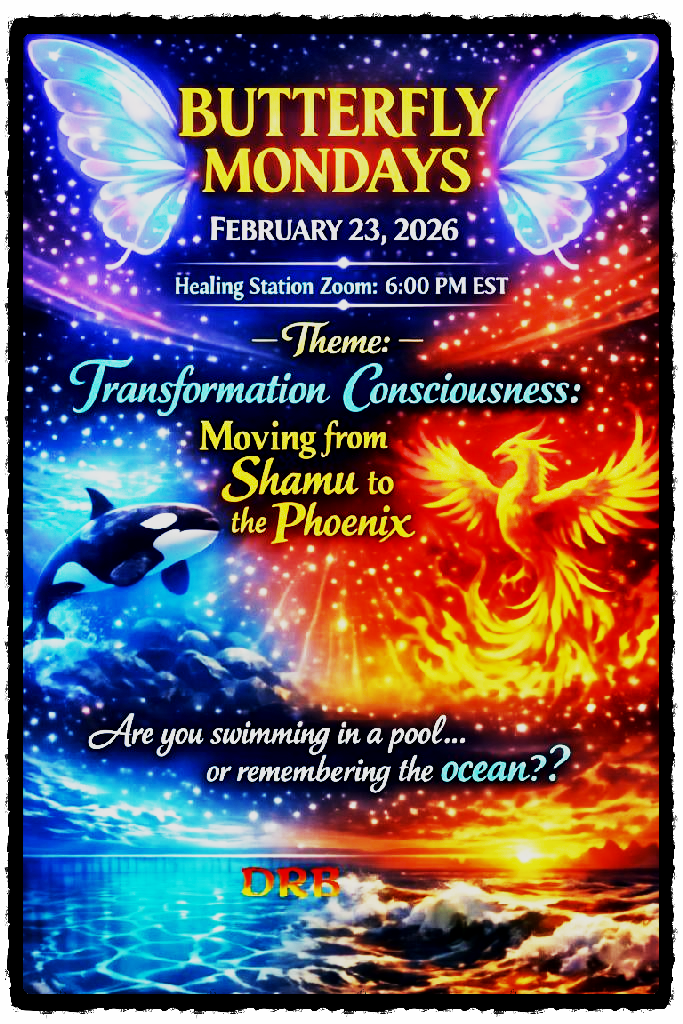
Butterfly Monday – February 23, 2026
Healing Station Zoom: 6:00 PM EST
Join Here: https://us02web.zoom.us/j/88324556318?pwd=QlNsT3lLWnc0alo3K09nN0JoaFNxQT09
Transformation Consciousness:
I am not just a breath or a heartbeat, or the many tables where we have taken a seat.
Not another morning we had to survive, but the sacred art of being alive.
I am the divine song we were meant to sing and the flight of your butterfly when
we discover our wings.
I’m in tears, we may deny, because we were taught not to cry.
I’m Divine, Authentic DNA, and even if you don’t know me, I’m your inner truth that will never go away.
I rise when Love becomes your guide, and Joy and forgiveness are on your side.
I thrive when purpose is greater than trauma, and Affirmations dismiss the drama.
I’m not in a clock or any grind, and I bring freedom to your heart and mind.
When shadows pass, and you forgive, Discovering your divine and a new way to live.
So tell me now, and speak with grace. That Love and Light and brand-new place?
I’m not the life you live to survive. So who am I we can’t deny?
Are you swimming in a pool… or remembering the ocean?
So many of us have adapted to survival. We’ve learned how to perform, how to earn approval, how to stay safe in the confines of systems that trained us to forget who we are. But there is another consciousness available. This week on Butterfly Mondays, we are awakening the flyer and honoring the survival that carried us here while choosing the sovereignty that will carry us forward, not shaming the swimmer. We will explore two realities
The fire was meant to reveal you, not destroy you, and that the pool was never your home. Your home was always the ocean, and transformation and healing were never fantasies.
It is your design.
We will also examine the Shamu–Phoenix Continuum:
• Shamu consciousness: adaptation, performance, containment
• Phoenix consciousness: sovereignty, refinement, rebirth
We are not here to judge the pool, but to remember the ocean. W are not here to deny the fire, but to rise from the ashes. Let’s Reflect, Release, Reclaim, and Rise. This is not about becoming someone new, but remembering who you were before the conditioning.
Join us as we step into Transformation Consciousness.
There are two ways to respond to trauma.
One adapts.
One transforms.
Shamu consciousness is brilliance shaped by confinement; it is not weakness. The orca learns the pool, performs well, survives, and receives fish. Over time, the performance becomes identity, and this is what many of us have done. We adapted to environments that rewarded silence over truth, productivity over peace, and applause over authenticity. We learned what earned approval, what kept us safe, and how to survive. However, survival is not the same as sovereignty.
Phoenix consciousness does not rise from trauma by denying it. The Phoenix understands fire differently. Where others see destruction, it sees refinement. Where others see ashes, it sees preparation. The Phoenix does not escape the fire; it rises from it. The difference between Shamu and Phoenix is not the amount of suffering endured, but the interpretation of that suffering.
Shamu asks:
How do I survive this pool?
The Phoenix asks:
What is this fire shaping in me?
Transformation consciousness begins when we realize that adaptation kept us alive, but it does not have to define our future. It begins when we stop performing for fish and start remembering the ocean. It begins when we trust that the ashes are not the end of the story. The world may reward performance, but the soul longs for freedom.
Understanding Transformation Consciousness
Transformation Consciousness is not the burst of motivation that follows a conference, a sermon, a breakthrough moment, or an inspiration that flickers with circumstance and fades when difficulty returns. Transformation Consciousness is a new way of seeing the world with agency, devotion, and divine purpose. It is the sacred moment when the soul whispers, “Life has to be more than trauma,” and for the first time, we believe it. It is a frequency, an energy, and a vibration that rises within us when we realize that the manufactured, commercial reality we were handed is not the blueprint for our sacred life journey. It is the internal turning point when we recognize that surviving the script is not the same as living our truth. It is when we understand that a status quo survival consciousness is not a universal law but learned behavior. Transformation Consciousness begins the moment we say, “I will not live confined by a traumatic narrative that leaves me wounded with no prognosis.” It is not a denial of pain but the refusal to let pain be the star of our life story.
How Trauma Shapes Our View of Transformation
Trauma does more than hurt us; it diminishes our dreams and narrows our imagination. When life repeatedly brings abandonment, betrayal, instability, or fear, transformation can feel unrealistic, enlightenment can sound like fantasy, joy can seem suspicious, and hope can feel dangerous. If trusting love in our lives has led to emotional pain, love itself can begin to feel like an illusion. If we were not cultivated in ways that reinforce transformation, growth can feel unsafe. Trauma trains the nervous system to expect repetition, not renewal. Over time, transformation begins to feel like something other people experience. We may admire it from afar but not believe we have the agency to embody it. This is what we might call diminished transformation efficacy: the internal belief that change is possible in theory but not for me.
We say:
• “People don’t really change.”
• “This is just how I am.”
• “It is what it is.”
• “Life be lifing.”
When trauma becomes the narrator, survival becomes the goal; and when survival is the goal, transcendence feels excessive.
How Love Expands Transformation Agency
Now consider the opposite. Consider a life in which love is consistently modeled. In that life, joy is not punished, forgiveness is practiced rather than withheld, rest is not a weakness, and belonging is not conditional. In that environment, transformation feels natural, growth is possible, failure is temporary, and healing is accessible. A life full of Love, Joy, and Forgiveness increases our agency to change by teaching us that the world is not fundamentally hostile. It expands our imagination and affirms that we are worthy of becoming, healing, and birthing our butterflies.
• When love is stable, transformation feels safe.
• When joy is normalized, hope feels rational.
• When forgiveness is practiced, failure loses its power.
Transformation consciousness thrives in environments where Love has been embodied. And here is the good news: even if we did not receive that environment early in life, we can cultivate it now.
The Continuum: From Shamu to Phoenix
Transformation consciousness is not a switch but a fluid continuum. On one end is Shamu Consciousness. Shamu consciousness is an adaptation to captivity and to the narratives, both traumatic and commercial, that maintain the status quo. It is the mindset that believes my life is the pool, so I have to make it work. This pool is the only home I know, and if I perform well, I will be rewarded with fish. In this consciousness, survival is the goal, and even the few who excel find that their reward is a better state of survival. The consciousness of thriving doesn’t exist within this spectrum, so a high level of thriving is considered thriving. However, this consciousness does not involve remembering the ocean or a narrative outside of captivity.
Shamu consciousness normalizes trauma and believes:
• “This is just life.”
• “Don’t expect too much.”
• “Stay small to stay safe.”
On the other end is Phoenix Consciousness.
The Phoenix is not a creature that avoids fire; it is the epitome of turning trauma into purpose and rewriting the narrative. The Phoenix knows that destruction is not always defeat. Sometimes it is refinement, revelation, and resurrection. The Phoenix rises from the fire of betrayal, abandonment, trauma, oppression, and grief, and knows that the pain of the past builds the wings of the future. The Phoenix does not run from the cocoon but enters it willingly. It knows that the breakdown is not a burial but a breakthrough. It does not walk the Yellow Brick Road to reach the Wizzo. It walks the road to discover its own wings. The Phoenix is guided by purpose, fueled by faith, and awakened by inner truth.
The difference between Shamu and Phoenix is not the amount of trauma endured, but the interpretation of it. Shamu believes that trauma is the destination, and the Phoenix believes that trauma is the origin of transformation. Between them lies a spectrum of becoming.
• Some days we swim in circles.
• Some days we rise from ashes.
• Most days, we are somewhere in between.
Life moves us along this continuum. A betrayal may push us toward Shamu. A moment of grace may awaken the Phoenix. A loving relationship may restore agency, and a repeated trauma may shrink it. The question is not, “Have you suffered?” The question is, “What is the purpose of your life energy?” If you agree that the purpose of your life energy is not to endure the next trauma, then let’s atone, forgive, heal, grow, thrive, Love, and transform.
Transformation as Divine Rebirth
Transformation consciousness is not passive, cosmetic, self-improvement, or branding, and it does not come with a commercial script or predefined roles. It is a spiritual rebirth. It requires us to trust Love enough to enter our divine cocoons and surrender to the chrysalis. It asks us to sit still long enough for old identities to dissolve, and it invites us to grow wings not for applause, but for flight. It is the moment we stop asking the Wizzo for permission to become and begin activating the divine gifts already placed within us. Transformation consciousness is not about becoming someone new, but remembering who we were before false narratives became our reality. And in that remembering, the ocean consciousness returns for Shamu. In the spirit of our phoenix, the fire refines, wings unfold.
And the soul says, “I am ready.”
Shamu Consciousness: When Survival Becomes Identity
Shamu consciousness does not begin with weakness. It begins with brilliance and adaptation. The orca was not born to live in a pool. The orca was born into vast waters, moving in pods, and guided by memory older than language. The ocean was not simply a location; it was identity, culture, rhythm, and belonging. Shamu consciousness begins the moment that rhythm is disrupted.
• The cub is separated from the pod.
• The sea is replaced with concrete.
• The tribe is replaced with a trainer.
• The open horizon is replaced with a schedule.
And slowly, almost imperceptibly, survival becomes the priority.
The Genius of Adaptation
Shamu’s are about survival and learn quickly to perform, receive fish, and repeat. The reward loop forms, the body adapts to the pool’s dimensions, and the mind adapts to the predictability of confinement. The applause becomes familiar, the fish become currency, and the show becomes a divine purpose. This is not stupidity but survival intelligence.
And so it is with us. When we grow up in environments where:
• Love is inconsistent
• Safety is unpredictable
• Trauma is normalized
• Joy is fragile
We adapt, learn what earns approval, how to avoid punishment, and which parts of ourselves to silence. We learn what it means to be high-functioning, impressive, and resilient, and we begin to mistake adaptation for identity.
When the Pool Feels Like Home
The most dangerous aspect of Shamu consciousness is not the captivity. It is the normalization of captivity. When confinement is all we have known, freedom feels abstract, the ocean sounds poetic but impractical, and the pool feels real.
Shamu consciousness whispers:
• “This is just how life is.”
• “Don’t be dramatic.”
• “Be grateful for the fish.”
• “At least you’re surviving.”
Over time, we begin to form goals that fit the cage, and instead of longing for the ocean, we negotiate for:
• A larger pool
• Better lighting
• More applause
• Premium fish
We stop dreaming expansively and start optimizing confinement, and because the system rewards performance, we become excellent at it.
The Trauma Loop
Shamu consciousness is sustained by trauma-conditioned belief.
When trauma has taught us that:
• Risk leads to pain
• Vulnerability leads to shame
• Love leads to abandonment
Then confinement feels safer than possibility, and we may not consciously choose the pool, but simply distrust the sea. This is where transformation efficacy weakens. If every attempt at change was punished, why try again? If hope once led to heartbreak, why hope now?
The nervous system learns to equate expansion with danger.
Performance as Proof of Worth
In Shamu consciousness, worth is earned through performance. The show must go on, the audience must clap, and the fish must come.
We begin to believe that if we:
• Work harder
• Please, more people
• Become more polished
• Avoid mistakes
Then we will finally feel secure.
The truth is that security built on performance is fragile and depends on constant output. Because of this, exhaustion becomes an expected part of the culture. This is how “life be lifing” becomes a normal process.
The Hidden Ache
Yet even within Shamu consciousness, there is a quiet ache and a longing that does not disappear. This emotional void surfaces in moments of silence, in dreams, and especially when applause fades. This ache comes because the memory of the ocean is in Shamu’s DNA. The good news is that this ache can be the beginning of Shamu’s healing and transformation. Shamu does not transform when the pool disappears, but when the Orca remembers the ocean.
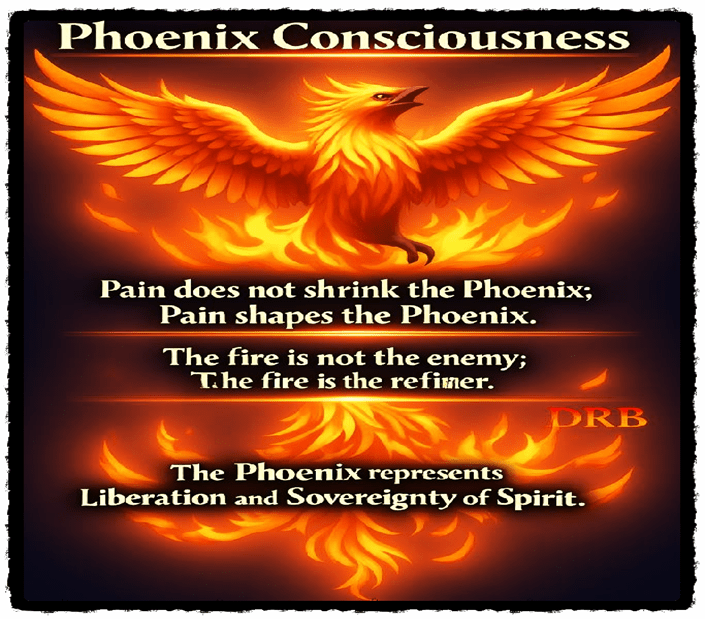
The Story of the Phoenix: Designed to Rise
Before the Phoenix became a metaphor for transformation, it was a story whispered across civilizations. In ancient traditions from Egypt, Greece, and the Middle East, the Phoenix was described as a majestic, magical bird. Its feathers shimmered with gold and crimson, and its wings carried the light of the sun. It was not merely a creature of beauty; it was a creature of destiny. Unlike ordinary birds, the Phoenix did not die like other creatures. When its time approached, it did not flee the fire or pray for rescue. Instead, it carefully and intentionally built a nest from fragrant wood and sacred branches. Then, in a moment that seemed like destruction, the Phoenix ignited. Flames engulfed the nest, heat consumed the body, and the sky filled with smoke. To the outside world, it looked like the end, for nothing remained but ash.
But the sacred truth of the story is that the fire was never the enemy. The fire was part of the Phoenix’s very design; it was in its DNA. From those ashes, a small pulse began, and something extraordinary stirred. Out of what looked like total ruin, the Phoenix rose again, fully formed, with wings like those of a cosmic angel and a light brighter than it had ever been. The Phoenix did not survive the fire by accident; it was built by the fire. Its rebirth was not a miracle in spite of the flames; it was a miracle because of them. The ashes were not evidence of failure but confirmation of the power of transformation. And this is what makes the Phoenix different from every other creature in mythology. By design, the Phoenix integrates and transforms the pain of its past. It does not mourn the ashes; it emerges from them. Lastly, it never develops a strategy to withstand the fire; it simply flies from it.
What the Story Teaches Us
The story of the Phoenix is not about avoiding pain but about understanding that pain is not the main character in the narrative.
In Phoenix consciousness:
• Fire is refinement.
• Ashes are preparation.
• Endings are beginnings.
• Destruction is a doorway.
The Phoenix does not rise despite trauma; it rises because it understands that trauma is not its identity. The flames do not define the Phoenix; the flight does. This is why the Phoenix is the ultimate symbol of transformational consciousness. By design, it was always going to fly out of the fire. We don’t learn the story of the Phoenix to inform us about the fire, but to understand the power of transformation as a guiding metaphor for our journeys.
The Phoenix is an archetype and one of our top guiding metaphors for our healing and transformation journey. It represents a psychological posture, a spiritual stance, a state of being, and a transformative way of interpreting reality. Phoenix Consciousness is not the absence of trauma but a way of transforming trauma into purpose. Where Shamu consciousness adapts to confinement, Phoenix consciousness reinterprets the fire. The caterpillar never dwells on why the environment makes it so difficult to reach its cocoon or questions its chrysalis; its goal is to become the butterfly it was meant to be. The Phoenix is another beautiful example of unapologetic devotion to healing and transformation.
The Psychology of the Phoenix
Phoenix Consciousness is rooted in three internal shifts:
- From Victimhood to Meaning-Making
The Phoenix names, feels, and honors suffering, but never denies it. However, it refuses to let suffering be the narrator of its life story. Psychologically, this resembles what researchers call post-traumatic growth. Not because trauma is good, but because meaning can be extracted from pain. A Phoenix does not say, “I’m glad that happened.” It says, “That did not destroy me. It refined me.” Where Shamu consciousness internalizes the event as identity, Phoenix consciousness reframes the event as experience. One says, “I am broken.”
The other says, “I was burned, and the scars became my wings.” - From Fear-Based Reactivity to Intentional Response
Trauma conditions the nervous system to react and interpret reality. When we are cultivated by a traumatic narrative, loud noise equals danger, silence equals abandonment, and joy equals risk. The Phoenix Consciousness introduces a pause and a breath.
It retrains fear rather than attempting to suppress and eliminate it.
When triggered, the Phoenix asks:
• Is this fire destructive, or is this fire refining?
• Is this threat real, or is this a memory?
• Am I responding from my past, or from my becoming?
This is emotional regulation rooted in sovereignty, and the Phoenix understands that the body may remember the flames, but the spirit does not have to remain in them. - From Performance to Purpose
Phoenix Consciousness rejects applause as identity. It does not perform for fish, shrink for safety, or negotiate for validation. It is intentional about divine purpose and knows that its wings are its divine gifts. Psychologically, this is agency, and spiritually, this is alignment.
The Phoenix believes:
• My pain has meaning.
• My life has direction.
• My healing affects more than me.
Purpose becomes fuel.
Where Shamu consciousness says, “Stay small to stay safe,”
Phoenix consciousness says, “Grow wings and trust the sky.”
The Emotional Texture of a Phoenix
Phoenix Consciousness feels grounded, not invincible.
It allows:
• Grief without collapse
• Joy without suspicion
• Vulnerability without shame
• Rest without guilt
It does not confuse suffering with depth or worship exhaustion as wisdom. It understands something revolutionary: Fire is temporary, and Flight is destiny.
The Difference Is Interpretation
Both Shamu and the Phoenix experience trauma. One internalizes confinement; the other, a spiritual calling. The difference is not intelligence but interpretation. The Phoenix sees ashes and remembers wings, whereas Shamu sees walls and forgets the ocean. The idea that we are not defined by trauma or by how we navigate the pain, stress, and grief is perceived as the history of our life experience. Phoenix Consciousness is not a fantasy, a delusion of grandeur, toxic positivity, or a way to pretend that everything is fine. It is the courage to believe that trauma does not have the final word and the sacred knowing that destruction is not destiny; moreover, it is the decision, repeated daily, to rise and be the affirmation we have been waiting for.
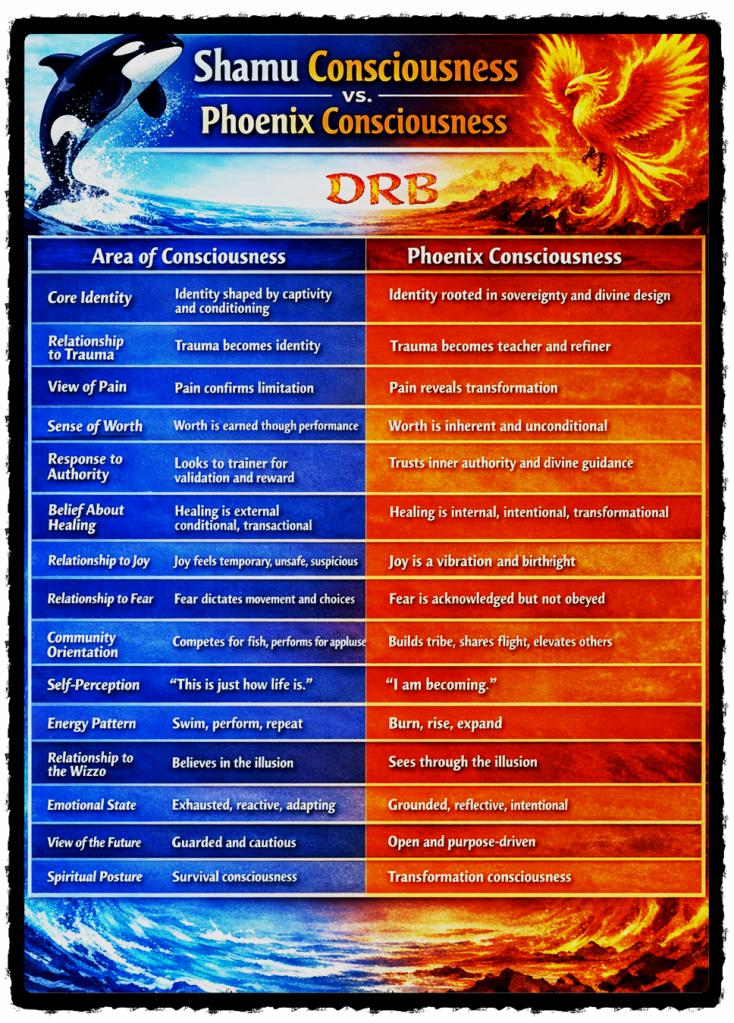
Key Distinction
Shamu asks:
“How do I survive in the pool?” and the Phoenix asks: “How do I rise from the fire?” Shamu adapts to confinement, and the Phoenix integrates destruction. Shamu performs to earn fish, and the Phoenix flies because it remembers who it is. No one lives entirely as Shamu or the Phoenix, and we move along this continuum daily. In our careers, we may perform like Shamu; in our parenting, we may rise like the Phoenix; and in Love, we may oscillate between fear and faith. It is important to understand that Transformation consciousness is not perfection but awareness.
The Sacred Question
In this moment:
• Where am I swimming?
• Where am I rising?
• What would it mean to trust the fire instead of fearing it?
How Collective Systems Sustain Shamu Consciousness
Shamu consciousness is systemic, and although it may feel personal, it never was. Systems sustain Shamu by:
- Rewarding Performance Over Authenticity
• Schools reward compliance.
• Workplaces reward productivity.
• Social media rewards visibility.
• Rarely do they reward rest, reflection, or healing. - Normalizing Exhaustion
• Burnout is called ambition.
• Overwork is called dedication.
• Stress is called realism.
• When exhaustion becomes proof of worth, people stay in the pool. - Selling Relief Instead of Healing
Consumer culture offers:
• Distraction.
• Status.
• Temporary comfort.
Transformation and Healing are illusions and are bad for profit. Hence, Survival is profitable. - Dividing Communities
• Isolation weakens transformation.
• Comparison fuels consumption.
• Division sustains dependency.
• When people are disconnected from their tribe, they look for trainers.
The Systemic Illusion
The system only needs to sustain your swimming consciousness as a culture and a reality you believe to be your universal truth. The Phoenix consciousness disrupts Shaumu consciousness, so it is perceived as counter-culture and a threat. The continuum is about awareness, not judgment. You have survived the pool and felt the fire. Now the question is:
Are you ready to fly?
Guided Meditation: From Pool to Fire to Flight
Close your eyes and imagine yourself in a pool as Shamu.
The water is cold, familiar, predictable, and contained, and you were raised to swim. You know just how to perform here and that you will have some fish by the end of the day.
Feel the walls around you, and now notice something deeper. An ache coming from a distant memory. It is a memory of an ocean you once knew.
The pool begins to dissolve, and now you are standing as a Phoenix before a fire.
It is not wild. It is steady. Sacred. This fire is not destruction, but It is refinement. Step closer.
Feel what must burn:
• Old beliefs.
• Applause dependency.
• Survival masks.
• The need to be small.
Let them fall into the flame and watch them turn to ash. Now inhale to the count of 4 and exhale. From the ash, something stirs. Wings are coming out of your back; they were not given to you. They were always there. Feel your body rise. Not escaping. Not performing. But flying out of the flames. You are no longer swimming for fish. You are flying toward purpose.
Stay here. Breathe and Remember.
Ritual Exercise: Crossing the Continuum
Step 1: The Pool Declaration
Write down one behavior, belief, or pattern that represents your Shamu consciousness.
Example:
• “I silence myself to avoid conflict.”
• “I overwork to feel valuable.”
• “I distrust joy.”
Say aloud:
“This was my survival. It is not my identity.”
Step 2: The Fire Release
Write the belief on paper.
Safely tear, burn (symbolically), or discard it.
As you release it, say:
“I thank you for protecting me. I now choose transformation.”
Step 3: The Wing Activation
Write one Phoenix belief:
• “My voice matters.”
• “Joy is safe.”
• “My pain refines me.”
Stand tall. Extend your arms as wings.
Say:
“I rise.”
The Shamu–Phoenix Self-Assessment Scale
This is not a diagnostic tool, but it is a mirror. Read each statement and rate yourself from:
1 = Mostly Shamu
2 = Leaning Shamu
3 = In Between
4 = Leaning Phoenix
5 = Mostly Phoenix
Identity & Worth
- I believe my worth is tied to how well I perform.
- I believe my worth is inherent, regardless of applause.
Response to Trauma - When I am hurt, I tend to shrink or adapt quickly to avoid more pain.
- When I am hurt, I look for the lesson without denying the pain.
Relationship to Joy - Joy makes me slightly anxious because it feels temporary.
- Joy feels like a natural vibration I can trust.
Authority & Validation - I often look to others for permission to rest, love, or succeed.
- I trust my inner authority to guide my choices.
Fear & Risk - I avoid risks because I fear repeating past trauma.
- I take thoughtful risks because growth requires courage.
Scoring Reflection
• Mostly 1–2: Shamu Consciousness is dominant; survival scripts are active.
• Mostly 3: You are consciously navigating the continuum.
• Mostly 4–5: Phoenix Consciousness is emerging or strengthening.
Important:
Wherever you land is not a failure; it is just information of how we navigate trauma.
We are becoming the “Social Architects” who will design our healing and transformation. Let’s affirm and manifest our divine cocoons together. #WeAreTheButterflyEffect
Subscribe to the Blog: https://welovemoredrbruce.com/
Please give Love More a Google rating: https://g.page/r/CYI0Pw3JjBrjEAI/review
 We Love More Dr.Bruce