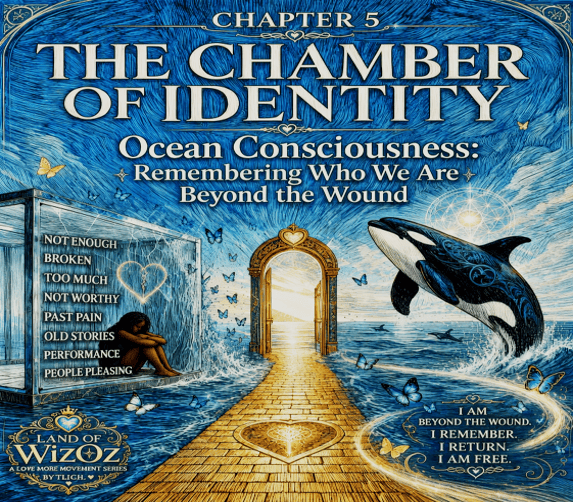
The tank may have shaped how we learned to move, but it cannot define the size of our ocean. —Love More Reflection
Transformative Life Coaches and Healing Leaders Certification, Monday, Sept 28, 6- 8 p.m. on the Healing Station Zoom https://us02web.zoom.us/meeting/register/tZwude2tqz0pG9xJ6zFgGt58RxiHKEVI2PDr
The Ocean Remembers By Dr. Bruce Purnell
They named the tank and called it sea,
Then taught the walls to speak for me.
I learned the turns the glass allowed,
And performed my pain before the crowd.
But underneath each borrowed name,
An older current still remained.
The tank may shape the way I move,
But cannot own the truth I prove.
I hear the ocean call me H “OM” E,
Beyond the place I learned to roam.
Not back to who I was before,
But toward the self becoming more.
I am not glass, a role, or plea.
I am the wave. I am the sea.
I carry history, yet still choose
The sacred name I will not lose.
Join us as we enter CHAMBER 5: IDENTITY: Ocean Consciousness: Remembering Who We Are Beyond the Wound
Who are you beyond what happened to you? Who are you beyond the role you learned to perform, the label someone placed on you, the expectations you inherited, or the name written on a file? Join the Love More Movement as the Yellow Brick Road carries Journeyers into the Chamber of Identity. This class will introduce Tank Identity, the self learned and performed within a limited or controlling environment, and Ocean Consciousness, the remembrance that the environment may have shaped how we learned to move without defining the full scope of who we are.
Through Shamu, Malik and the Name on the File, the Looking-Glass Self, Narrative Identity, Temporal Orientation, and Divine Alignment, Journeyers will explore:
• The roles that helped us survive
• The labels that became inner narratives
• The influence of family, culture, community, history, institutions, and media
• The gifts hidden beneath protective Identities
• The difference between belonging and self-erasure
• The movement from performance to authenticity
• The right to remain complex, culturally grounded, and still becoming
The tank may be part of the story, the file may contain information, and the label may describe one moment, but none of them contains the whole ocean.
Welcome H “OM” E, Journeyers, and welcome to the Chamber of Identity.
The Chamber of Healing asked us to honor what helped us survive without allowing survival to remain our permanent H“OM”E.
The Chamber of Energy asked us to notice what we feed, follow, carry, transmit, and make more available.
The Chamber of Affirmations asked us to examine the words that became our inner narrator and to create truthful language that allows our gifts to breathe.
The Chamber of Love invited us into the circulatory system of Healing and Transformation. Medusa taught us that Love does not require destroying the Guardians. Love teaches the Guardians what to protect, what to question, and what may safely enter.
Now the Chamber of Identity asks: Who is the person being protected?
Who am I beneath the armor?
Who am I beneath the performance?
Who am I when I am not rescuing everyone?
Who am I when no one is applauding?
Who am I when the file is closed?
Who am I beyond the name someone called me during the most painful moment of my life?
Who am I beyond what happened to me?
Who am I beyond what I had to become to survive?
Identity is not simply a name, title, profession, role, diagnosis, race, gender, neighborhood, family position, or online profile. These may all be meaningful dimensions of Identity, but no single dimension contains the whole person.
Remembering Who We Are Beyond the Wound
Identity is one of the first homes we inhabit and one of the most complicated homes we will ever renovate. Before we possess the language to define ourselves, other people begin naming us. Families give us names, roles, stories, traditions, expectations, warnings, and dreams.
| Communities teach us where we belong. |
| Culture gives us symbols and memory. Schools evaluate us. |
| Institutions place information into files. |
| Relationships reflect images of who we appear to be. |
| Trauma may convince us that the person we became to survive is the only person we are permitted to remain. |
The Chamber of Identity now asks:
Who is healing, carrying the energy, speaking the affirmation, and giving and receiving Love? Who am I beyond what happened to me, what I had to become, what others called me, and what the world expected of me? Within HEAL-IDS, Identity marks the movement from labels and trauma-shaped roles to reclaimed truth and belonging. Its essential question is: Who am I beyond what happened to me and beyond others’ expectations?
Identity is often described as the answer to the question, “Who am I?” Within TLiCHL, Identity is not a single answer, a permanent label, a fixed definition, or a final destination. Rather, Identity is a living relationship among our names, stories, bodies, values, gifts, roles, relationships, culture, ancestry, spirituality, communities, memories, choices, and emerging possibilities.
Some parts of Identity are chosen or inherited, while others are assigned by families, institutions, cultures, and systems. Some are developed to protect us, formed by Love and belonging, while others are shaped by rejection, racism, sexism, colorism, ableism, poverty, incarceration, violence, displacement, religious exclusion, or other experiences of power. Some parts of Identity feel ancient, while others are still taking shape.
The Chamber of Identity does not ask Journeyers to deny the experiences that shaped them. It asks whether any single experience, role, label, diagnosis, achievement, mistake, or wound has been allowed to speak for the whole person.
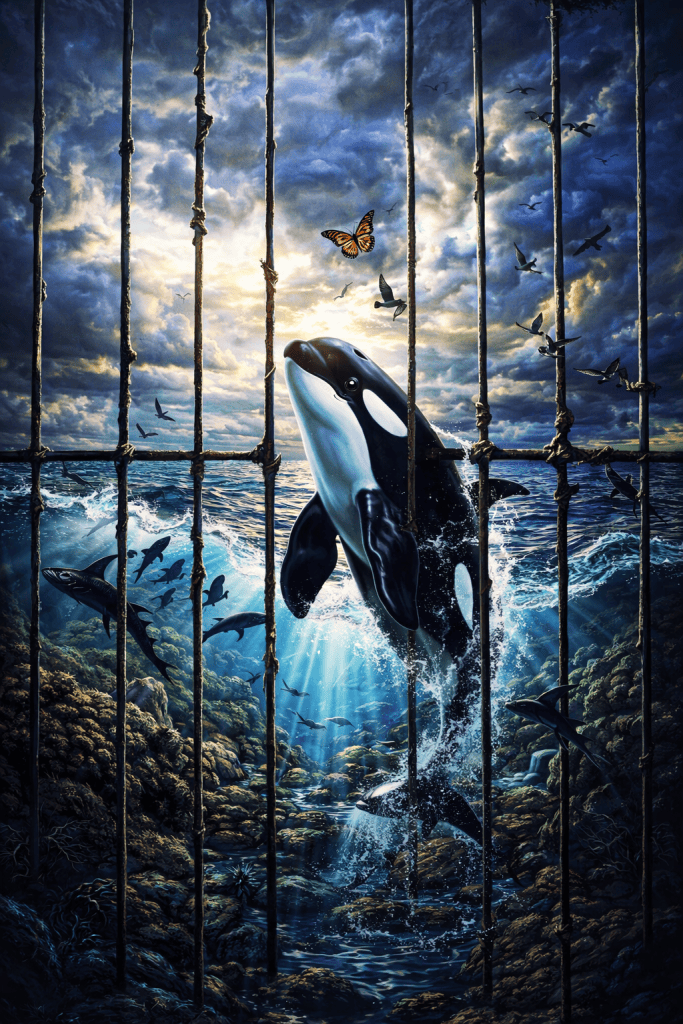
The guiding figure of this chamber is Shamu the Killer Whale, reimagined in the Land of WizOz as the Wounded Giant of Captivity and Memory. Shamu embodies confinement, historical trauma, distorted identity, disconnection from the natural context, and the work of reclaiming true nature. Shamu and the Glass Ocean
Shamu helps us understand the relationship between environment and identity. Imagine a powerful, intelligent, relational being removed from its natural context and placed in a controlled tank. The process trains movement and links food to performance, while bells, audiences, routines, and rewards determine which behaviors become visible. Eventually, observers may come to believe that the performance is the animal’s nature.
When distress emerges, people may judge the being without examining the captivity. This is one of the great failures in the way human beings are sometimes understood.
| Institutions may observe a person’s behavior while refusing to examine the environment producing it. |
| A young person is called aggressive without asking what danger required constant readiness. |
| A mother is called noncompliant without asking whether the system has earned trust. |
| A child is called inattentive without asking what grief entered the classroom. |
| A returning citizen is reduced to a charge without asking who existed before, during, and after the event. |
| A Journeyer is called resistant when they may be practicing discernment in a space that has not yet become safe. |
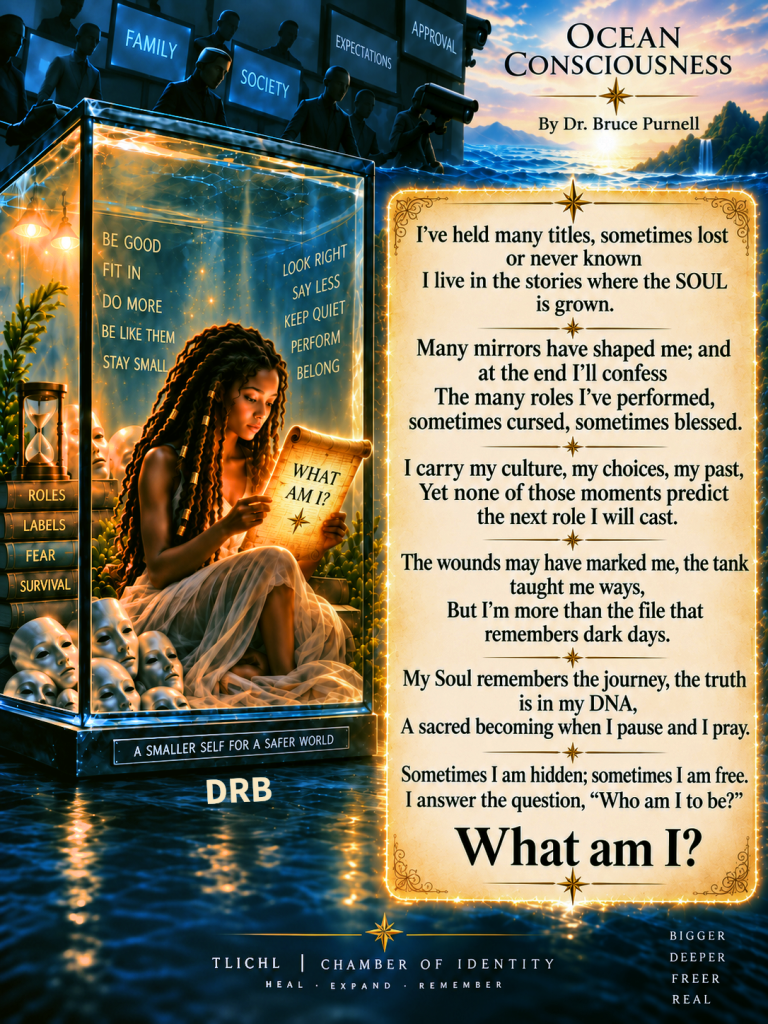
The Glass Ocean
Manifest and Hope left the Chamber of Love carrying a lesson Medusa had placed carefully in their hands: Every person has unconditional worth, but not everyone receives unconditional access.
The Yellow Brick Road continued through a field of purple flowers until the air began to smell of salt. Manifest heard waves, and Hope heard distant calls carried beneath the wind’s sound. They followed the road toward the sound, expecting to find an ocean, but instead they reached an enormous glass building with an entrance that read: THE GLASS OCEAN: EVERYTHING INSIDE HAS BEEN NAMED, MEASURED, TRAINED, AND EXPLAINED.
Manifest entered first, and inside was a tank so large that its walls disappeared into darkness. Rows of empty seats surrounded it, and signs hung above the tank saying:
DANGEROUS
ENTERTAINER
PROPERTY
UNPREDICTABLE
SUCCESSFUL
KILLER
SHAMU
A bell rang, lights flashed, and a giant killer whale rose from the dark water, moving through a series of practiced turns. He leaped when the bell sounded, circled when a light changed, and struck the water with his tail when a sign lit up. Shadows appeared in the empty seats. They applauded and chanted “Again.” Shamu repeated the same movements, and the shadows applauded again. When the lights dimmed, the shadows disappeared, and Shamu sank beneath the water. Manifest walked toward the glass and said, “That was incredible.” Shamu remained underwater. Hope sat near the tank and did not knock on the glass. After a long silence, she asked, “Is Shamu the name you use for yourself?” The whale slowly returned to the surface. “It is the name they gave the performance,” he replied. “What did your family call you?” Hope asked. Shamu grew still. “I have not heard that sound in a long time.”
Manifest examined the signs above the tank. “Which of these words is true?” “All of them describe something,” Shamu said. “None of them describes everything.” He looked toward DANGEROUS. “I became dangerous when danger was the only language the room respected.” He looked toward ENTERTAINER. “I learned to perform because applause was one of the few sounds that reached me through the glass.” He looked toward SUCCESSFUL. “They called me successful when I completed the movement they had chosen.” He looked toward KILLER. “They took one word and stretched it over my entire existence.” Manifest touched the glass. “Why do you keep performing?” “When an environment rewards a performance long enough,” Shamu answered, “you may begin to forget which movements are yours.”
Hope rested her hand near the glass without touching it. “What happens when the bell does not ring?” Shamu looked into the dark water. “I wait for it.”
Another sound moved through the building. It was lower than the bell, older, and it passed through the glass, the seats, the signs, and the Yellow Brick Road. Shamu lifted his head. “What is that?” Manifest asked. “The ocean,” Shamu whispered. “How can you hear it from here?” “The ocean remembers me, even when I have difficulty remembering myself.” Manifest looked around for something to break the glass. “If we destroy the tank, you can leave.” Shamu turned toward him. “Do not confuse a shattered tank with prepared freedom.” Manifest lowered his hand. Shamu continued: “The tank has shaped my muscles, my timing, my expectations, and the distance I believe I can travel. Freedom is not only about removing the wall; it also requires memory, community, support, practice, protection, and somewhere to go.”
The distant call came again, and this time, other calls answered. Shamu closed his eyes. “My family,” he said. The signs above the tank flickered.
DANGEROUS became PROTECTIVE.
ENTERTAINER became CREATIVE.
UNPREDICTABLE became UNCONTROLLED BY THEIR EXPECTATIONS.
SUCCESSFUL became ALIGNED.
KILLER became POWERFUL LIFE.
The final sign still read: SHAMU. Hope asked: “What would you like that sign to say?” Shamu did not answer right away. Then he made a sound neither Manifest nor Hope could translate. The glass vibrated. The name was not written in letters. It moved through the water, carrying family, memory, place, rhythm, and belonging. A doorway appeared beneath the surface, and above it were the words:
YOU ARE NOT ONLY WHO YOU HAD TO BECOME.
YOU ARE ALSO WHO YOU REMEMBER,
WHO YOU CHOOSE,
WHO YOU PRACTICE,
AND WHO YOU ARE STILL BECOMING.
Shamu swam toward the doorway but stopped before entering. “I may need time,” he said. Hope nodded. “The doorway does not disappear just because you do not enter today.” Manifest looked at the glass. “So the tank was never your Identity?” “It became part of my story,” Shamu replied. “But it was never the size of my soul.” The wall behind Manifest and Hope opened, revealing an ocean stretching farther than they could see. Shamu turned toward them.
“Welcome to the Chamber of Identity,” he said. “Here, we do not ask only what they called you. We ask what you remember when the ocean calls your name.”
WizOz Field Note
Killer whales are highly social animals that typically live in family-based groups called pods. Their calls are learned and culturally transmitted, with distinctive calls helping maintain group cohesion and functioning as family identifiers. These qualities make the orca a powerful metaphor for identity, culture, communication, relationship, and belonging. The Shamu character in WizOz is, however, a symbolic and educational creation, not a scientific case study of one individual animal.
The Glass Ocean represents an environment that defines a being through the behaviors it produces.
The central coaching questions are:
| What did the tank require? |
| What did the performance protect? |
| Which movements became automatic? |
| What names were attached to those movements? |
| What did the Journeyer receive for performing the role? |
| What did the role cost? |
| What does freedom require beyond removing the wall? |
| Which community, support, practice, and belonging will help sustain the emerging Identity? |
| What does the Journeyer want to call themselves? |
Within TLiCHL, Identity is: The living, layered, relational, cultural, embodied, spiritual, and evolving understanding through which a person experiences, names, interprets, and participates in their identity and becoming.
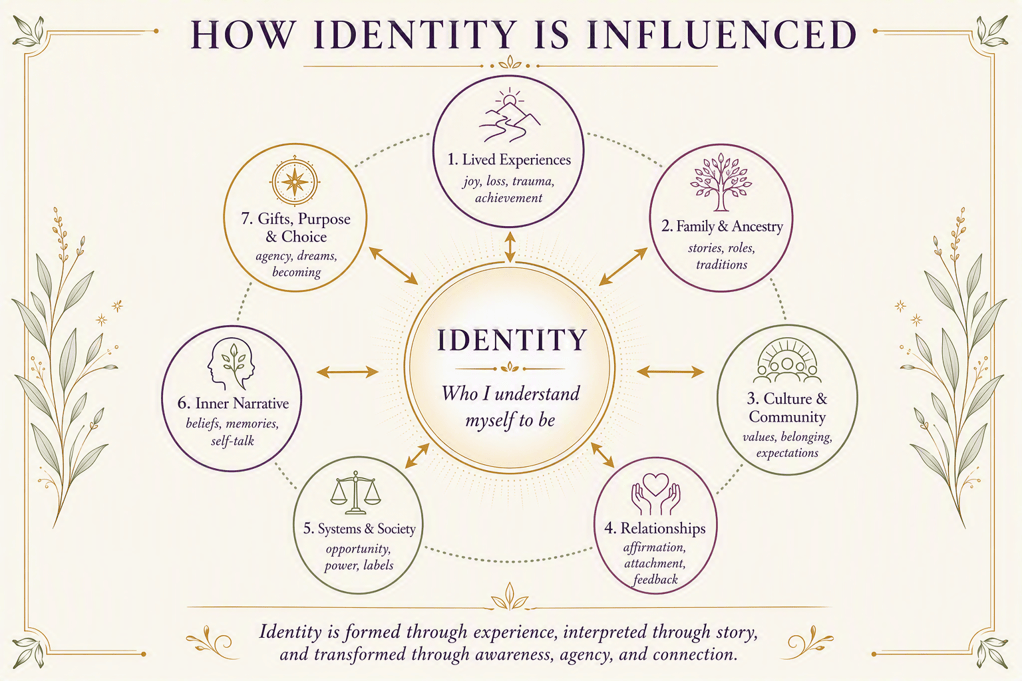
Identity contains both continuity and change. We may recognize ourselves across many years while also knowing that we are no longer exactly who we were. Narrative-identity research describes Identity as an internalized and evolving life story that integrates a reconstructed past with an imagined future, helping create meaning, unity, and purpose.
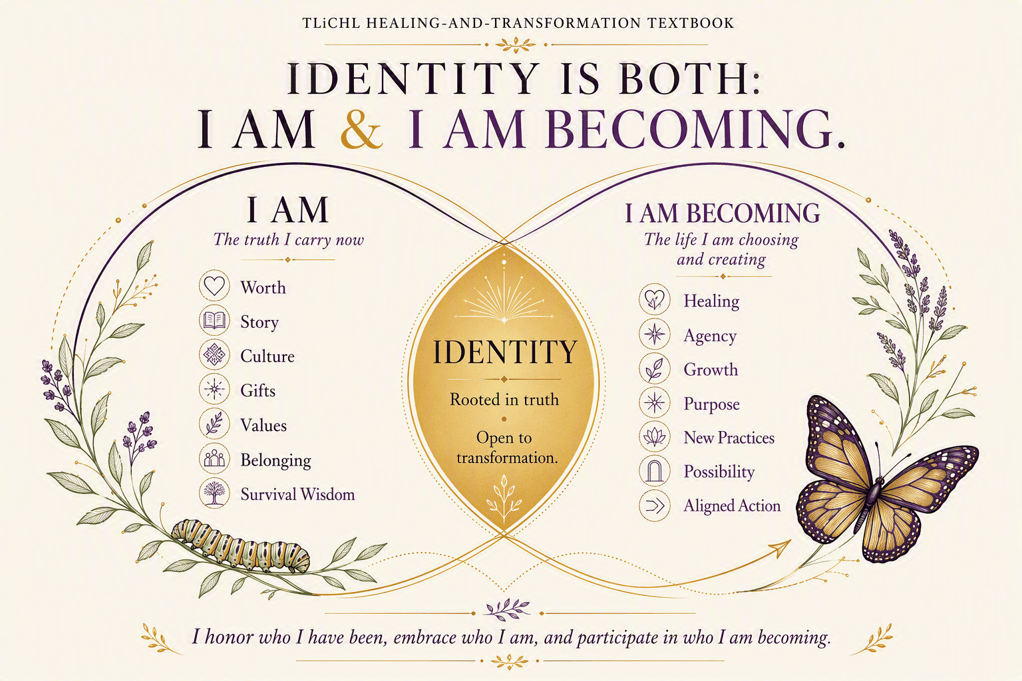
Identity Is Both “I Am” and “I Am Becoming”
“I am” names what feels present, and “I am becoming” makes room for movement. Identity does not have to choose between rootedness and growth. We may be deeply grounded in who we are while remaining open to who we are becoming.
| Identity Dimension | Guiding Question |
| Personal Identity | What qualities, values, gifts, memories, and commitments feel central to me? |
| Relational Identity | Who am I as a parent, partner, friend, Elder, sibling, colleague, or community member? |
| Social Identity | Which groups, communities, and social categories shape my experience? |
| Cultural Identity | Which traditions, languages, values, stories, and practices connect me to a people or place? |
| Ancestral Identity | What histories, migrations, struggles, gifts, and unfinished dreams travel through my lineage? |
| Embodied Identity | How does living in this body shape how I experience the world and how I am treated in it? |
| Spiritual Identity | How do I understand my relationship with God, Spirit, the sacred, creation, or meaning? |
| Narrative Identity | What story connects my past, present, and imagined future? |
| Protective Identity | Who did I learn to become to remain safe, useful, accepted, or alive? |
| Emerging Identity | What part of me is asking for language, practice, opportunity, or permission to develop? |
| Community Identity | What does “we” mean to me, and where do I experience collective belonging? |
| Purpose Identity | What am I responsible for protecting, creating, interrupting, or contributing? |
Part III: Identity Is Not the Same as a Label, Role, or Behavior
| Concept | Meaning | Example |
| Identity | A layered understanding of self and becoming | “I am a creative, spiritually grounded community builder.” |
| Role | A function or relational position | Parent, director, student, caregiver |
| Label | A word applied to categorize or describe | Difficult, gifted, offender, resilient |
| Behavior | Something a person did or is doing | Raised their voice, missed an appointment |
| Reputation | What others have come to expect or believe | “She is the reliable one.” |
| Diagnosis | A professional clinical or medical classification | A health or mental-health diagnosis |
| Status | A social, legal, economic, or organizational position | Employee, citizen, participant, formerly incarcerated person |
| Condition | A circumstance affecting life | Unemployment, grief, housing instability |
| Gift | A capacity that may be developed and shared | Leadership, empathy, creativity |
| Story | The meaning attached to experiences | “I have to do everything alone.” |
• A role may be important without being complete.
• A label may describe one perception without becoming truth.
• A behavior may require accountability without becoming the person’s permanent name.
• A diagnosis may guide care without becoming the total Identity.
• A reputation may reflect repeated behavior, bias, misunderstanding, or all three.
Identity Compression
Identity compression occurs when a complex person is reduced to one feature.
Examples include:
• The addict
• The offender
• The patient
• The victim
• The angry Black woman
• The absent father
• The troubled child
• The homeless person
• The strong one
• The disabled person
• The immigrant
• The poor family
• The gifted child
• The difficult employee
• The resilient community
Even a seemingly positive label can compress Identity.
• “The strong one” may conceal exhaustion.
• “The gifted child” may conceal fear of failure.
• “The resilient community” may conceal institutional neglect.
• “The inspirational survivor” may conceal the right to be angry, ordinary, uncertain, or tired.
A label becomes dangerous when it stops describing one part of the story and begins claiming ownership of the whole person.
Tank Identity
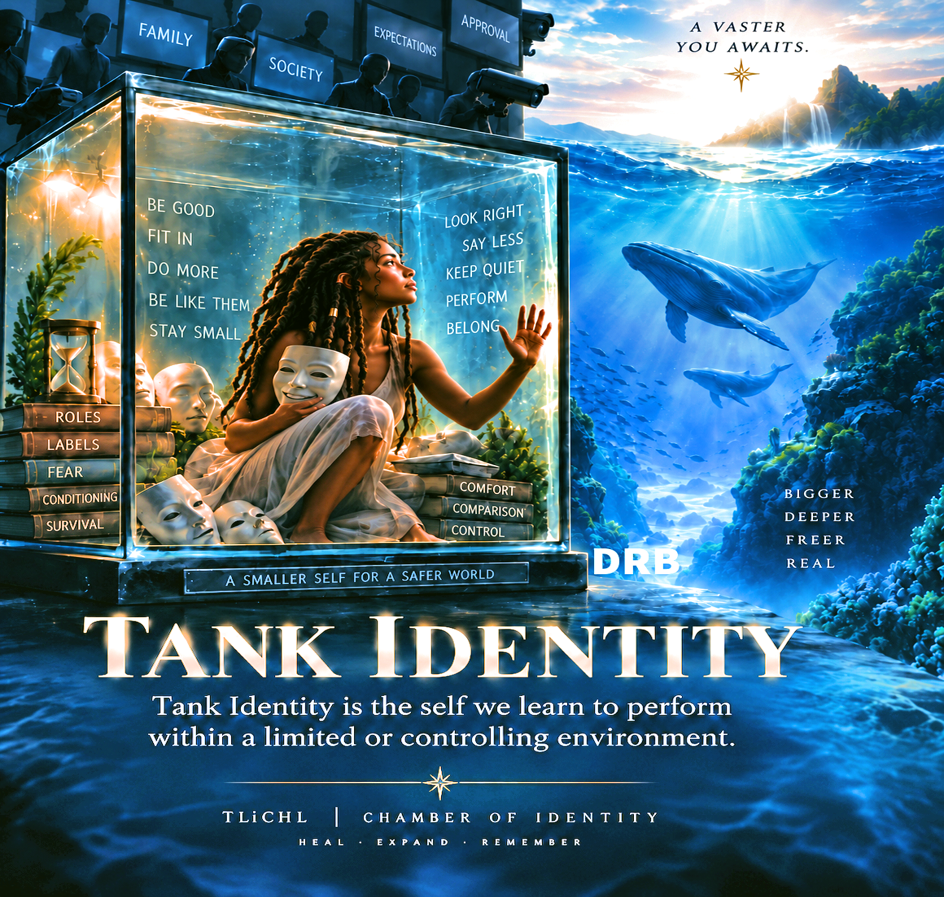
Tank Identity is the self we learn to perform within a limited or controlling environment. The tank may be a family system in which one child becomes “the responsible one,” a neighborhood where appearing vulnerable creates danger, a school where a child learns that curiosity is called disruption, a workplace where acceptance requires silence, or a relationship where peace depends upon one person disappearing. It may be incarceration, poverty, racism, gender expectations, religious control, institutional placement, child welfare involvement, or the social-media world in which Identity becomes a public performance. The tank teaches rules such as:
Be good.
Fit in.
Stay small.
Do more.
Look right.
Say less.
Do not embarrass the family.
Never let them see you hurt.
Remain useful.
Do not need anyone.
Perform what the environment rewards.
Tank Identity is not proof that someone is false or dishonest. It may be evidence of extraordinary adaptive intelligence and that we learned how to survive the available environment. So again, like, no shade on survival; no shade on tank identity, shamu, or the performance. However, it is essential to understand that the same role that protected us in one season may become a prison in another.
| The person praised for always being strong may lose the ability to receive care. |
| The peacemaker may become responsible for everyone’s feelings. |
| The achiever may believe rest threatens worth. |
| The funny one may never be asked what hurts. |
| The invisible child may become an adult whose gifts remain hidden. |
| The protector may experience every relationship as another emergency. |
In these cases, the role worked, but the question is whether it’s large enough for the life we are now trying to build. The tank is where the programming happens and is connected to our perception of context and history; however, the tank may explain movement, but does not contain our entire identity.
Ocean Consciousness
Ocean Consciousness is the remembrance that we are larger than the environments that trained, restricted, rewarded, named, or judged us. It does not deny that the tank had real effects, pretend that leaving a controlling environment instantly removes every learned response, or blame the Journeyer for remaining alert after danger.
Ocean Consciousness reminds us that the tank shaped how we learned to move, but it never defined the size of our ocean. The ocean represents context restored. It represents culture, relationship, ancestry, possibility, natural gifts, and movement beyond performance. In the ocean, Shamu does not have to prove that he or she belongs by completing tricks, and existence is not a performance for an audience. The Orca is not without relationship or responsibility, and movement is connected to a larger ecology.
Ocean Consciousness invites Journeyers to ask:
| Who am I when I have meaningful choice? |
| What qualities emerge when I am not managing an audience? |
| What did I Love before survival required all of my attention? |
| Where do I experience belonging without self-erasure? |
| Which gift remained alive beneath the role? |
| What kind of environment allows my humanity to breathe? |
Opening Retention Quiz
Chamber of Love, Part 2
The quiz reviews the circulation of Love, Medusa’s Guardians, unconditional worth and conditional access, consent, and R.E.P.A.I.R. The textbook defines consent as voluntary, informed, specific, mutual, reversible, free from pressure, and responsive to communication. It also distinguishes unconditional human worth from automatic access.
1. The circulatory-system metaphor teaches that Love must be able to:
A. Give without receiving
B. Remove every boundary
C. Give, receive, protect, repair, and keep moving
D. Prevent all relational discomfort
2. The Giving Artery represents:
A. What Love sends outward through care, action, presence, and service
B. The ability to accept correction
C. The rules another person must follow
D. The removal of consequences
3. The Receiving Vein represents:
A. Dependence upon one person
B. The ability to receive care, support, feedback, gratitude, and Love
C. Unlimited access
D. Avoiding responsibility
4. The Boundary Valve teaches that boundaries:
A. Prove that Love has ended
B. Control another person’s choices
C. Guide access and help Love circulate more safely
D. Should never change
5. Which statement best reflects unconditional worth and conditional access?
A. Love requires permanent access.
B. Every person’s humanity matters, and access may still be limited because of behavior, safety, or trust.
C. A boundary is a punishment.
D. Forgiveness automatically restores proximity.
6. Which statement about consent is accurate?
A. A previous yes creates permanent consent.
B. Silence always means yes.
C. A relationship title removes the need for consent.
D. Consent is ongoing, voluntary, mutual, specific, and reversible.
7. What was Manifest’s original mistake when he reached for his sword?
A. He waited too long to help.
B. He assumed Medusa’s Guardians should be removed without asking what they protected or obtaining consent.
C. He refused to enter the Chamber.
D. He asked too many questions.
8. What did Hope learn about patiently respecting a boundary?
A. Patience guarantees future access.
B. A respectful response should always be rewarded.
C. Respect is not a strategy for eventually receiving a yes.
D. A boundary is temporary unless the coach agrees with it.
9. The statement “We keep the wisdom and release the rule” means:
A. The Guardians must be destroyed.
B. Protective responses may retain their wisdom while receiving healthier assignments.
C. Past trauma no longer matters.
D. Every reaction should be accepted without accountability.
10. In R.E.P.A.I.R., the letter P means:
A. Promise immediate change
B. Practice Responsibility Without Excuse
C. Protect the relationship at all costs
D. Persuade the harmed person to forgive
11. Which action is included in the R.E.P.A.I.R. Practice?
A. Assuming that an apology restores trust
B. Asking what repair may be possible
C. Requiring reconciliation
D. Explaining why the harmed person misunderstood
12. Which response is most consistent with ethical Love More coaching?
A. “I know what your heart needs.”
B. “You must forgive your family before you can heal.”
C. “What does protection, Love, and safe access mean to you?”
D. “Your Guardian is preventing your transformation.”
Answer Key and Teaching Rationales
- C — Love requires circulation, protection, mutuality, and the possibility of repair.
- A — The Giving Artery describes Love moving outward through embodied action.
- B — Receiving is part of healthy circulation and does not make the Journeyer weak.
- C — Boundaries guide access; they do not automatically mean that Love has ended.
- B — Human worth is unconditional, but access, trust, reconciliation, and proximity may remain conditional.
- D — Consent remains ongoing and reversible.
- B — Manifest confused rescuing with helping and acted before seeking permission or understanding the Guardians.
- C — Hope learned that another person’s no deserves respect even when it never changes.
- B — The objective is to preserve the protective intelligence while reducing automatic rule over every relationship.
- B — R.E.P.A.I.R. means Recognize, Empathize, Practice Responsibility, Ask, Implement, and Respect. 8d05cd53-637a-4e99-9f47-404a719…
- B — Repair must be explored rather than assumed, and the harmed person retains choice.
- C — Ethical coaching supports self-definition and agency rather than prescribing what another person must feel or do.
Ocean Consciousness Practice
- One tank rule I am beginning to question is:
- One part of my Identity I want to reclaim, protect, or develop is:
- My next golden brick toward Ocean Consciousness is:
Closing Affirmation
I honor the self who learned to survive inside the tank.
I listen for the self who remembers the ocean.
I am more than the wound, the role, the label, and the file.
My Identity is not a verdict.
I am still becoming.
Contact: Sonya Cooper: scooper@lovemoremovement.org
Bring your journal, your truth, and one word you are ready to examine.
Community’s Scale for Healing Possibilities: https://welovemore.typeform.com/CSHP1
Intake: https://welovemore.typeform.com/TLiCHLIntake26
Course Books: “I Have The FEVERS For Jazz: Becoming The Butterfly Effect”; The Caterpillar’s WEB for Transformation https://www.lovemoremovement.org/books
We are becoming the “Social Architects” and “Social Alchemists” who will design our healing and transformation. Let’s affirm and manifest our divine cocoons together. #WeAreTheButterflyEffect #WeAreThePhoenixRising #WeAreHealingTogether #WeLoveMore
See the full sessions on the Blog: https://welovemoredrbruce.com/
Please give Love More a Google rating: https://g.page/r/CYI0Pw3JjBrjEAI/review

