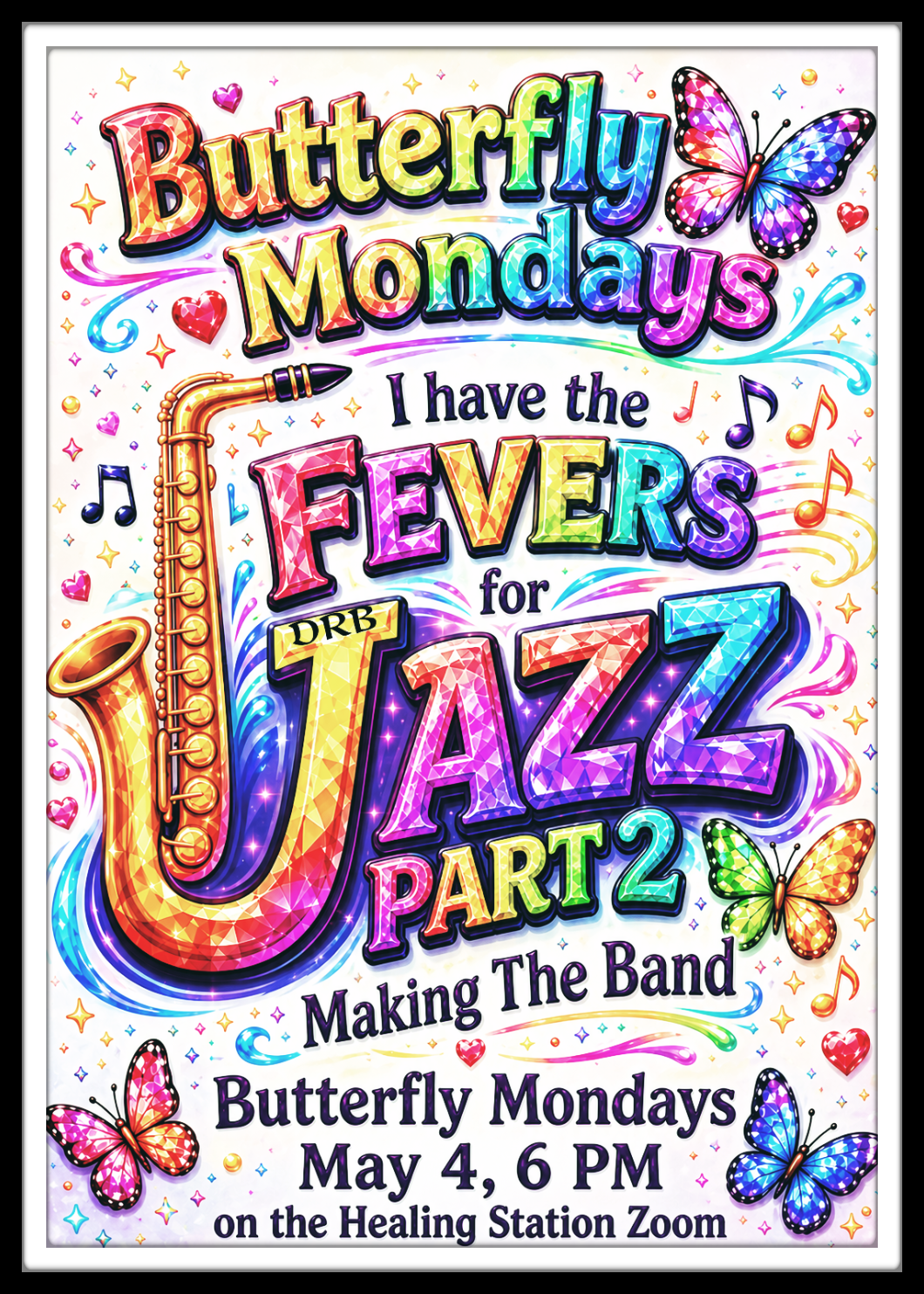
Butterfly Mondays – May 4, 2026
Healing Station Zoom: 6:00 PM EST
Join Here: https://us02web.zoom.us/j/88324556318?pwd=QlNsT3lLWnc0alo3K09nN0JoaFNxQT09
I Have the FEVERS for Jazz Part 2: Making The Band: Who We Choose Reveals Who We Are Becoming
Making My Band
I have the FEVERS for jazz, it’s on the healing station
A vibration and frequency to heal the nation.
A poet for words we may never say,
An elder to guide what we lost on the way.
A child to remind us that joy still exists,
Pathways to realign with Love, we’ve dismissed
Our phoenix is flying, the pain became wings
The Butterfly Effect makes the caterpillar sing.
But even with all of the roles that we see,
There’s something still missing, and that somethings in me.
A sound that was silenced, a need left unnamed,
A truth we avoided, a part left untamed.
So we give it a voice, we bring it to light,
We name it with purpose, we claim it as right.
Because what we call something begins what it becomes,
And our hearts know the truth by the beat of our drums.
We are not just a band, we are rhythms and flames,
And the world will remember when we learn our true names.
As social alchemists, social architects, and social entrepreneurs, we are seeking our internal Jazz: the group of musicians who will hold the FEVERS (Frequency of Loving More, Energy of Joy, Vibration of Hope, Elevation of Peace, and Scope of Forgiveness) of healing and transformation for ourselves, our families, and our communities. Because healing and transformation are not solo journeys but collective experiences, we must let go of individualism and embrace Ubuntu. Last week, we were introduced to the FEVERS through a Jazz lens.
This Butterfly Monday, we step into the selection and naming of our ensembles/bands, where we will:
• Build our healing and transformation ensemble
• Identify the roles we trust and the ones we avoid
• Create our Sixth Sound, what we feel is missing
• Name our band and define our purpose
We are not just choosing people; we are revealing what we believe healing requires, what we trust, and what we are ready to build. This is meant to be more of a mirror than a session. Come ready to reflect, to build, and to become.
Who We Choose Reveals Who We Are Becoming
The fact that we do not heal alone is a quiet truth many of us overlook. Every step we take toward healing is shaped by the people around us, the voices we listen to, and the roles we invite into our lives. Some of those voices uplift us, some challenge us, some reflect us, and some reveal where we still have work to do. The question is not simply “Who is in our circle?” The deeper question is:
Why are they there?
In Step 1: Making The Band, of I Have the FEVERS for Jazz, we explore how to build an ensemble, much like a jazz band. Each role brings a distinct sound, energy, and purpose. No single instrument carries the entire composition, and no single person carries the entire healing process. When we choose our ensemble, we are making statements about:
• What we believe healing looks like
• What types of support we value
• What we trust
• What we avoid
As we look inside ourselves, we will begin to see patterns connected to our life experiences.
Do we choose people who make us feel safe, or those who stretch us?
Do we choose familiarity or diversity?
Do we include voices that challenge our thinking, or only those that affirm it?
Then comes the deeper work, where we open up and choose a new vibration we call our Sixth Sound. The Sixth Sound represents what is missing. It may be something we never had, something we lost, or something we are just now realizing we need. It is often the most honest part of the exercise because it reveals not only who we are but who we are becoming. We then name our band. This is not just a creative moment but a powerful one for pause, intention, and reflection. More than a name, we are creating a self-fulfilling prophecy. We know that names carry meaning and labels shape identity; therefore, our name will influence our perception, purpose, and movement.
When we name our ensemble, we name our purpose, define our sound, and declare what we are bringing into the world. Healing is not just about feeling better but about becoming aligned, and one aspect of alignment may begin with a question as simple as: Who are we choosing to build with, and why?
Overview
Making The Band introduces journeyers to the foundational question of healing and transformation: Who do we choose to journey with, and what does that choice reveal about us? This step is designed to uncover how identity, lived experience, internalized beliefs, and cultural conditioning shape the way journeyers build relationships, form teams, and define trust. Through the metaphor of a jazz ensemble, journeyers are invited to explore how healing is not performed in isolation but within a collective, where each voice, role, and frequency contributes to the overall composition.
Learning Objectives
By the end of this step, journeyers will:
• Identify personal values that influence relationship-building
• Examine implicit biases in selecting collaborators and support systems
• Understand the importance of diverse roles in collective healing
• Recognize patterns of trust, familiarity, and exclusion
• Begin to map their internal “healing council.”
Conceptual Framing
Healing does not occur in isolation but is shaped by the people we trust, the voices we elevate, and the roles we assign within our relational ecosystems. When journeyers are asked to build an ensemble, they are not simply making selections. They are revealing:
• Who they believe is capable of healing
• What types of knowledge they value
• Which experiences they prioritize
• How they define safety and effectiveness
This process is deeply influenced by both personal history and systemic conditioning. The work of Na’im Akbar emphasizes that identity formation within African American communities must be understood in the context of historical disruption and the need for cultural reclamation. Similarly, W.E.B. Du Bois introduces the concept of double consciousness, highlighting the tension between self-perception and societal perception.
These frameworks help us understand that the choices journeyers make are not neutral but are shaped by internal narratives, social expectations, and lived experiences.
The Jazz Ensemble Metaphor
In Jazz, each musician plays a distinct role, yet no single instrument defines the music.
The quality of the performance depends on:
• The diversity of voices
• The ability to listen and respond
• The willingness to share space
• The capacity to adapt
This mirrors healing collectives, where transformation emerges not from uniformity but from intentional collaboration across differences.
The Jazz Ensemble
Jazz teaches us that no single instrument carries the entire composition, that each role matters, that each voice contributes, and that each presence shifts the sound. In our healing journey, our ensemble embodies the different energies, perspectives, and forms of support that could shape our paths toward healing and transformation. This is not about choosing the “best” people, but about understanding our perceptions, conceptions, and perspectives regarding healing and transformation.
Exercise: Making The Band, Building Our Healing and Transformation Collective
We are now invited to build our healing and transformation ensemble, let’s Make Our Band.
We will select five journeyers or roles to form our band/ensemble. Whether they are real people, symbolic figures, or imagined archetypes, they should embody an energy, wisdom, or presence that supports our journeys of healing and transformation. This is not just about who we trust, but about who we believe is necessary to take this healing and transformation show on the road.
As we choose, we reflect on the following:
• What does this person or role represent for our healing and transformation, our families’ healing and transformation, and our community’s healing and transformation?
• Why should we trust this type of presence?
• Why will this ensemble be effective?
• What need does this fulfill in our healing?
Choose Our Healing and Transformation Ensemble/Band
We select five from the following roles. Each role represents a frequency, a function, and a form of presence within our healing ecosystem.
Core Archetypal Roles
The Poet
Represents emotional translation and truth-telling. Helps us name what we feel and give language to what has been silenced.
The Elder
Represents wisdom, lived experience, and ancestral memory. Grounds us in perspective, history, and continuity.
The Community Builder
Represents connection and mobilization. Brings people together, builds relationships, and creates pathways for collective healing.
The Child
Represents joy, curiosity, and imagination. Reminds us how to feel, explore, and reconnect with possibility.
The Therapist
Represents structured reflection and emotional processing. Supports insight, accountability, and intentional growth.
The Public Voice
Represents amplification and influence. Extends messages beyond immediate spaces and increases visibility.
The Transformed Individual
Represents lived transformation and accountability. Embodies change and demonstrates that healing is possible.
The Quiet Presence
Represents deep listening and emotional awareness. Holds space without judgment and offers intuitive understanding.
The Joy-Centered Person
Represents celebration and emotional release. Reminds us that joy is not a luxury, but a necessary part of healing.
The Community Leader
Represents guidance, responsibility, and collective direction. Helps align vision with action within the community.
The Spiritual Leader
Represents faith, meaning, and connection to something greater. Supports purpose, grounding, and inner alignment.
The Life Coach
Represents forward movement and intentional goal-setting. Helps translate healing into action and growth.
The Healer
Represents restoration and care across emotional, physical, and spiritual dimensions. Focuses on wholeness and balance.
The Artist
Represents creativity and expression. Transforms pain into beauty and provides alternative ways of understanding experience.
Institutional and Structural Roles
The Police Officer
Represents safety, authority, and community accountability. Invites reflection on protection, trust, and systemic relationships.
The Politician
Represents policy, decision-making, and systemic influence. Shapes the structures that impact collective well-being.
The Scientist
Represents inquiry, evidence, and discovery. Seeks understanding through observation, testing, and knowledge-building.
The Inventor
Represents innovation and possibility. Creates new solutions and reimagines what can exist.
Relational and Family Roles
Parents
Represent nurturing, guidance, and early influence. Shape identity, attachment, and foundational beliefs.
Grandparents
Represent legacy, generational wisdom, and continuity. Offer perspective rooted in time and lived experience.
Everyday Functional Roles
The Mechanic
Represents repair and restoration. Fixes what is broken and ensures systems continue to function.
The Salesperson
Represents persuasion, communication, and exchange. Influences how ideas and values are shared and received.
Critical and Transformational Roles
The Troubled Person
Represents pain, struggle, and unresolved trauma. Challenges us to confront discomfort, extend compassion, and understand healing beyond ideal conditions.
Reflection Journal
As we look at our selections, we ask:
• What patterns do we notice in who we chose
• Did we prioritize familiarity, effectiveness, or emotional connection
• Which roles did we avoid
• What does this reveal about how we define healing and transformation
The Sixth Sound and Naming the Ensemble
Now we move beyond the given options, and because Jazz requires improvisation, we will create something that does not yet exist. We will add a sixth role to our ensemble, one that was not listed. So we have selected our five with intentionality and have the opportunity to add one more instrument to complete the selection that will give us that special sound, our “secret sauce”. This will be our sixth role, or Sixth Sound, which represents what we feel is missing, overlooked, or deeply needed for our healing and transformation ensemble.
The Sixth Sound can represent:
• An unmet need
• A silenced voice
• A future vision
• A part of ourselves that has not been fully acknowledged
• What we feel is missing
• What we have needed but may not have had
• What we believe is essential for healing
Reflection Journal 2
As we defined our Sixth Sound:
• What was this role
• Why was it essential
• What does it represent in our lives
• How does it connect to our FEVERS
This moment often reveals something deeper. It may reflect a gap in our support system, an unmet need, or a part of ourselves that has not been fully acknowledged.
Deeper Reflection
As we step back and observe our full ensemble, we ask:
• Whose voices are strongest in our lives
• Whose voices are missing
• Do we have balance, or do we lean heavily in one direction
• Are we building an ecosystem of healing and transformation, or a circle of comfort
The work of Beverly Daniel Tatum reminds us that identity is shaped by both connection and separation. The choices we make reflect how we navigate these dynamics. Howard Stevenson emphasizes the importance of navigating stress, identity, and relationships with awareness and intentionality.
The Naming Exercise, The Power of Labels
Now it is time to name our ensemble. This is intentional because we know that names hold power and energy and shape identity.
What we call something influences:
• How we understand it
• How we relate to it
• How others respond to it
Na’im Akbar’s work reminds us that naming is a critical part of identity reclamation. To name ourselves is to define ourselves beyond imposed narratives. Bell Hooks’s work reinforces that language is not neutral and can either limit or liberate.
Naming Reflection
We ask:
• What is the name of our ensemble
• What does this name represent
• How does this name reflect our purpose
• How does this name align with our FEVERS
Journal
“Our ensemble is called __________________________.
We chose this name because ____________________.
This name reflects our commitment to _____________________.
Through this ensemble, we aim to bring _______________________ into ourselves, our families, our communities, the nation, and the world.”
Closing Insight
There is no correct combination. The selection and naming of our band/ensemble reflect our intentions, perceptions, and perspectives. This choice reveals:
• What we believe healing requires
• What we trust
• What we are ready to build
We have now defined who we journey with; in our next step, we will explore what we carry and whether it supports survival or transformation.
Self-Assessment Quiz
I answer the following honestly: Which role was hardest to include
A. Someone different from me
B. Someone with authority
C. Someone unpredictable
D. Someone unfamiliar
What most influenced my selections
A. Familiarity
B. Effectiveness
C. Emotional connection
D. Diversity
Which role felt most necessary
A. Emotional support
B. Structure and guidance
C. Wisdom and experience
D. Energy and motivation
Interpreting My Responses
These answers are reflections; hence, there is no right or wrong.
If I leaned toward familiarity, I may value safety and predictability.
If I leaned toward effectiveness, I may prioritize outcomes and results.
If I leaned toward emotional connection, I may center relationships and feelings.
If I struggled to include differences, I may be navigating trust issues, biases, or past experiences.
This is information, not judgment.
Key Concepts
• Identity formation
• Collective healing
• Relational trust
• Archetypal roles
• Cultural conditioning
Theoretical Foundations: This step draws from:
• Carl Jung, archetypes and individuation
• Albert Bandura, social learning theory
• McMillan and Chavis, sense of community
African American and culturally grounded frameworks include:
• Na’im Akbar, identity and transformation
• W.E.B. Du Bois, double consciousness
• Beverly Daniel Tatum, racial identity development
• Howard Stevenson, stress and relational navigation
Glossary
Archetype
A symbolic role representing patterns of human experience.
Collective Healing
A process in which individuals heal through connection with others.
Relational Trust
The confidence I place in others to support, understand, and hold space.
Identity Formation
The ongoing development of my understanding of myself.
Closing Reflection
We ask ourselves: What does our ensemble/band reveal about how we understand healing, and what might be missing from that understanding?
We are becoming the “Social Architects” and “Social Alchemists” who will design our healing and transformation. Let’s affirm and manifest our divine cocoons together. #WeAreTheButterflyEffect
See the Full Sessions and Subscribe to the Blog: https://welovemoredrbruce.com/ Please give Love More a Google rating: https://g.page/r/CYI0Pw3JjBrjEAI/review

