Transformative Life Coaches and Healing Leaders Certification, Monday, Oct 12, 6- 8 p.m. on the Healing Station Zoom https://us02web.zoom.us/meeting/register/tZwude2tqz0pG9xJ6zFgGt58RxiHKEVI2PDr
Born Free: By Dr. Bruce Purnell
The gate opened wide, and I entered the sea,
But the water felt strange even though it was supposed to be free.
No whistle directed, no wall held my frame;
The ocean said softly, “I remember your name.”
I thought being free meant the fear would be gone,
That the moment I crossed, I would know how to belong.
But the current ran deeper than pool lessons came,
And the ocean kept calling, “I remember your name.”
The crowd was behind me, yet still in my mind,
Its mirror kept asking what judgment I’d find.
Would the whales see a stranger, a trick, or the shame?
The ocean replied, “You are more than their frame.”
I knew how to leap when the trainer said rise,
But not how to follow the moon or the tides.
I had strength in my body, yet doubted my aim;
The ocean said, “Practice. Learn your true name.”
The past said, “Go backward. The pool rules are clear.”
The present said, “Notice the movement and fear.”
The future said, “Choose what you want to reclaim.”
And the ocean kept whispering, “Remember your name.”
Two truths moved within me and pulled me apart:
“The pool was a prison,” but it still held part of my heart.
If the ocean is H‘OM’E, then why does it feel so strange?
Both hold a truth, but my story is starting to change.
Some run toward freedom through darkness and night.
Some hear that the law has acknowledged their right.
Some break through the wire; some are carried from pain.
No doorway alone tells what lives in the brain.
Pathways don’t rank courage or measure their Soul.
We will know when we are ready, and what helped us feel whole.
Ask what story they carried, what fear still remained,
What freedom made possible, what freedom retrained.
I do not have to swim to the world’s farthest shore
To prove that the pool doesn’t own me anymore.
Every movement I choose is a link in the chain
And it joins me to the ocean, to purpose, to name.
The gate is an opening, not the journey’s end.
The ocean is a teacher, relation, and friend.
Home may be true before H “OM” E feels the same.
But the ocean remembers, and it’s all in my name.
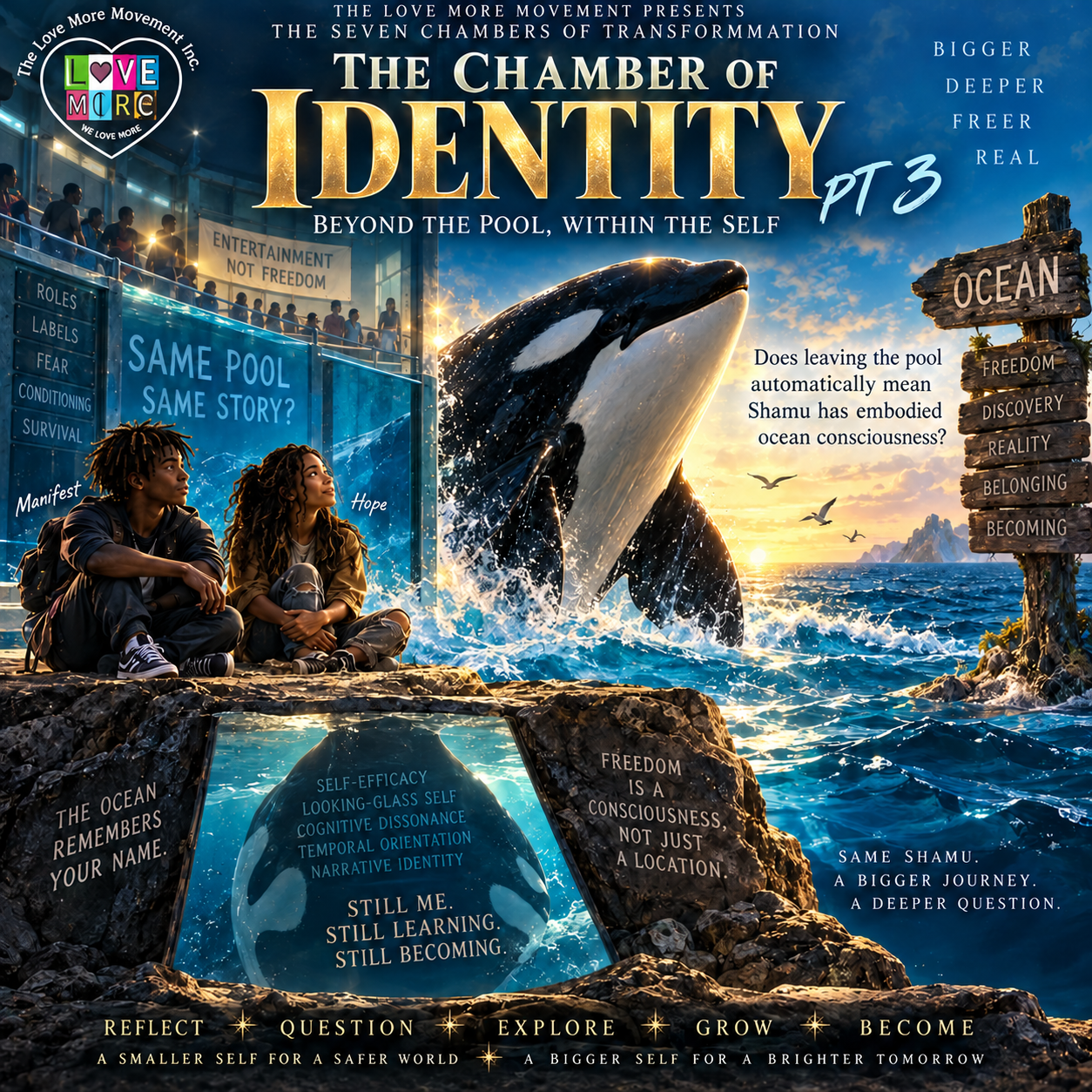
Last week, Shamu made a courageous move. The external gate opened, and she swam from the pool toward the ocean. But does leaving the pool automatically mean Shamu has embodied Ocean Consciousness? What happens when the ocean is her natural H “OM” E, yet the pool is the only world that feels familiar? What happens when her body was born for the ocean, but the pool shaped her identity? The ocean has no whistle telling her when to rise, no trainer determining when she is successful, no audience applauding her movements, and no wall marking where her world ends. Freedom may be real, yet it may also feel frightening.
Join us for Chamber 5: Identity, Part 3, as Manifest, Hope, and Shamu explore:
• Why changing location does not automatically transform consciousness
• How the pool may continue living inside us after the gate opens
• Why familiar captivity may initially feel safer than unfamiliar freedom
• The Looking-Glass Self and the mirrors through which we learn who we are
• Self-efficacy and the belief that we can move successfully in a new environment
• Cognitive dissonance when freedom and fear exist together
• Temporal Orientation and the competing voices of past, present, and future
• Narrative Identity and the story we tell about how freedom entered our lives
• Whether escaping, being released, being rescued, and receiving news of freedom may shape consciousness differently
• Why we must ask these questions without ranking, diagnosing, or assuming anyone’s experience
• What Shamu must learn about the ocean—and what the ocean may need to teach her about belonging
We will also complete the Beyond the Gate Freedom and Identity Survey to capture Journeyers’ understanding of freedom, agency, identity, rescue, escape, consciousness, and belonging.
The Ocean Is Home, but Home Is Not Yet Familiar
Does Leaving the Pool Mean Shamu Has Embodied Ocean Consciousness?
At the end of our last journey, Shamu made a powerful move. The gate between the pool and the ocean opened. She did not leap for an audience, respond to a whistle, or wait for a trainer. She swam toward the threshold, and for the first time, the movement was hers. Her conscious choice was courageous and meaningful, expressing emerging freedom, but was it Ocean Consciousness? Not necessarily. It may have been the beginning, evidence that Shamu was becoming available to another possibility, an external movement before an internal transformation, and even a movement she was not yet emotionally prepared to complete.
The Chamber of Identity, Part 3, urges us to resist the temptation to oversimplify the ending. The gate opened, and Shamu began to move, but the story didn’t end. Crossing is an Event, and embodiment is a Practice. Leaving the pool changes our location, but Ocean Consciousness involves a developing change in:
• Identity
• Expectation
• Relationship
• Agency
• Imagination
• Movement
• Belonging
• Self-trust
• Narrative
• Consciousness
A person may leave a restrictive environment while still living by the rules that environment taught them.
| The external trainer may be gone, but the internal whistle may remain. |
| The wall may no longer surround the body, but it may continue shaping imagination. |
| The file may be closed, but its language may remain active within the inner narrator. |
| The relationship may have ended, but the person may continue asking permission to speak. |
| The sentence may have ended, but the institution may still live in how the person understands themselves. |
Legal freedom, physical release, environmental change, emotional freedom, psychological integration, spiritual liberation, and relational belonging are connected but not identical. This does not mean the external gate is unimportant, because the gate must open, harmful conditions must change, and rights, safety, resources, access, justice, community, and opportunity are essential. Ocean Consciousness must never be used to tell a person that external oppression is irrelevant because freedom is “all in the mind.” That would turn spiritual language into another wall.
The Love More question is broader:
What must change around Shamu, and what must be remembered, practiced, supported, and transformed within Shamu, so that freedom becomes lived rather than a “public service announcement”? The ocean can be H “OM” E and still feel frightening; it is Shamu’s natural environment, but not her familiar one. Those are different things. The pool was restrictive but predictable. The whistle told her when to move, the wall gave her a boundary, the schedule organized time, the audience told her whether she had succeeded, and the trainer provided food. Even the limitations had a rhythm.
The ocean offers freedom, but it also offers:
• Unpredictable currents
• Great distances
• Depth
• Weather
• Other ocean beings
• New forms of communication
• Self-directed movement
• Choices without immediate instructions
• Possibilities without guaranteed outcomes
A person raised in a pool may experience the ocean as disorienting.
| The absence of a command may initially feel like abandonment. |
| The absence of a wall may feel like exposure. |
| The absence of applause may feel like invisibility. |
| The absence of the old role may feel like the absence of Identity. |
Shamu may know that the ocean is H “OM” E yet still want to return to the pool. That would not automatically mean she prefers captivity. It may mean familiarity is speaking louder than freedom.
The Looking-Glass Self: Which Mirror Is Shamu Using?
The Looking-Glass Self asks how our self-concept is shaped by how we imagine others see and judge us. In the chamber of Identity, we explore how relational mirrors shape self-concept, efficacy, love, and esteem. In the pool, Shamu learned to see herself through an audience’s eyes.
When they cheered, she succeeded; when they fell silent, she failed; when the trainer raised a hand, she knew what was expected; and when the program called her a star, that public image became part of her identity. Now, as Shamu enters the ocean, we explore which mirror she uses. She may imagine the ocean pod saying:
• You move like a pool whale.
• You do not know our language.
• You cannot keep up.
• You are not one of us.
• You are too trained.
• You are too damaged.
• You do not belong here.
The other whales may not be thinking any of these things, yet imagined judgment can still shape Shamu’s movement. Ocean Consciousness therefore requires more than replacing a negative pool mirror with an idealized ocean mirror. It requires developing a relationship with the self that neither the audience nor the performer fully controls.
The question becomes:
Can Shamu listen to feedback, culture, community, and relationships without surrendering her sense of self?
Self-Efficacy: Belonging Is Not the Same as Believing I Can Move Here
Shamu may belong to the ocean yet still lack confidence in her ability to navigate it. Self-efficacy is the belief that we can carry out the behavior required to respond to a situation or produce an outcome. We discuss four important pathways: performance experience, what significant people tell us, what we observe in others, and how we interpret bodily responses. Let’s see how this applies to Shamu.
Performance Experience
Shamu needs small, carefully chosen experiences of ocean movement. She may:
• Swim from the gate to a nearby marker
• Follow one gentle current
• Dive a little deeper
• Return to the surface
• Find her way back without a whistle
• Choose to rest
Each experience may serve as evidence: “I moved through the ocean once; therefore, I believe I may be able to do it again.”
Relational Encouragement
Hope may say: “You do not have to know the whole ocean today,” and Manifest may say: “Returning to the threshold does not erase the progress you have made.” Encouragement must remain truthful because empty praise could become another performance demand.
Vicarious Experience
Shamu may observe other whales navigating currents, resting, communicating, protecting their young, finding food, and moving in groups. She doesn’t have to copy them. Their presence may simply show that other forms of movement exist.
Interpreting the Body
The ocean current may make Shamu’s heart race. She could interpret that feeling as: “My fear proves I do not belong,” or she might gradually learn: “My body is responding to something new, vast, and uncertain. I can notice the response, seek support, and choose my next move.” Her anxiety should not be dismissed, nor should it be treated as a verdict.
Cognitive Dissonance: When Two Truths Collide
Shamu may experience several conflicting truths:
• The pool harmed me.
• The pool kept me alive.
• The ocean is my natural H “OM” E.
• The ocean does not yet feel like H “OM” E.
• I wanted the gate to open.
• I am frightened now that it has opened.
• I do not want to perform anymore.
• I miss knowing exactly what was expected.
• I am free to choose.
• I do not yet trust my choices.
Cognitive dissonance helps explain the discomfort that can arise when important beliefs, experiences, or actions conflict. The theory holds that inconsistency can create psychological discomfort and motivate efforts to reduce or resolve it, though researchers still debate and refine how to measure this process.
Shamu might reduce that discomfort by:
• Convincing herself the ocean is dangerous
• Romanticizing the pool
• Blaming herself for not feeling free
• Denying that the pool caused harm
• Demanding that she feels at H “OM” E immediately
• Returning to performance because it restores predictability
• Creating a more complete story capable of holding both fear and freedom
The most healing and transformative response is not predetermined.
The task is to recognize the conflict without turning it into shame. Feeling afraid in freedom does not prove that captivity was H “OM” E.
Temporal Orientation: Which Time Is Steering?
Temporal orientation examines our relationship with past, present, and future.
Shamu’s past says:
• Listen for the whistle.
• Stay close to the wall.
• Perform before asking for anything.
• Do not move unless instructed.
• Approval keeps you safe.
Shamu’s present says:
• The water is moving.
• The gate is open.
• My body is activated.
• Manifest and Hope are nearby.
• I have one choice in this moment.
Shamu’s future asks:
• Who might I become in the ocean?
• What relationships could I develop?
• What movements could become mine?
• What would belonging feel like?
• What could freedom make possible?
Healing doesn’t require the past to fall silent. The past holds warnings, wisdom, grief, language, skill, Love, pain, joy, sunshine, rain, and memory. But the past should not automatically hold authority over every present movement and future possibility.
Ocean Consciousness integrates time:
I honor what the pool taught me.
I notice what is happening now.
I prepare for a future the pool could not have taught me to imagine.
Narrative Identity: What Story Will Shamu Tell?
Narrative Identity Theory examines how people develop an evolving sense of self by organizing experiences into life stories. These stories convey themes, turning points, values, goals, meanings, agency, and interpretations of the past, present, and future. Before the gate opened, Shamu’s story may have been: “I am the star of the pool.” Or: “I am the captive who performs.” Both stories center on the pool. If Shamu simply changes the ending to: “I escaped, and now I am completely free,” the new sentence may move too quickly. A fuller narrative might be:
“I am an ocean being whose movement was shaped by the pool. I crossed the gate, carrying pool memories, survival intelligence, grief, skill, fear, and possibility. I am learning the ocean through relationship, choice, practice, and time.”
That narrative does not deny captivity, nor does it allow captivity to remain the sole author. The Journeyer’s story should not be rewritten dishonestly or forced into redemption. Narrative reclamation means expanding authorship, not creating a prettier lie.
Different Doors Into Freedom
Healing and Transformation also ask two difficult comparisons.
The Underground Railroad and the Announcement of Emancipation
What might be different in consciousness between:
• A person who escaped enslavement, navigated danger, evaded capture, used relationships and networks, and physically pursued freedom
• A person who learned through an external announcement that legal enslavement had ended
We must not assume that the first person had greater freedom consciousness or that the second person lacked agency. Freedom seekers on the Underground Railroad were not passive passengers awaiting rescue; they initiated journeys and made decisions under dangerous conditions, whether or not outside assistance was available.
The comparison should therefore generate questions rather than conclusions:
• How did each person understand agency?
• What did each person risk?
• What did freedom require them to believe?
• Was the legal announcement trusted?
• Did the surrounding community honor the change?
• What did each person know about life beyond enslavement?
• How did family separation affect the meaning of freedom?
• What survival responses remained necessary?
• What new skills, relationships, resources, or protections were required?
• How did each person tell the story of becoming free?
The door through which freedom enters may become part of Narrative Identity.
It does not determine the worth, courage, consciousness, or future of the person who walks through it.
Escape From a Prisoner-of-War Camp and Rescue
What might be different between:
• A prisoner who plans and carries out an escape
• A prisoner who survives until rescuers arrive
Again, we are not assuming one was better or more noble than the other, but we are taking a deep dive to understand how these different experiences may shape consciousness. The person who escaped may experience agency, competence, fear, guilt, vigilance, or responsibility. The person who was rescued may experience relief, gratitude, disbelief, vulnerability, powerlessness, restored trust, or renewed agency. Either person may experience any combination. The point is not to rank escape over rescue but to ask: How does the pathway into freedom enter the person’s story about who they are, what they can do, whom they can trust, and what the future requires?
Freedom Is Not a Competition, and Ocean Consciousness is not proven by:
• Swimming farthest from the pool
• Refusing to feel fear
• Never looking back
• Rejecting every pool memory
• Becoming independent from everyone
• Telling the most inspiring freedom story
• Appearing grateful
• Forgiving the people who built the enclosure
• Performing confidence before confidence has developed
A Journeyer may move forward, pause, return to the threshold, seek support, grieve, become angry, feel disoriented, and still be participating in liberation. Embodied Ocean Consciousness may begin when Shamu can say:
I recognize the pool’s voice without automatically obeying it.
I can receive help without believing help owns me.
I can choose a movement without requiring an audience.
I can learn from the ocean without pretending I already know it.
I can belong without performing perfection.
I can remember captivity without allowing captivity to define the limits of my future.
A Metaphor Is an Invitation
Shamu’s ocean must not tell a human Journeyer that a family, neighborhood, religious community, nation, or relationship is their “true H‘OM’E” and that they must return. The Journeyer defines H “OM” E and decides which relationships, cultures, communities, practices, and environments support belonging. The textbook makes clear that WizOz characters are mirrors and invitations, not diagnoses, and that the Journeyer retains the authority to determine what fits and what does not.
The metaphor is not meant to decide where someone belongs.
It is to ask:
What environment shaped my movement?
Which rules remain inside me?
What does freedom require around me?
What does freedom invite within me?
What kind of support will help me learn another way to move?
The ocean remembers Shamu’s name, and this part of our journey in the chamber of identity asks whether Shamu is ready to learn what that name means.
The Ocean Beyond the Gate
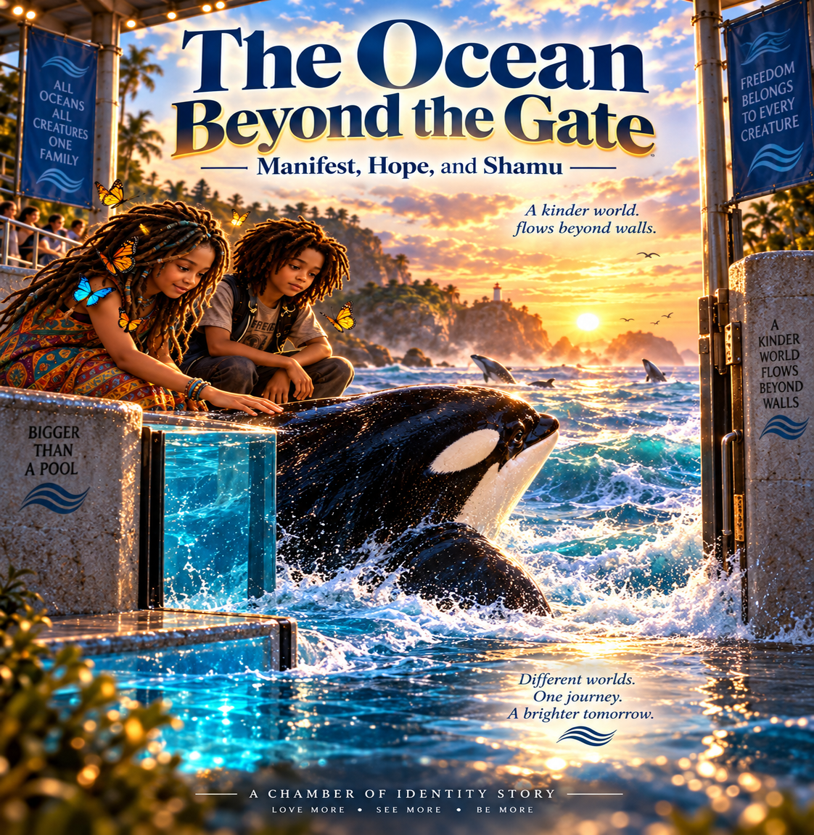
Shamu crossed the threshold, but only slightly. One length of her body remained near the pool, while the other entered the ocean. For the first time, no wall stood on either side. The water beneath her dropped farther than she could see. The current didn’t wait for her to understand. It touched her side, nudged her, and kept moving, and Shamu panicked. She swung her tail hard and returned to the narrow channel between the pool and the sea.
Manifest raised his arms. “You made it!” he shouted. “You are free!” Shamu did not answer. Hope watched as she stayed in the channel. Her head pointed toward the ocean, and her tail pointed toward the pool. She was between two worlds. “Are you all right?” she asked. “I do not know,” Shamu said. Manifest approached the water. “The gate is open. No one can stop you now.” Shamu looked toward him. “Then why do I still feel stopped?” Manifest had no answer. Behind Shamu, the pool was calm and clear.
Ahead of her, the ocean moved in several directions at once. The pool had always told her when movement began and ended, but the ocean gave no such warning. A wave moved through the channel, and Shamu turned back toward the pool. From the stands, the Audience Chorus began chanting: “Jump!” “Show us!” “One more time!” Shamu’s body rose automatically, and before her mind could decide, she began a familiar trick. Then she stopped.
The ocean did not applaud, and the other whales in the distance did not turn to watch. The sun stayed where it was, and the current kept moving. Shamu lowered herself into the water. “In the pool,” she said, “I knew when I had done something correctly.” Hope sat near the channel. “How did you know?” “They cheered.” “And when no one cheered?” “I assumed I had failed.” Manifest pointed toward the ocean. “No one is judging you out there.” Shamu looked toward the distant whales. “How do you know?” Manifest fell silent.
Hope asked, “What do you imagine they see?” “A pool whale.” “What does that mean?” “A whale who knows tricks instead of currents, hears whistles instead of family, and has the body of the ocean and the movement of captivity.” The water’s surface smoothed, and Shamu saw her reflection, but it shifted. First, she saw herself through the audience’s eyes: famous, powerful, entertaining. Then she saw herself through the trainer’s eyes: compliant, valuable, predictable. Then she saw herself through the imagined eyes of the ocean pod: unprepared, unnatural, out of place.
“Every mirror gives me another name,” Shamu said. Hope touched her own heart. “What name do you give yourself?” Shamu looked away. “I do not know yet.” A deep sound moved through the ocean. It was not a word, but Shamu felt it in her body. Far beyond the gate, a whale surfaced and released another call. Shamu listened. “Do you understand it?” Manifest asked. “No.” “Does that mean it is not your language?” Shamu paused. “No. It may mean I have not learned how to hear it.”
Another current approached. This one was stronger, and Shamu’s body tensed. “The ocean is pushing me,” she said. Hope watched the water. “Or moving beside you.” “That sounds like something people say when they want fear to become beautiful.” “You are right,” Hope replied. “What does it feel like to you?” “Unpredictable.” “What do you need?” “A smaller movement.” Manifest pointed to a rock just beyond the gate. “What about swimming to that rock?” Shamu looked at it and thought, “It is not far.” “You choose whether it is far enough,” Hope said.
Shamu moved out of the channel, and the current touched her again. This time, she let it turn her slightly before adjusting her body. She reached the rock, but no whistle sounded, no fish appeared, and no one clapped. She turned back toward Manifest and Hope. “I reached it.” “Yes,” Manifest said, and Shamu returned to the channel. The water around her shimmered, and five currents appeared. The first current formed a mirror, showing Shamu every face that had ever watched her.
“I am the Mirror Current,” it said. “You have learned to see yourself through the eyes you imagine are watching.” The second current became a bridge of small waves leading to the rock. “I am the Efficacy Current. Belonging to the ocean and believing you can move within it are not the same. Confidence may grow with one chosen movement at a time.” The third current split in two. One side flowed toward the pool, the other toward the sea. “I am the Crosscurrent, and I hold the discomfort of truths that do not seem to fit together.”
The pool side said: “The pool harmed you,” and the ocean side said: “The pool kept you alive.” The pool side said: “You wanted freedom,” and the ocean side said: “You are afraid of freedom.” Shamu looked between them and thought, “Which one is true?” “Perhaps both,” said the Crosscurrent. “Your work is not to destroy one truth so the other can survive. Your work is to create a consciousness large enough to hold complexity without surrendering choice.”
The fourth current divided into three bands. The first moved behind her, the second circled her body, and the third stretched toward the horizon. “I am the Current of Time,” it said. The past band whispered: “Listen for the whistle.” The present band said: “Notice the water touching you now,” and the future band asked: “What movement do you want to learn?”
The fifth current became a scroll of water, and words appeared and vanished across its surface. “I am the Story Current. I do not erase what happened, but I ask who holds the pen now.” Shamu read the first sentence, “I am the star of the pool,” and it dissolved. Another appeared: “I am the captive who performs,” and that sentence dissolved too. A third formed: “I am an ocean being learning to inhabit freedom.” Shamu stared at it and thought, “That sentence does not sound finished.” “It should not,” said the Story Current, “but neither are you.” The five currents merged, and the ocean’s surface became a wide mirror.
Four images appeared within it. In the first, a person moved through darkness toward freedom, navigating danger and evading capture. In the second, a person received word from an outside authority that legal enslavement had ended. In the third, a prisoner crawled through an opening and escaped from a camp. In the fourth, rescuers entered a camp and released those who had survived inside. Manifest studied the images. “The people who escaped must have had greater freedom consciousness,” he said.
Hope looked toward him. “How do we know?” “They took action.” “Does rescue erase the agency required to survive until rescue arrived?” Manifest fell quiet, and Shamu moved closer to the mirror. “What did the person escaping enslavement have to believe?” she asked. “That another life was possible,” Hope said. “What did the person receiving the announcement have to believe?” “That the announcement could become real.” “What did the escaping prisoner learn?” “Perhaps that planning and action could create an opening,” Manifest said. “What did the rescued prisoner learn?” “Perhaps that help could arrive,” Hope answered. Shamu looked at both of them. “Or perhaps they learned something entirely different. The person who escaped might remain afraid of being caught, and the person rescued might experience restored trust. The person who received the announcement might become a leader, and the person who escaped might feel lost. We cannot know consciousness from the doorway alone.”
The images faded, and above the water, the words appeared: DO NOT RANK THE DOORS. ASK HOW THE DOOR ENTERED THE STORY.
Manifest lowered his head. “I keep trying to make freedom into one decisive act.” “Because decisive acts are easier to see,” Hope said. Shamu looked toward the ocean. “What if I swim out and then return?” “The gate remains open,” Hope said. “What if I miss the pool?” “Missing familiarity is not the same as choosing captivity.” “What if the ocean pod does not accept me?” “Then Ocean Consciousness will also require community accountability,” Manifest said. “Freedom cannot be sustained by the individual alone.” “What if I never become the whale I would have been without the pool?” Hope’s eyes filled with tears. “You do not have to become a version of yourself from a history that did not happen.”
Shamu remained still, and the Voice of the Ocean returned. It did not say, “Come farther,” but “Choose your movement.” Shamu swam beyond the gate and circled the nearby rock once. She then returned to the threshold but did not reenter the pool. She rested in the channel, where he could feel water moving from both worlds. Manifest looked uncertain. “Is this Ocean Consciousness?” Shamu answered: “It is one practice of it.” “What changed?” “I heard the pool’s voice and did not automatically obey it.” “Are you free now?” “I am participating in freedom.” Hope smiled. “What is your name?” Shamu listened to the water. “I do not know the whole name yet.” The distant pod called again. This time, Shamu answered with a sound that was neither a pool trick nor a perfect ocean song. It was her first self-directed call, and for the first time, she felt that “the ocean carried her sound farther than the walls ever could.”
The End or Better: A New Beginning
Beyond the Gate Survey
Freedom, Identity, and Ocean Consciousness Reflection Survey
Purpose
This survey captures how Journeyers understand:
• External freedom
• Internal freedom
• Identity after confinement
• Familiarity and fear
• Agency
• Rescue
• Escape
• Self-efficacy
• Social mirrors
• Cognitive dissonance
• Time
• Narrative
• Belonging
The survey is not a diagnostic instrument, a measure of healing, or a ranking of freedom consciousness. Responses should open conversation rather than close conclusions. This follows the TLiCHL principle that numbers should help reveal a story without replacing the Journeyer’s interpretation. Response Scale
0 — Prefer not to answer
1 — Strongly disagree
2 — Disagree
3 — Unsure / It depends
4 — Agree
5 — Strongly agree
Section One: The Gate and the Ocean
- Leaving a restrictive environment automatically means that a person has embodied freedom consciousness.
0 1 2 3 4 5 - A person can be externally free while still living by rules learned under captivity or control.
0 1 2 3 4 5 - A true or meaningful H “OM” E can feel frightening at first when it is unfamiliar.
0 1 2 3 4 5 - Returning temporarily to something familiar does not always mean that a person prefers oppression, confinement, or harm.
0 1 2 3 4 5 - Freedom requires changed external conditions as well as opportunities for internal, relational, and narrative transformation.
0 1 2 3 4 5 - No one should be expected to perform confidence, gratitude, or joy to prove that they are free.
0 1 2 3 4 5
Section Two: The Looking-Glass Self - How other people once saw us may continue influencing Identity after our circumstances change.
0 1 2 3 4 5 - A person may anticipate rejection from a new community even when that community has not rejected them.
0 1 2 3 4 5 - Developing Ocean Consciousness includes learning from relational mirrors without allowing those mirrors to completely define the self.
0 1 2 3 4 5
Section Three: Self-Efficacy - Knowing that I belong somewhere is different from believing that I can function successfully there.
0 1 2 3 4 5 - Small experiences of choosing and successfully moving can strengthen confidence in freedom.
0 1 2 3 4 5 - Watching people with similar experiences navigate a new environment may expand our sense of possibility.
0 1 2 3 4 5 - Fear or bodily activation in a new environment should not automatically be interpreted as proof that the person does not belong.
0 1 2 3 4 5
Section Four: Cognitive Dissonance
14. A person may simultaneously believe that an old environment was harmful and feel emotionally attached to its familiarity.
0 1 2 3 4 5
15. The statement “The ocean is my H‘OM’E” can exist beside the statement “The ocean frightens me.”
0 1 2 3 4 5
16. Conflicting truths may produce discomfort without proving that one of the truths must be denied.
0 1 2 3 4 5
17. People may return to old patterns partly because those patterns temporarily reduce uncertainty.
0 1 2 3 4 5
Section Five: Temporal Orientation
18. Past survival rules can continue directing present behavior after the original conditions have changed.
0 1 2 3 4 5
19. Freedom consciousness requires attention to what is happening in the present, not only what happened in the past.
0 1 2 3 4 5
20. A future Identity may require practice before it feels authentic or familiar.
0 1 2 3 4 5
21. Healing does not require rejecting the past; it may require changing the authority the past has over the present and future.
0 1 2 3 4 5
Section Six: Narrative Identity
22. The story a person tells about how freedom entered their life may shape what freedom means to them.
0 1 2 3 4 5
23. A person can reclaim authorship of their story without denying captivity, trauma, oppression, or loss.
0 1 2 3 4 5
24. A freedom story should not be forced to end with triumph, gratitude, forgiveness, or reconciliation.
0 1 2 3 4 5
25. “I am an ocean being learning to inhabit freedom” is a more complete narrative than either “I am only a performer” or “the pool had no effect on me.”
0 1 2 3 4 5
Section Seven: Different Pathways Into Freedom
26. A person who escaped enslavement through the Underground Railroad necessarily possessed more freedom consciousness than someone who received an external announcement that legal enslavement had ended.
0 1 2 3 4 5
27. A prisoner who escaped a prisoner-of-war camp necessarily had greater self-efficacy than a prisoner who was rescued.
0 1 2 3 4 5
28. Escape, legal release, rescue, and collective liberation may become different narrative turning points without creating a hierarchy of courage or worth.
0 1 2 3 4 5
29. Being rescued can coexist with agency, courage, resistance, and leadership.
0 1 2 3 4 5
30. Escaping through one’s own planning does not guarantee that fear, captivity consciousness, grief, or uncertainty will immediately disappear.
0 1 2 3 4 5
31. The most ethical response is to ask how the pathway into freedom affected the individual rather than assume that we already know.
0 1 2 3 4 5
Open-Ended Reflection Questions
- Leaving the Pool
Does Shamu’s movement through the gate demonstrate Ocean Consciousness, the beginning of Ocean Consciousness, something else, or a combination? - Fear of H “OM” E
Why might the ocean feel frightening even if it is Shamu’s natural H “OM” E?
- Pool Rules
Which pool rule might continue to influence Shamu after the gate opens?
- Looking-Glass Self
Whose eyes is Shamu most likely to see herself through when she first enters the ocean?
- Self-Efficacy
What specific experience might help Shamu begin believing that she can navigate the ocean? - Cognitive Dissonance
Name two truths Shamu may be struggling to hold at the same time. - Temporal Orientation
What is the past telling Shamu?
What is the present showing Shamu?
What is the future inviting Shamu to imagine?
The Next Brick
What movement would belong to you rather than to the whistle?
Narrative Identity
Complete Shamu’s emerging life-story sentence:
I am ________________________________________________.
Pathways Into Freedom
What questions arise when comparing someone who escaped enslavement with someone who learned through an external announcement that legal bondage had ended?
Escape and Rescue
What questions arise when comparing a person who escaped a prisoner-of-war camp with a person who was rescued?
No Assumptions
What assumption should journeyers especially avoid?
External Conditions
What must change around Shamu for freedom to become real and sustainable?
Internal Practice
What may Shamu need to remember, grieve, learn, practice, or release?
Personal Reflection
What “pool rule” may still influence how you move, even after the external situation has changed?
Contact: Sonya Cooper: scooper@lovemoremovement.org
Bring your journal, your truth, and one word you are ready to examine.
Community’s Scale for Healing Possibilities: https://welovemore.typeform.com/CSHP1
Intake: https://welovemore.typeform.com/TLiCHLIntake26
Course Books: “I Have The FEVERS For Jazz: Becoming The Butterfly Effect”; The Caterpillar’s WEB for Transformation https://www.lovemoremovement.org/books
We are becoming the “Social Architects” and “Social Alchemists” who will design our healing and transformation. Let’s affirm and manifest our divine cocoons together. #WeAreTheButterflyEffect #WeAreThePhoenixRising #WeAreHealingTogether #WeLoveMore See the full sessions on the Blog: https://welovemoredrbruce.com/
Please give Love More a Google rating: https://g.page/r/CYI0Pw3JjBrjEAI/review

