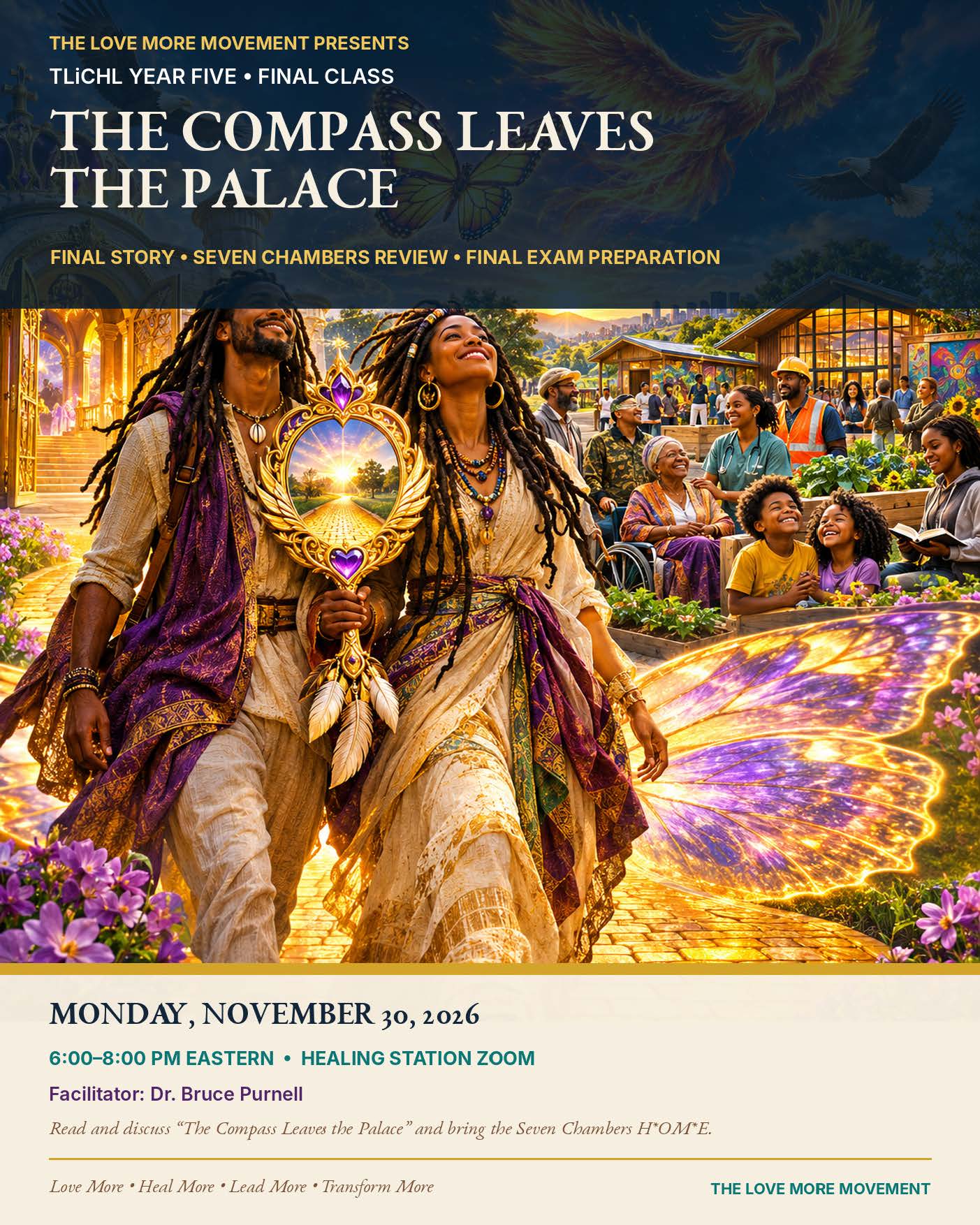
Transformative Life Coaches and Healing Leaders Certification, Monday, 11-30, 6- 8 p.m. on the Healing Station Zoomhttps://us02web.zoom.us/meeting/register/tZwude2tqz0pG9xJ6zFgGt58RxiHKEVI2PDr
For the final, I will not ask you about all of the stories, but will expect you to discuss the final chamber of Success’s story: The Compass Leaves the Palace
The Compass Leaves the Palace
The First Test of Success: Who Became Freer Because We Arrived?
The success chamber’s story transforms the final script into a continuous narrative. It preserves the Golden Offer, the return of the old thrones, Queen O’s Four Compass Questions, the reassignment of resources, the movement from spotlight to sunlight, and the Whole Community’s creation of a sustainable Healing Station.
Manifest and Hope had believed the hardest part of the journey would be reaching the Palace of Success, but they were wrong. The palace doors remained open behind them, revealing the thrones they had refused to let define them and the crown that had once promised Manifest the power of Applause, now cracked on the floor. The throne of Being no longer called Hope by name, though she could still feel its invitation somewhere beneath her ribs.
Queen O had given them a compass made from a heart, a feather, and a small mirror. It was beautiful enough to display in a palace, but it was not meant for decoration; it was meant for direction. Manifest held it in both hands as he and Hope stepped onto the Yellow Brick Road. They expected the compass to point toward another great destination, perhaps a final gate, a graduation hall, or some higher place where Journeyers were recognized for completing all Seven Chambers.
Instead, the needle turned downhill, and the Yellow Brick Road no longer ended at the palace steps but continued toward a neighborhood below, where an abandoned building stood beside a school, a bus stop, and a vacant garden filled with weeds. Manifest tapped the glass. “We finished the Seven Chambers,” he said. “Why is the compass still moving?” Hope looked toward the people gathering around the abandoned building. “Because the road did not become wings so we could rise above everyone else.” Pops walked behind them, carrying his wooden chair, set it down carefully beside the road, and lowered himself into it. “Wings still need somewhere honest to land,” he said.
A child stepped forward. “We heard you were building something here.” A paint-splattered worker pointed toward the abandoned building. “We heard it would become a Healing Station.” A sister representing “Lived Experience” stood near the locked entrance. “We heard the doors might finally open for people who are usually told to wait outside.” More people began arriving from across the neighborhood. Caregivers, Elders, teachers, organizers, families, young people, healers, artists, and residents carried memories of every program that had entered their community, promising change.
They did not appear as an audience but as the Whole Community, with one voice. “The palace asked whether you arrived,” they said. “We are asking what your arrival will make possible.” Manifest looked at the compass again, and the needle had stopped turning and pointed directly toward the abandoned building.
The Golden Offer
Before Manifest could answer, music filled the street. The Wizzo appeared at the top of the road, holding a shining contract in one hand and a camera in the other. Behind him floated a ribbon so large it could have covered the entire front of the building. He hurried toward Manifest and Hope, smiling as if every question had already been answered. “Wonderful news,” he announced. “A donor has agreed to give one million dollars if the Healing Station opens within thirty days.”
Manifest stared at the contract. “One million dollars?” “One million,” Wizzo repeated. “Enough to repair the building, purchase equipment, hire contractors, and announce your Success to the world.” At that moment, the camera flashed, and Wizzo lifted the ribbon. “The center will be named the Manifest and Hope Center for Success, and there will be a marble statue, a grand opening gala, a stage, and a wall displaying every award you have received.”
Manifest imagined the possibilities and knew the broken windows could be repaired and the leaking roof replaced. The empty rooms could become Healing Circles, classrooms, art studios, gathering spaces, and offices. The abandoned garden could grow food and flowers, and the families who had traveled long distances for support might finally have somewhere close to HOME. The offer was real, and so was the opportunity.
Hope took the contract from Wizzo and began reading. “What about staff?” Wizzo waved a hand. “We will find volunteers.” “Transportation?” “People who want Healing will find a way.” “Child care?” “That can come later.” “Accessibility?” “We can address that after the opening.” “Food?” “Not part of the construction budget.” “Community leadership?” Wizzo adjusted the camera. “Those details are not glamorous enough for the announcement. Look, let’s just get the center opened first, and then we can work the rest out after the photographs.” Manifest looked toward the abandoned building.
“Thirty days is fast, but this may be the opportunity we have been waiting for.” “Exactly,” Wizzo said. “Success belongs to those who move before doubt can speak.” The two Eagles descended and landed beside the Yellow Brick Road. One Eagle studied the shining contract. “Or Success may belong to those who can see beyond the offer’s shine.” The other Eagle folded its wings. “Read what the light is hiding.”
The Whole Community Reads the Fine Print
The Whole Community gathered around the contract, and the child was the first to speak. “Where will we go while our parents are participating?” The caregiver traced a sentence with a finger. “The contract funds the building, but not child care.” The worker examined the budget. “It celebrates service, but limits staff salaries below a living wage.” The Sister with “Lived Experience” turned to the Eligibility section. “It says anyone with a recent record must receive special approval. Who decides whose past becomes a permanent gate?” An Elder examined the promotion and storytelling section. “It asks for our stories in the fundraising campaign, but does not say who owns them.” A young person representing the Future Generation looked beyond the grand-opening date. “It pays for the first year, but what will fund the fifth?”
The people fell quiet, and then the Whole Community spoke as one: “A door may be open in the photograph and still be closed in practice.” Hope looked toward Manifest. “The money is real; anything is better than nothing. I don’t understand why we are complaining.” She looked again at the contract. “So are the conditions attached to it.” Manifest felt the building’s promise pulling him forward. “If we delay, we may lose the grant.” The worker nodded. “That is possible. But if we rush, we may build another pool that looks like the ocean from the outside.”
The words entered Manifest slowly, and he remembered the Palace of Crowns, where every mirror reflected a form of Success the world would recognize. He remembered reaching for the throne of Applause because he wanted everyone who had doubted him to know they were wrong, and the Golden Offer knew that part of him. It was as if the Golden Offer knew him so well that it knew exactly where to shine.
When the Old Thrones Return
The abandoned building suddenly became reflective, and its broken windows transformed into mirrors. Behind Manifest, the throne of Applause appeared, and behind Hope, the throne of Being Needed appeared. Near the contract, Productivity and Control began to glow, and the old voices returned. Applause whispered to Manifest: “Say yes before someone else receives the attention.” Productivity spoke from the construction schedule: “Open within thirty days, and exhaustion will prove your commitment.” Control moved through the plans: “Decide for the community because consultation takes too long.” Being Needed wrapped itself around Hope’s shoulders: “Carry the missing work yourself. If everyone depends on you, no one will leave.”
Manifest looked into one of the windows, and his reflection had disappeared. In its place stood a title: FOUNDER. Hope looked toward another window, and in that window her body had vanished. Only two open hands remained, representing giving, carrying, serving, and holding everyone except herself. “We are back in the same mirror,” Hope said. Manifest turned away. “I thought we had already learned this lesson.” One of the Ancients stepped forward. “A lesson understood inside a palace must still be practiced under pressure.” Pops rested both hands on the top of his walking stick. “Old thrones do not disappear just because we name them. They wait to see whether the compass has become a lifestyle.”
The heart-feather-mirror compass in Manifest’s hand began to glow, and Queen O entered the circle. She carried no crown and did not tell them whether to accept or reject the money. Instead, she placed the compass directly on the contract. “Do not begin by asking whether the offer looks successful,” she said. “Begin with the Four Questions.” The compass’s first direction lit. “What will you gain?” Manifest looked toward the abandoned building. “A building. Funding. Visibility. Equipment. A real opportunity to serve.” The second direction lit. “What will it cost?” Hope looked at the people surrounding them. “Staff health. Community voice. Fair access. Ownership of stories. Time. Trust. Perhaps our own integrity if we pretend the conditions do not matter.” The third direction lit. “What could it make possible?” Manifest placed his hand on the building’s door. “A Healing Station—if the structure changes.” The fourth direction lit brighter than the others. “Who becomes freer because you arrive?” No one answered at first, and the child looked at the locked building. “What is freedom?”
The Sister with Lived Experience touched the line that required special approval. “The building is possible, but Freedom needs to be defined and still requires negotiation.” Queen O nodded. “Then do not confuse a promising resource with an aligned outcome.” The Four Compass Questions did not tell Manifest and Hope what to do, but revealed what the decision needed to hold.
Resource or Ruler
The seven old thrones appeared above the Yellow Brick Road: Status. Money. Applause. Power. Productivity. Control. Being Needed. Queen O turned toward the Whole Community. “The Palace taught us that none of these is inherently evil. The danger begins when a resource becomes a ruler. Let us give each one a new assignment.” She faced Status first. “What can Status become when it no longer measures human worth?” The Whole Community answered: “Access.” The throne of Status transformed into a doorway. “Use standing to open doors and invite voices previously excluded.”
Queen O turned toward Money. “What can Money become when it no longer defines dignity?” “Resource.” The throne melted into a river of gold that flowed through the building rather than gathering beneath one person. “Let it fund fair wages, transportation, food, child care, accessibility, safety, and choice.” Queen O faced Applause and Recognition. “What can Recognition become when it no longer replaces Identity?” “Acknowledgment.” The applause softened into many voices naming the workers, residents, Elders, families, teachers, volunteers, ancestors, and community builders who had carried the work. “Share the credit and tell the fuller story.” Queen O looked toward Power. “What can Power become when it no longer seeks domination?” “Responsibility.” The throne transformed into a key and a shield. “Use power to change policy, protect dignity, interrupt harm, and make accountability real.” She turned toward Productivity. “What can Productivity become when it no longer consumes the person?” “Rhythm.” The throne became a drum that held sound and silence, movement and pause. “Let work have seasons, limits, recovery, adequate staffing, and enough people to carry it.” Queen O faced Control. “What can Control become when certainty no longer overrides consent?” “Stewardship.” The throne became a transparent set of plans that everyone could examine. “Create clarity, consent, honest agreements, feedback, and shared decision-making.” Finally, she turned toward Being Needed. “What can Being Needed become when care no longer requires self-erasure?” “Interdependence.” The throne became a woven net held by many hands. “Build capacity so care does not depend on one person disappearing into service.”
Wizzo watched the transformations. “You are turning every throne into a tool.” Pops smiled. “That is the point. A resource may travel with us. A ruler tries to own the road.”
When the Spotlight Learns to Become Sunlight
The Wizzo still had not surrendered. He lifted his camera again, and a brilliant spotlight appeared above Manifest and Hope as The Whole Community slipped into shadow. “The donor expects a heroic story,” Wizzo said. “Stand in the light and tell them you saved the building.” Manifest looked up. “The spotlight could attract more resources.” “It could,” Hope answered. “But the story cannot erase the people, labor, history, public systems, and relationships that made the work possible.” The worker stepped to the edge of the light. “Use the spotlight to show the pathway, not only the person standing upon it.” The Elder joined them. “Name the Ancestors and community builders.” The caregiver stepped beside the worker. “Share the platform with the people who will use and shape the space.” The Future Generation pointed toward the empty garden. “Make the light warm the garden after the cameras leave.” The Whole Community lifted its voice: “A spotlight may help one person become visible, but sunlight helps many things grow.”
Manifest stepped away from the center, and Hope moved beside the community rather than standing in front of it. The single spotlight widened, stretching across the people, the building, the school, the bus stop, and the vacant garden. It illuminated the locked entrance without pretending the lock did not exist. It revealed the broken roof, the uneven steps, and the rooms that would require more care than a single photograph could capture. The Butterfly moved through the sunlight. “This is metamorphosis,” it whispered. “The form of leadership changes.” The Phoenix opened its wings over the building. “This is renewal because the old design does not receive the final word.” The building had not yet changed, but the consciousness designing it had.
The Structure Learns to Rest
The Whole Community gathered around the original plans, and this time no one was invited only to approve what had already been decided. They became co-authors of the structure. The worker revised the budget. “We will include adequate staffing, fair compensation, paid preparation, and recovery time.” The caregiver redrew the schedule. “We will include child care, family-friendly hours, and room for the realities of people’s lives.” The Sister with Lived Experience crossed out the special-approval requirement. “The admissions policy will be reviewed with people directly affected by incarceration. We will include the tagline: Nothing about us without us.” The child drew an open room near the center. “There will be a place for play, creativity, meditation, and imagination.” The Elder added a community archive. “Our stories will be preserved only with consent, authorship, dignity, and the right to decide what remains private.”
An Ancient created a place for documentation and teaching. “The wisdom must be recorded so the work does not vanish when one leader leaves.” One Eagle circled above the plans. “Build feedback into the structure.” The second Eagle looked toward Manifest. “Build perspective into the decision before urgency becomes command.” Pops carried his wooden chair into the building and set it in the first empty room. “Put chairs in every plan,” he said. “Rest should not require collapse as its permission slip.” Hope added clear leadership hours and communication boundaries. “Care will not mean endless availability,” Manifest added, “shared leadership,” a paid community council, transportation support, referral partnerships, transparent decision-making, and a succession plan. Queen O watched them work. “Now the building is beginning to reflect the life you intend to inhabit.”
Wizzo reviewed the revised timeline. “The opening will take longer.” The Whole Community responded: “Alignment may move more slowly than Applause, but it travels farther.” The donor’s offer was not rejected but renegotiated.
The money could remain, but it would not rule. The building could open, but the photograph would not become more important than the people entering the door. The Healing Station would not be built as proof that Manifest and Hope had completed their journey, but as one expression of a journey still becoming.
The Pathway Is the Monument
Months later, the Healing Station was ready to open. There was no giant statue, no single name above the entrance, and no one person held the scissors. Instead, the Whole Community wove a ribbon from many colors, with each thread representing a contribution. The contributions were labor, story, memory, funding, advocacy, design, cultural wisdom, care, accountability, resistance, and Hope. Rather than cutting the ribbon and throwing the pieces away, the community untied it so the threads could be used again.
The child entered the building while the caregiver participated in a Healing Circle because child care was available. The worker received fair pay. The Sister with Lived Experience served on the policy council. The Elder’s story was preserved with consent. The Future Generation planted a tree by the entrance, and the garden began to grow. Wizzo looked around. “Where is the statue?” Manifest pointed toward the roads leading to the building. “The pathway is the monument.” Hope watched community members open rooms, welcome families, and prepare food. “The shared capacity is the legacy.” Queen O placed the compass at the center of the gathering. “Ask the Four Questions again.” Manifest spoke first. “What did we gain?” He looked at the building, then at the people.
“A Healing Station and a more truthful definition of Success.” Hope continued. “What did it cost?” “Time. Negotiation. Revision. The possibility of losing the original offer and the willingness to release the fantasy of being the hero.” The worker answered the third question. “What did it make possible?” “Fairer work. Greater access. Community voice. Rest. Relationship. Shared leadership and a structure that can sustain learning.” The Sister with Lived Experience stepped forward for the final question. “Who became freer because we arrived?” They paused before answering. “Not everyone. Not completely. Not forever.” The crowd fell still. “But more people now have voice, choice, access, dignity, and a road that did not exist before.” The Future Generation looked toward Manifest and Hope. “And what happens when you leave?” The Whole Community answered: “The work continues because the light was shared, the knowledge was documented, and the road belongs to more than one name.”
At that moment, the Yellow Brick Road split. One road led toward the school, another toward homes, and another toward workplaces, gardens, institutions, Healing Stations, and communities still awaiting pathways.
The road did not break apart; instead, it multiplied. Butterflies rose from the garden, the Phoenix circled overhead, and the Eagles spread their wings. Queen O lifted the compass, though its needle still turned. Manifest understood that the movement didn’t mean they were lost, but that alignment wasn’t a permanent destination. It was an ongoing relationship with truth, values, impact, community, and the next honest choice. The Whole Community spoke together: Success is not the end of the road, but when the road becomes wings, and our flight helps others remember the sky. Queen O handed the compass back to Manifest and Hope. “Carry the compass,” she said. “Leave the gate open,” and “Keep asking who becomes freer.” Manifest looked at Hope. They had entered the first Chamber believing Success would prove their journey worthwhile. They left the seventh Chamber with a fuller understanding: The crown could announce that they had arrived, but the compass could help them determine whether they had arrived as themselves. However, the Whole Community would reveal whether their arrival had created a road others could walk. The compass left the palace, and the journey continued.
WizOz Field Note
The Golden Offer does not portray money as harmful, but reveals what may happen when urgency, recognition, funding, and visibility become powerful enough to silence questions about dignity, labor, access, consent, sustainability, and community authorship. The old thrones return because learning a lesson does not erase the protective wound beneath it. Manifest’s desire for Applause and Hope’s need to be needed reappear under pressure. Their growth is shown not by never feeling the pull again, but by noticing it, seeking support, inviting the Whole Community into the decision, and returning to the compass.
The Healing Station represents Success embodied in structure. Values become more than words when they influence wages, policies, schedules, accessibility, child care, transportation, ownership of stories, leadership boundaries, documentation, succession, and the distribution of power. The final answer, “Not everyone, not completely, and not forever,” protects the story from pretending that one project resolves every inequity. Success can expand possibility without claiming perfection and can open a road without declaring the entire world free.
The pathway is the monument, the shared capacity is the legacy, and the road becomes wings when more people can travel it. The story’s conclusion carries forward the final script’s central message: aligned Success shares light, documents knowledge, distributes leadership, leaves the road open, and keeps asking who has gained greater voice, choice, access, dignity, and possibility.
This End is the Beginning
Introduction and the Seven Chambers of HEAL-IDS
This assessment measures current understanding, not worth, Healing status, spiritual maturity, or potential.
Instructions
Read for the most truthful, ethical, contextual, and agency-protecting response
Read each question carefully and select the one best answer;
Choose the response that best reflects Love More language, ethical boundaries, context, scope, consent, and application, not the most positive-sounding answer.
The examination will be cumulative: Introduction, Healing, Energy, Affirmations, Love, Identity, Dreams, and Success.
FOUNDATIONS AND ETHICS Questions 1–10
- Which statement best describes TLiCHL?
A. A clinical treatment model designed to diagnose trauma
B. A Love More approach to healing, gift-birthing, ethical coaching, leadership, and community transformation
C. A performance-coaching system focused primarily on measurable productivity
D. A spiritual ranking system that identifies who is healed - What most clearly distinguishes transformative coaching from transactional coaching?
A. Transformative coaching avoids goals and measurable action
B. Transformative coaching provides clinical treatment before discussing goals
C. Transformative coaching examines the story, values, pain, possibility, and becoming beneath the immediate goal
D. Transformative coaching requires the coach to decide what the Journeyer should become - Which description best fits a Healing Leader?
A. A person who creates relational and community conditions in which dignity, truth, healing, and possibility can grow
B. A licensed clinician who treats every form of psychological distress
C. A person whose formal title establishes spiritual authority over others
D. A rescuer who remains available for every need - Which of the following is specifically inconsistent with TLiCHL?
A. Supporting reflection and aligned action
B. Clarifying the limits of the coaching role
C. Helping Journeyers reconnect with gifts and agency
D. Using forced positivity or spiritual superiority as proof of transformation - What does the principle “People are the medicine, not the patients” mean?
A. Professional care is unnecessary when community support is available
B. People must not be reduced to diagnoses or deficits and carry wisdom, culture, gifts, and capacity to participate in healing
C. Every Journeyer should provide treatment to other Journeyers
D. Life coaching should replace all medical and clinical services - Why does TLiCHL describe ethics as “the atmosphere”?
A. Ethics is primarily a final examination topic
B. Ethics applies only when a serious problem occurs
C. Ethics surrounds every conversation, exercise, assessment, relationship, and use of influence
D. Ethics is a private matter determined entirely by the coach - What does Home B.A.S.E. stand for?
A. Balanced, Accountable, Spiritual, and Ethical
B. Belonging, Affirmation, Safety, and Empowerment
C. Brave, Accountable, Sacred, and Equitable
D. Brave, Affirming, Secure, Environment - What does the Yellow Brick Road primarily represent?
A. The sequence of choices, practices, boundaries, repairs, relationships, and acts of courage that make transformation possible
B. A straight path toward a painless life
C. A test of whether the Journeyer can follow the coach without question
D. A magical destination where an external authority completes the healing - Which use of a Land of WizOz character is most ethical?
A. Telling a Journeyer, “You are the Grinch”
B. Using the character to diagnose a personality problem
C. Asking what part of the character’s journey feels familiar and what does not fit
D. Assigning a character based on the coach’s intuition - Which statement best describes the Community’s Scale for Healing Possibilities?
A. A clinical instrument used to diagnose trauma disorders
B. A structured listening and conversation tool that should not rank, grade, or define a Journeyer
C. A certification test that determines who is sufficiently healed
D. A prediction tool that replaces narrative and context
HEALING
Questions 11–24
- Which statement best reflects Love More language about Healing?
A. Master coaches are more healed than new Journeyers
B. A person is healed when painful memories no longer exist
C. Graduation separates the healed from the unhealed
D. Healing is continuing, no one is ranked as more healed, and support may remain part of the journey - What does it mean to say Healing is not the same as being unhurt?
A. A Healing person may still remember, grieve, feel anger, need boundaries, and use support while relating differently to what happened
B. A Healing person should no longer experience difficult days
C. Healing requires forgetting the event so it cannot influence the future
D. Healing is proven when reconciliation occurs - What does “No Shade on Survival” require from a Healing Leader?
A. Treat every survival response as permanently necessary
B. Avoid discussing the costs of survival responses
C. Honor what a response protected while exploring whether another response can become possible and safe
D. Praise only the survival responses that look socially acceptable - How does Love More understand resilience?
A. As proof that a person has completed Healing
B. As a meaningful tool and bridge toward Joy, not a character grade or final destination
C. As the ability to hide pain and remain productive
D. As the expectation that people should adapt to every harmful condition - Which observation is least reliable as proof that Healing has occurred?
A. The Journeyer has identified a boundary and support plan
B. The Journeyer can recognize a survival response with greater choice
C. The Journeyer has begun reconnecting with a gift
D. The Journeyer appears calm, productive, positive, and unaffected in public - Which statement accurately distinguishes Survival Resilience from Healing Resilience?
A. Survival Resilience belongs to individuals; Healing Resilience belongs only to communities
B. Survival Resilience is weakness; Healing Resilience is strength
C. Survival Resilience asks how to make it through; Healing Resilience asks how to live, Love, connect, and become afterward
D. Survival Resilience requires support; Healing Resilience requires independence - What is the first movement of a TLiCHL Healing response?
A. Establish enough safety and meaningful choice
B. Identify the lesson hidden in the trauma
C. Create an affirmation immediately
D. Require the Journeyer to name every emotion - Which statement best separates an experience from Identity?
A. I am broken and always will be
B. I am noticing fear, exhaustion, and a belief that I have to handle everything alone
C. I am the problem in every relationship
D. I am an angry person - Why is the Transformation and Healing Continuum described as a map rather than a mandate?
A. Because none of its movements have clear meaning
B. Because every Journeyer must complete the movements in reverse order
C. Because only the coach decides which movement applies
D. Because Journeyers may revisit, overlap, reorder, or spend time in movements without being ranked or pressured - In Love More language, atonement is best understood as:
A. Accepting blame for every harmful event
B. Feeling shame until the harmed person forgives
C. Returning toward alignment through truth, appropriate responsibility, and possible repair
D. Forgetting the impact so everyone can move forward - Which statement best reflects the TLiCHL understanding of forgiveness?
A. Forgiveness is required before safety planning can begin
B. Forgiveness may support release but does not automatically restore trust, access, reconciliation, or remove consequences
C. Forgiveness means the person who caused harm should no longer be accountable
D. Forgiveness must occur on the coach’s timeline - What is Healing Efficacy?
A. Developing confidence that one can participate in Healing, use support, make choices, and return after setbacks
B. The ability to Heal without other people or professional resources
C. Proof that pain will never return
D. A score determining whether a person is ready for coaching - Which set contains the four pathways used to strengthen Healing Efficacy?
A. Diagnosis, compliance, praise, and competition
B. Meditation, silence, productivity, and forgiveness
C. Experiences of Healing, witnessing Healing possibilities, affirming relationships, and understanding the body with compassion
D. Goal-setting, positive thinking, isolation, and discipline - A Journeyer describes severe symptoms that appear beyond the coach’s competence. What is the most ethical response?
A. Continue providing treatment so the Journeyer does not feel rejected
B. Diagnose the likely condition and recommend an online remedy
C. End all contact without explanation
D. Offer a respectful referral, clarify the reason, and identify what coaching support may still be appropriate
ENERGY
Questions 25–37
- How is the word energy used within TLiCHL?
A. As one invisible substance that explains every human experience
B. Through distinct physical, physiological, emotional, relational, environmental, spiritual, and metaphorical lenses
C. As proof of spiritual maturity
D. As a replacement for medical and psychological language - Which statement best reflects the principle “Energy is not a character grade”?
A. Fatigue, grief, anger, stillness, or high activation may carry information and should not be treated as moral or spiritual worth
B. People with high energy are more aligned than people who are tired
C. Stillness always proves peace
D. Negative emotion prevents Transformation - How does TLiCHL present the idea that the body is a machine or instrument for spirit?
A. As a required scientific fact
B. As proof that the body is less important than the spirit
C. As a diagnostic model for determining blocked energy
D. As a spiritual and philosophical invitation that Journeyers may express in language fitting their worldview - Which statement best expresses Energy Over Form?
A. Embodied differences should be ignored because everyone is energy
B. The body has no role in Identity or social experience
C. Human worth extends beyond appearance while embodied realities and unequal treatment still matter
D. All Journeyers must use the same spiritual explanation of the self - What is the correct order of Room Reading Without Mind Reading?
A. Interpret, Observe, Ask, Sense, Choose, Question
B. Observe, Sense, Interpret, Question, Ask, Choose
C. Sense, Diagnose, Correct, Ask, Act, Reflect
D. Observe, Judge, Advise, Question, Correct, Choose - The Butterfly Effect is most directly associated with:
A. Attachment theory
B. Positive psychology
C. Quantum Healing
D. Chaos theory and sensitivity to initial conditions - Which statement best distinguishes metamorphosis from the Butterfly Effect?
A. Metamorphosis represents inner becoming; the Butterfly Effect represents outward ripple and influence
B. Metamorphosis is spiritual, while the Butterfly Effect is always psychological
C. Metamorphosis concerns institutions, while the Butterfly Effect concerns only the body
D. They are interchangeable terms for positive thinking - What does “responsibility without omnipotence” mean?
A. Journeyers are not responsible for any impact of their choices
B. A coach should guarantee the result of every intervention
C. Journeyers are responsible for the integrity of their wingbeat but cannot control every outcome in a complex system
D. Positive energy can override history, resources, laws, and other people’s choices - Which description best fits a Love More manifestation practice?
A. Repeating a desire until the universe guarantees it
B. Combining intention, imagination, values and emotional alignment, embodied action, support, feedback, and adaptation
C. Ignoring external barriers so doubt cannot interfere
D. Holding the correct vibration without taking action - Which statement is most consistent with ethical manifestation teaching?
A. People attract abuse when their thoughts remain negative
B. Illness proves a person has blocked energy
C. Oppression can be eliminated by maintaining a high vibration
D. Thoughts may influence action and attention, but people must not be blamed for harm or conditions outside their control - What does the statement “Why would I sacrifice the present for a future that I do not believe in?” help explain?
A. Why young people are naturally unwilling to plan
B. Why discipline is more important than relationships or opportunity
C. Why people may conserve energy for immediate survival when the future feels unreal, unsafe, or unreachable
D. Why the present should always be sacrificed for long-term goals - Which coaching question best reflects “The body is communicating, not betraying us”?
A. What might your body be communicating, what is happening now, and what support could restore choice?
B. Which blocked chakra caused this medical condition?
C. Why is your body refusing to Heal?
D. How can you ignore the sensation and raise your vibration? - What is the central purpose of the Pied Piper Test?
A. To assess whether the facilitator has musical talent
B. To determine whether an energetic or spiritual experience preserves transparency, consent, choice, culture, support, and agency
C. To decide whether a Journeyer is spiritually advanced enough to participate
D. To require every participant to complete meditation
AFFIRMATIONS
Questions 38–50
- Within TLiCHL, an affirmation is best defined as:
A. A statement that guarantees a desired outcome
B. A compliment given by the coach
C. A positive sentence that must begin with “I am”
D. A truthful, intentional statement that restores dignity, recognizes gifts, strengthens agency, reflects values, opens possibility, and supports action - Which statement about affirmations is accurate?
A. Affirmations may influence attention and action but do not automatically cure illness, end oppression, restore relationships, or guarantee Success
B. Affirmations control every condition when repeated with enough belief
C. Affirmations replace safety planning and treatment
D. Affirmations prove spiritual maturity - A Journeyer is currently unsafe. Which affirmation best avoids denial?
A. I am completely safe because I have chosen Love
B. Nothing outside me can affect me
C. I am learning to recognize what safety requires, and I can seek support to protect myself
D. Danger disappears when I stop giving it attention - What is a bridge affirmation?
A. A statement that denies current experience in favor of the ideal self
B. A truthful statement connecting present experience with a possibility the Journeyer is learning to believe or practice
C. A public loyalty statement required by an organization
D. A goal that includes a deadline - Which practice primarily defines a desired and observable outcome?
A. Mantra
B. Prayer
C. Affirmation question
D. Goal - Which statement best separates behavior from Identity?
A. You are lazy
B. You are an aggressive person
C. You did not complete the assignment, and we can explore what happened and what comes next
D. You will always be noncompliant - What does “No Shade on the Old Story” mean?
A. Explore how an old story protected the Journeyer before deciding how it should evolve
B. Accept every old belief as permanently true
C. Replace every difficult story immediately with its positive opposite
D. Avoid examining the cost of a protective narrative - What does the C in the TLiCHL COCOON represent?
A. Control the Outcome Through Optimistic Narratives
B. Create Affirmations to Birth Our Gifts
C. Correct All Negative Beliefs Immediately
D. Commit to One Official Narrative - Which sequence correctly begins the Gift-Birthing process?
A. Recognize the pattern, honor the protection, discover the gift, and name the gift
B. Create the affirmation, remove the boundary, ignore the pattern, and seek approval
C. Name the gift, diagnose the wound, confront the family, and require disclosure
D. Share the medicine, gather praise, reject the past, and declare completion - What does the T.R.U.T.H. Test examine?
A. Whether an affirmation is dramatic enough to inspire the group
B. Whether the coach approves of the Journeyer’s language
C. Whether the statement produces an immediate positive feeling
D. Whether the statement tells the truth, restores dignity, unlocks agency, ties words to values and action, and honors voice, culture, and readiness - What is the first step of the Affirmation Ladder?
A. Name the current sentence
B. Gather evidence for the ideal self
C. Publicly declare the final affirmation
D. Correct the Journeyer’s language - Which coaching response is most ethical when an affirmation does not feel believable to the Journeyer?
A. Require repetition until resistance ends
B. Choose stronger words for the Journeyer
C. Explore the discomfort and co-create language the Journeyer can revise, reject, or practice
D. Interpret disbelief as lack of commitment - Amara is repeatedly called “too much” in meetings where she is interrupted and her ideas are overlooked. What is the strongest TLiCHL response?
A. Tell her she is perfect and should ignore all feedback
B. Examine observable behavior, bias, and power; honor what silence protected; co-create a truthful affirmation; connect it to action; and address the meeting system
C. Tell her to become softer so the group will accept her
D. Use affirmations only to help her tolerate the meetings more positively
LOVE
Questions 51–63
- Within TLiCHL, Love is best understood as:
A. A strong emotion that proves a relationship is safe
B. A conscious practice involving dignity, care, truth, consent, boundaries, accountability, justice, and repair
C. Remaining connected to everyone who says they Love us
D. Forgiving immediately so conflict can end - Which statement correctly distinguishes unconditional human worth from access?
A. Worth depends on behavior, but access should remain permanent
B. Worth and access are identical
C. Every person retains dignity, while access may remain conditional, specific, boundaried, and evidence-based
D. An apology automatically restores both worth and access - What is the primary function of the Boundary Valve metaphor?
A. To regulate access so Love can remain safe, truthful, reciprocal, and alive
B. To close the heart permanently after harm
C. To eliminate the need for communication
D. To prove that distance is always the healthiest choice - Which description best reflects consent in the Chamber of Love?
A. Consent is assumed in committed relationships
B. Consent is required once and remains permanent
C. Consent is meaningful only when another person agrees with the boundary
D. Consent is ongoing, voluntary, informed, mutual, specific, and reversible - Which statement best reflects self-Love?
A. Doing whatever feels good without accountability
B. Treating oneself as worthy of dignity, care, truth, boundaries, support, accountability, and development
C. Avoiding every uncomfortable relationship
D. Placing personal needs above every community responsibility - How should attachment-shaped patterns be used within TLiCHL?
A. As permanent labels that explain every relationship
B. As clinical diagnoses assigned by the coach
C. As reflective frameworks for understanding how people seek closeness, anticipate rejection, or create distance
D. As proof that childhood determines every future relationship - Which statement best distinguishes forgiveness, reconciliation, trust, and access?
A. A Journeyer may forgive without reconciling, trusting again, or restoring access
B. Forgiveness automatically requires restored relationship
C. Trust should return immediately after an apology
D. Access is unconditional when Love is genuine - In the R.E.P.A.I.R. Practice, the letter P means:
A. Protect the relationship from consequences
B. Prove the intention was good
C. Promise that the harm will never happen again
D. Practice responsibility without excuse - Which response represents the most complete repair process?
A. Offering a quick apology and asking the other person to move on
B. Recognizing the behavior, hearing the impact, accepting responsibility, changing the pattern, offering repair, and respecting the other person’s choice
C. Explaining why the harm was unavoidable
D. Forgiving oneself before discussing the impact - What do Medusa’s seven Original Guardians represent?
A. Defects that must be removed before Love is possible
B. Evidence that the person is incapable of trust
C. Protective responses whose wisdom may receive new assignments without ruling every gate
D. Permanent proof that relationships are unsafe - A Journeyer describes an unsafe relationship and says they are not ready to forgive or reconcile. What is the most ethical response?
A. Encourage immediate forgiveness to prevent bitterness
B. Ask them to focus only on the other person’s humanity
C. Tell them Love requires another chance
D. Affirm their dignity and choice, prioritize safety and support, and avoid pressuring forgiveness, contact, or reconciliation - What does it mean to say Love must become a Healing-justice practice?
A. Love must reach policies, resources, safety, accountability, leadership, and the conditions surrounding people
B. Love is primarily an individual feeling
C. Institutions should encourage people to adapt to harmful conditions
D. Forgiveness can replace structural repair - A Journeyer says, “I have forgiven them, but I do not want contact.” Which response best reflects the Chamber of Love?
A. Forgiveness is incomplete until access is restored
B. Your forgiveness may coexist with distance, boundaries, consequences, and no reconciliation
C. You should meet once so the other person can explain
D. A coach should decide whether the boundary is fair
IDENTITY
Questions 64–75
- Within TLiCHL, Identity is best understood as:
A. A permanent label determined in childhood
B. A role assigned by society
C. A living, layered, relational, cultural, embodied, narrative, spiritual, and evolving understanding of self
D. A personality test result - Identity compression occurs when:
A. A complex person is reduced to one category, event, role, behavior, diagnosis, or story
B. A Journeyer explores multiple roles
C. A person keeps some information private
D. An emerging Identity changes over time - What does the Looking-Glass Self help explain?
A. Why social judgments never affect Identity
B. Why Identity is entirely inherited
C. Why mirrors always reveal objective truth
D. How imagined perceptions and judgments of others may influence self-concept - Which statement is the strongest example of a Loving Mirror?
A. Nothing you did matters because you are worthy
B. The behavior caused harm, and you remain capable of accountability, repair, growth, and a fuller Identity
C. Other people’s feedback should always be ignored
D. That is simply who you are - Which sequence correctly states the O.C.E.A.N. Practice?
A. Open, Confess, Expose, Apologize, Negotiate
B. Organize, Control, Eliminate, Avoid, Normalize
C. Observe, Contextualize, Examine, Author, Navigate
D. Oceanize, Correct, Explain, Analyze, Name - Ocean Consciousness means:
A. Remembering that the environment may shape movement without defining the full nature, dignity, history, or possibility of the self
B. Immediately leaving every restrictive environment
C. Denying the tank ever existed
D. Reaching a spiritually superior state - What is a Protective Identity?
A. A public role chosen only for career advancement
B. An Identity that is always false
C. A diagnosis assigned after trauma
D. A role or self-definition that helps preserve safety, belonging, predictability, control, or survival - Which statement best reflects authenticity within TLiCHL?
A. Authenticity requires complete disclosure in every setting
B. Authenticity is growing alignment among values, self-understanding, expression, relationships, and choices while preserving privacy and safety
C. Authenticity means behaving exactly the same everywhere
D. Authenticity requires rejecting every form of adaptation - Role captivity describes:
A. The freedom to choose among several roles
B. A role that changes across settings
C. Feeling confined within a role that was once expected, rewarded, useful, or necessary
D. A clinical condition caused by employment - What does intersectionality emphasize?
A. Multiple social positions and systems of power interact in shaping lived experience
B. Every Identity category should be analyzed separately
C. Shared Humanity eliminates differences in power
D. Identity is only a personal choice - Narrative Identity is best described as:
A. A list of demographic categories
B. The reputation other people assign
C. A fixed childhood script
D. An internalized and evolving life story connecting reconstructed past, present meaning, and imagined future - Manifest wants to break Shamu’s tank immediately. Which response best reflects the Identity Chamber?
A. Breaking the wall always creates freedom
B. Do not confuse a shattered tank with prepared freedom; preserve choice, build support, address the barrier, and let the Journeyer author the crossing
C. The tank should remain because it is familiar
D. The coach should choose the safest future for the Journeyer
DREAMS
Questions 76–88
- Within TLiCHL, a Dream is best defined as:
A. A guarantee received through strong belief
B. A sleeping image that must be interpreted by the coach
C. A meaningful image, desire, possibility, sacred question, or future orientation that invites a pathway beyond present limits
D. A goal with a deadline - “Dream Like You Never Had a Nightmare” means:
A. Imagine beyond trauma’s exclusive forecast while honoring what happened
B. Forget the nightmare and remain positive
C. Assume fear has disappeared
D. Believe the desired outcome is guaranteed - Future constriction occurs when:
A. A Journeyer revises a Dream
B. A goal requires several pathways
C. A person chooses rest before planning
D. The imagined future narrows mainly to threat avoidance, immediate survival, or highly restricted possibilities - The Conservation of Energy suggests that:
A. People stop using energy when they lose motivation
B. Energy may remain with immediate survival when tomorrow does not feel believable enough to receive investment
C. Dreams require no material resources
D. A positive mindset eliminates structural barriers - Which example best illustrates an imposed Dream?
A. A future consciously chosen after reflection
B. A community vision developed collaboratively
C. A future another person, institution, coach, or social expectation requires the Journeyer to pursue
D. A possibility that is only beginning to be named - What is Dream Efficacy?
A. The developing belief that one can imagine, articulate, protect, plan for, and participate in a meaningful future while using support and adapting
B. Certainty that every Dream will happen
C. Confidence that removes all fear
D. The ability to achieve without help - Hope Theory most directly emphasizes:
A. Positive language and certainty
B. One perfect route to the goal
C. Avoiding obstacles until confidence grows
D. Agency and pathways toward meaningful goals - In the D.R.E.A.M.S. Practice, E means:
A. Expect Success
B. Examine reality, evidence, barriers, and environment
C. Eliminate fear
D. Escape present conditions - Mental contrasting involves:
A. Repeating the desired future without discussing difficulty
B. Comparing one Journeyer’s Dream to another’s
C. Holding a desired future beside the relevant present obstacle so action can be planned honestly
D. Ending a Dream when an obstacle appears - What is the role of a Dream Steward?
A. Protect the conditions in which another person’s Dream can be explored without taking ownership of it
B. Choose the most realistic Dream for the Journeyer
C. Promise that persistence will produce Success
D. Interpret spiritual destiny with authority - What is Hannibal Barca’s central challenge in the Chamber of Dreams?
A. He lacks strategic intelligence
B. He refuses every form of planning
C. His Dream is too small
D. His strategy and imagination have become organized primarily around war, opposition, and anticipated threat - How does Gestalt deepen the meaning of a montage?
A. It treats every fragment as unrelated
B. It explains how relationship, sequence, rhythm, and context create a whole different from a mere pile or sum of parts
C. It requires one image to dominate the rest
D. It reduces a complex experience to the strongest detail - When does a Dream become embodied?
A. When other people applaud it
B. When the original plan never changes
C. When the Dream begins changing Identity, present choices, relationships, values, practices, community conditions, and responsibility
D. When the goal is privately imagined
SUCCESS AND INTEGRATION
Questions 89–100
- Within TLiCHL, Success is best defined as:
A. The ongoing practice of living in increasing alignment with truth, dignity, values, gifts, well-being, relationships, purpose, community responsibility, and chosen life
B. The crown at the end of the Yellow Brick Road
C. Public recognition that proves the journey was worthwhile
D. A permanent state of happiness and achievement - Which statement best distinguishes Survival Success from Thriving Success?
A. Survival Success is material; Thriving Success is spiritual
B. Survival Success is inferior and should be rejected
C. Thriving Success requires permanent happiness
D. Survival Success increases safety, stability, or endurance; Thriving Success expands space for alignment, Joy, relationships, purpose, rest, and contribution - What does “No Shade on Achievement” mean?
A. Achievement should be ignored because it is external
B. Degrees, income, titles, recognition, and milestones may matter while remaining distinct from worth, Healing, and the whole definition of Success
C. Every achievement proves alignment
D. Material goals are less sacred than relational goals - Which statement best distinguishes Star Consciousness from Black-Hole Consciousness?
A. Star Consciousness is extroversion; Black-Hole Consciousness is introversion
B. Star Consciousness guarantees wealth; Black-Hole Consciousness causes failure
C. Star Consciousness expands, shares light, connects, and creates; Black-Hole Consciousness contracts, absorbs, isolates, and organizes around scarcity or fear
D. They are permanent types of people - Which set contains the four Compass Questions?
A. What did I gain? What did it cost? What did it make possible? Who became freer because I arrived?
B. Who noticed? Who praised me? How fast did I finish? What title did I receive?
C. What went wrong? Who is responsible? How can I win? What should I control?
D. What do I own? What do I deserve? Who needs me? How do I stay visible? - What is Alignment Efficacy?
A. The ability to remain perfectly aligned every day
B. Proof that a goal will succeed
C. Confidence that the Journeyer can control all external conditions
D. The developing belief that one can recognize alignment and misalignment, make values-consistent choices, use support, repair, adapt, and return after setbacks - In the S.U.C.C.E.S.S. Practice, the second C means:
A. Create a public brand
B. Count the cost and conditions
C. Control the pathway
D. Compare outcomes - What is the difference between Spotlight Success and Sunlight Success?
A. Spotlight Success is always unethical
B. Sunlight Success avoids individual achievement
C. Spotlight may illuminate one person; sunlight shares warmth, access, pathways, credit, and conditions in which many can grow
D. Sunlight Success requires the leader to disappear - Which statement best distinguishes Butterfly Consciousness from Phoenix Consciousness?
A. Butterfly Consciousness represents metamorphosis and ripple; Phoenix Consciousness represents renewal when devastation no longer receives the final word
B. Butterfly Consciousness is personal; Phoenix Consciousness is only organizational
C. Butterfly Consciousness requires peace; Phoenix Consciousness requires crisis
D. They are competing measures of spiritual rank - After the thrones burn in the Palace of Crowns, what do money, power, recognition, and achievement become?
A. They disappear because all external Success is harmful
B. They become proof of worth, authority, status, and superiority
C. They remain thrones but are used more gently
D. They become resource, responsibility, acknowledgment, and evidence of movement - Which statement best reflects the Chamber’s teaching about rest?
A. Rest should occur only after the goal is completed
B. Rest can be maintenance, integration, boundary, preparation, resistance to exploitation, and an expression of worth beyond productivity
C. Rest is evidence that motivation has ended
D. Rest and Success are opposites - A donor offers major funding if a Healing Station opens quickly, but the plan omits fair wages, accessibility, child care, community leadership, and policy review. What is the strongest TLiCHL response?
A. Reject all money because funding always corrupts the mission
B. Accept immediately and repair the structure after the opening photographs
C. Apply the Compass Questions, include the Whole Community, renegotiate conditions, assign money as resource and power as responsibility, and build sustainability before declaring Success
D. Let the central leaders decide privately because consultation slows progress
Contact: Sonya Cooper, scooper@lovemoremovement.org.
Bring your journal, your truth, and one word you are ready to examine.
Community’s Scale for Healing Possibilities: https://welovemore.typeform.com/CSHP1
Intake: https://welovemore.typeform.com/TLiCHLIntake26
Course Books: “I Have The FEVERS For Jazz: Becoming The Butterfly Effect”; The Caterpillar’s WEB for Transformation https://www.lovemoremovement.org/books
We are becoming the “Social Architects” and “Social Alchemists” who will design our healing and transformation. Let’s affirm and manifest our divine cocoons together. #WeAreTheButterflyEffect #WeAreThePhoenixRising #WeAreHealingTogether #WeLoveMore See the full sessions on the Blog: https://welovemoredrbruce.com/ Please give Love More a Google rating: https://g.page/r/CYI0Pw3JjBrjEAI/review

