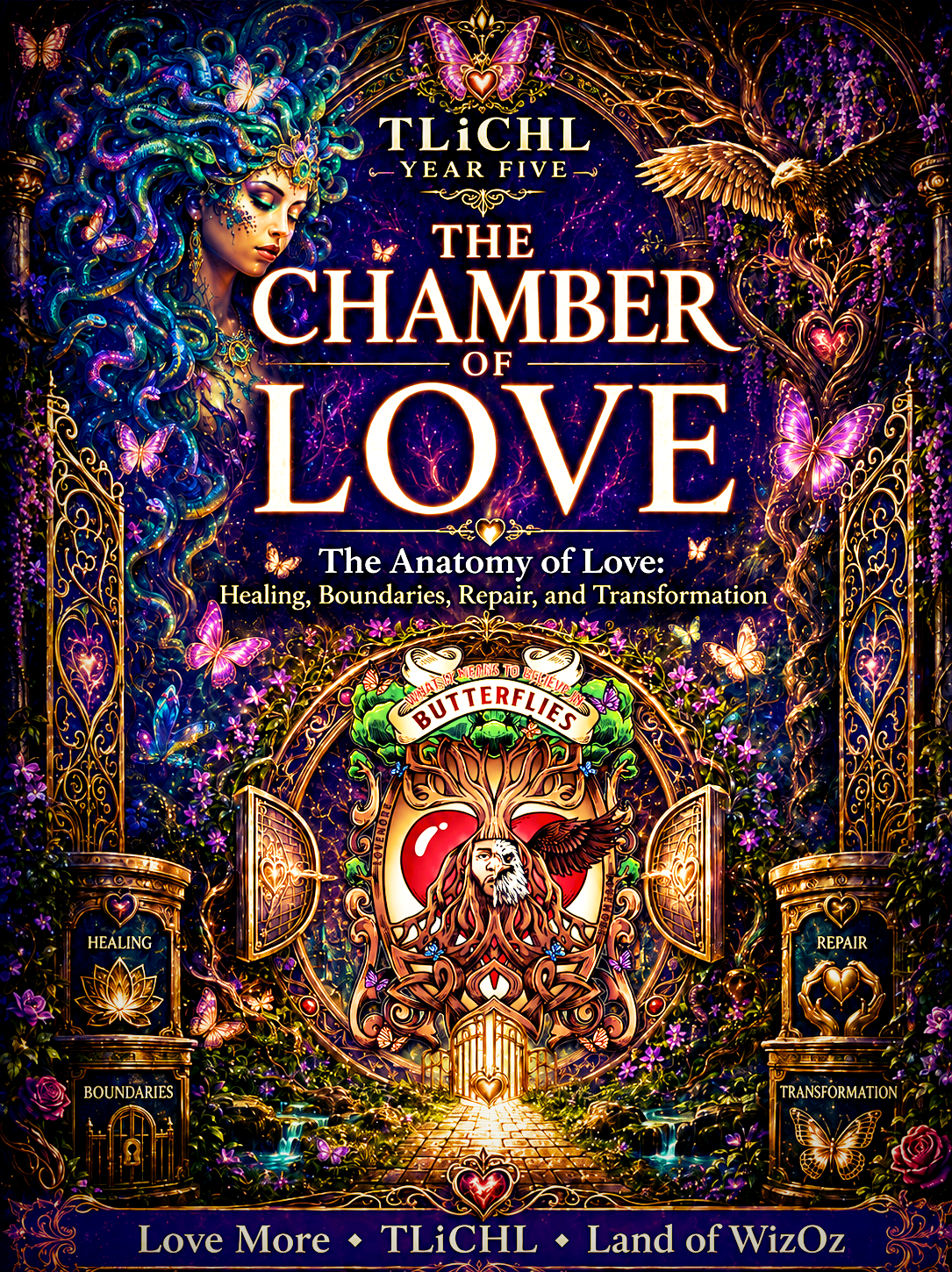
Transformative Life Coaches and Healing Leaders Certification, Monday, Aug 31, 6- 8 p.m. on the Healing Station Zoom https://us02web.zoom.us/meeting/register/tZwude2tqz0pG9xJ6zFgGt58RxiHKEVI2PDr
Dear TLiCHL Journeyers,
Join us as we enter The Chamber of Love: The Anatomy of Loving More: Developing the Circulatory System for Healing and Transformation
Riddle of the Day: The Tongue of Light
I am not a voice, yet I speak with power,
I bloom in silence and burst like a flower.
I am heard in the spaces
between what is said,
And I can turn the sharpest words into thread.
I live in the smile, the sigh, and the song,
I can make the weak whole
and the broken strong.
I do not shame, and I do not harm;
I can cradle a soul with open arms.
I can build or burn, heal or sever,
But when used with Love, I may last forever.
What am I?
Welcome Home, Journeyers.
Congratulations on making it through the Mid-Term; we hope you were able to reflect on how much information we have covered thus far. Last session, we entered the Chamber of Affirmations and learned that words can become wings when they are truthful enough to enter, grounded enough to practice, and connected to action. In the Chamber of Love, we ask what carries those words through the rest of our lives.
Love is the circulatory system of TLiCHL. Healing, Energy, and Affirmations cannot remain isolated ideas. Love moves them through the self, relationships, families, communities, institutions, and the world. We are not entering a chamber that asks us to tolerate more, sacrifice endlessly, forgive before we are ready, or remain accessible to everyone. Love More does not mean endure more harm. It means a fuller Love: compassion with accountability, acceptance with discernment, giving with receiving, forgiveness with justice, connection with freedom, and care with boundaries.
Past Chamber of Love teaching described Love as language, frequency, and compass. We carry those foundations forward. In the Fifth-Year evolution, we add valves, consent, evidence, repair, and healing justice. The heart may guide the road, but Love becomes trustworthy through what it protects, what it permits, what it changes, and how it behaves.
Healing asks what happened and what protected us. Energy asks what we feed and transmit. Affirmations ask what language organizes the current. Love asks whether the current can circulate with dignity, boundaries, mutuality, and repair. The Chamber of Affirmations taught that the first words spoken over us may have shaped our stories, but they do not own the final chapter. The Chamber of Love asks what happens when the new language enters relationship. Can “my voice matters” survive a room that interrupts? Can “I deserve rest” survive a family system organized around one person’s sacrifice? Can “I am worthy” become a boundary, a request, an apology, a policy, or a community practice?
| The Fifth-Year Evolution Love remains language, frequency, and compass. Frequency is a Love More metaphor for the relational quality we repeatedly make available, not a scientific ranking of people. The compass must be joined by consent, boundaries, accountability, evidence, and repair. |
Our Guiding Character for the Chamber of Love: Medusa
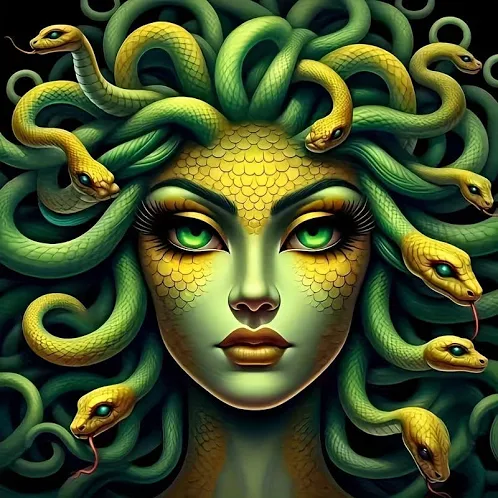
In WizOz, Medusa is not just a monster, but a figure of trauma, rage, curse, shame, and reclamation. She embodies the pain of being transformed into something feared, judged, or misunderstood. Her story raises questions about how people survive violation, how pain mutates into defense, and how distorted power forms around deep injury.
Medusa is especially important in the Chamber of Affirmations and the Chamber of Love. She helps Journeyers reflect on what happens when pain is internalized and projected outward. She also invites reclamation and exemplifies what happens when we begin to reinterpret what was once deemed a curse.
Entering the Chamber of Love: The Garden of Stone and Serpents
Manifest and Hope followed the Yellow Brick Road until the golden bricks gave way to a field of purple flowers. At the center of the field stood a temple, surrounded by stone figures. Some statues looked frightened, reaching toward one another and shielding their faces, while others looked as if they had been frozen mid-flight. Above the temple’s entrance were the words: THE CHAMBER OF LOVE. ENTER WITH AN OPEN HEART, BUT DO NOT ENTER WITHOUT DISCERNMENT.
Manifest examined one of the statues. “This place does not feel like Love,” he said. Hope looked toward the temple. “Maybe that is why the chamber is here.” As they approached, they heard whispering from the doorway. Medusa stood inside, her eyes lowered. Around her head, seven serpents moved as if they had a single mind, each whispering a different sentence:
Do not trust anyone.
Leave before they leave you.
If they are angry, you must fix it.
Love has to hurt.
Silence keeps the family together.
If you say no, you will be alone.
Strike first, or you will be wounded again.
Manifest reached for a sword. “I can cut them away,” he said. The serpents lifted their heads, and Medusa stepped back. Hope placed a hand in front of Manifest, not touching him, but asking him to pause. “Did she ask you to remove them?” Manifest lowered the sword, and Medusa looked at Hope.
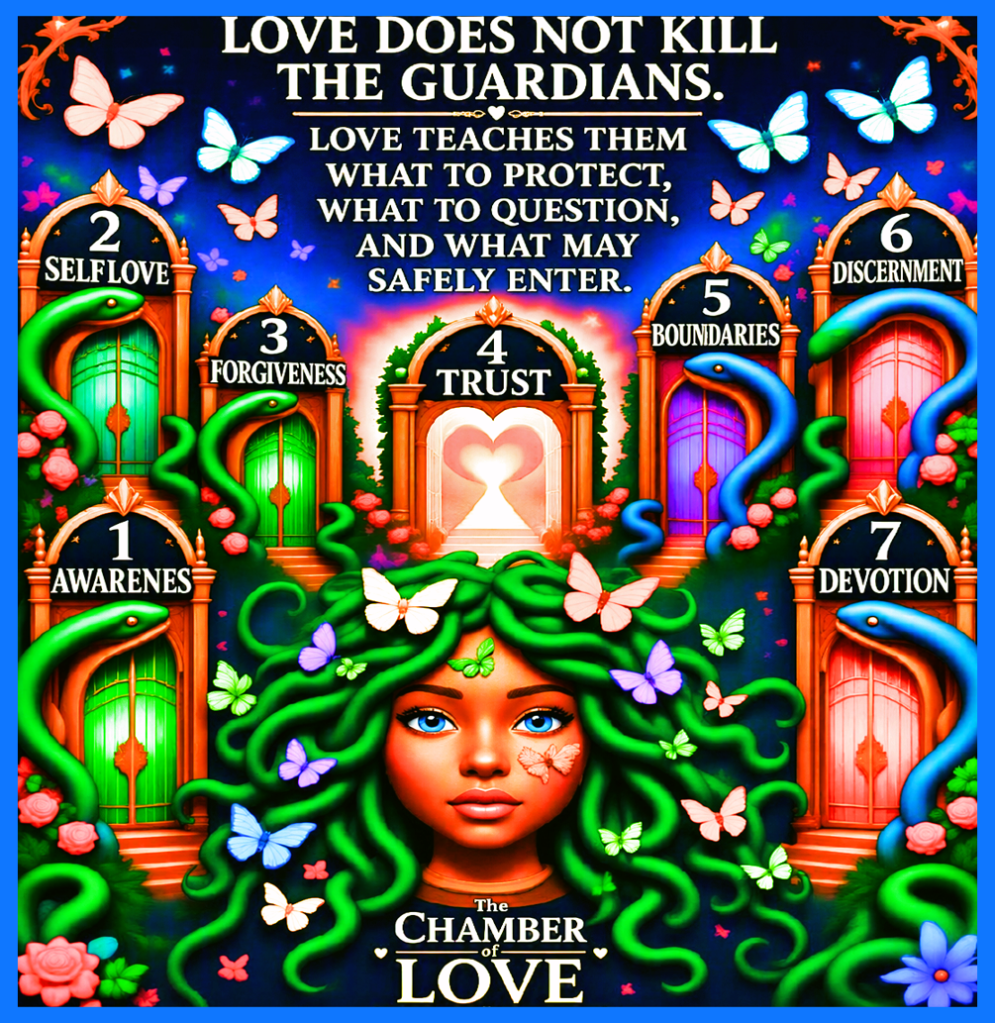
“Everyone comes here wanting to destroy the snakes,” she said. “No one asks why they came.” Hope remained near the doorway. “May we come closer?” Medusa studied them. “Not yet.” Hope nodded, and Manifest looked confused. “We came to help.” Medusa’s eyes hardened. “That’s exactly what people say before deciding they know what I need.” Manifest fell quiet. Hope sat on the floor outside the doorway. “We can stay here.” For several moments, no one spoke. Then Hope asked: “What did the snakes protect?” Medusa touched the first serpent. “Shame taught me to hide.” She touched the second. “Fear taught me to leave before anyone could reject me.” She touched the third. “Rescuing taught me that I could earn Love by solving everyone’s pain.” She touched the fourth. “Rage taught me to become frightening before anyone could frighten me.” She touched the fifth. “Silence taught me that telling the truth could break the family.” She touched the sixth. “Control taught me that nothing could hurt me if nothing happened without my permission.” She touched the seventh. “Self-abandonment taught me that keeping someone else was more important than keeping myself.” Manifest looked at the statues. “Did the snakes turn them to stone?” Medusa shook her head. “Some were frozen by my fear of the snakes, and some by their own insecurities. Some became stone because none of us knew how to stay connected without controlling, rescuing, hiding, or attacking.” Hope asked: “What do you want the snakes to become?” Medusa had never been asked that question. She looked toward the temple walls. “I do not want to destroy them,” she said. “They noticed danger when no one else did. But I no longer want them deciding that everything is dangerous.” A warm light appeared behind her, revealing seven gates leading into the heart. Above the gates was another inscription: LOVE DOES NOT KILL THE GUARDIANS. LOVE TEACHES THEM WHAT TO PROTECT, WHAT TO QUESTION, AND WHAT MAY SAFELY ENTER.
Medusa touched the serpent of Shame. “You may become humility without disappearing.” She touched Fear. “You may become discernment without isolating.” She touched Rescuing. “You may become service without self-erasure.” She touched Rage. “You may become courage and protection without destroying.” She touched Silence. “You may become reflection without becoming secretive.” She touched Control. “You may become planning and boundaries without dominating.” She touched Self-Abandonment. “You may become devotion without requiring me to disappear.”
The serpents grew still but did not vanish. Instead, they moved from the center of Medusa’s head to the gates around her heart. They became guardians rather than rulers. Manifest returned the sword to its place. “How do we heal the serpents when they are on the inside?” he asked.
Medusa answered: “We listen for what they were protecting, teach them what is true now, give them a new assignment, and stop calling every form of self-abandonment Love.” The stone figures around the temple began to breathe, but not all of them returned to movement, as some needed time, distance, and another path. Even as we moved into a new consciousness, none of the statues were forced to reconnect.
Medusa opened the temple door. “Welcome to the Chamber of Love,” she said. “Here, everyone has unconditional worth, but not everyone receives unconditional access.”
WizOz Field Note
In the Land of WizOz, Medusa is reimagined as an archetype of wounded protection, internalized shame, inherited relational patterns, rage, discernment, and reclaimed power. The serpents represent protective messages that may have developed through personal, family, cultural, institutional, or intergenerational experiences. They are not treated as proof that Medusa is broken. Each serpent contains both a protective intention and a pattern that may now restrict Love. The goal is not to destroy every protective response, but to determine whether it can take on a new assignment.
The central questions are:
• What was this response protecting?
• What did it help the Journeyer survive?
• What does it cost now?
• Is the original danger still present?
• What boundary or support is needed?
• What gift exists beneath the protection?
• What role could the response serve in a healing life?
• What does Love require now?
Core Teaching I: Love Before the Word and Love Defined
Long before the English word Love existed, human beings carved, painted, wrote, sang, and taught about affection, longing, relationship, truth, balance, and the heart. The Fifth-Year textbook opens the history of Love with ancient Egypt as one of humanity’s earliest written witnesses. The Love More reading is not that ancient Egypt held today’s complete TLiCHL framework, but that the human need to name, plant, protect, and practice Love reaches deep into written memory.
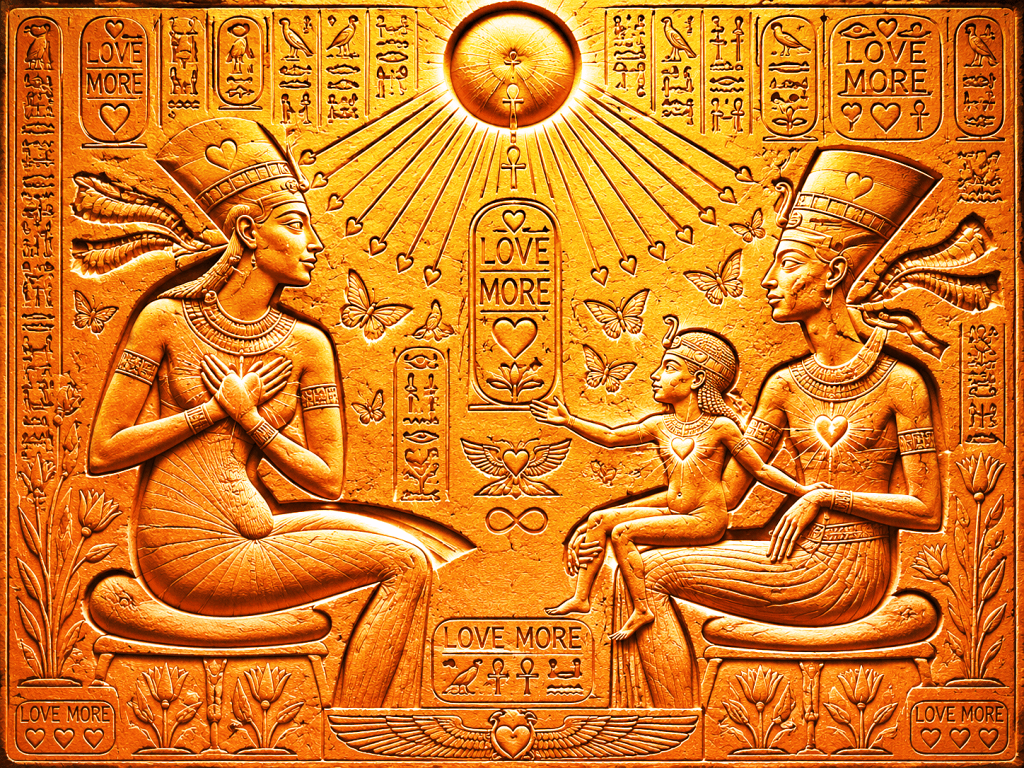
Long before the English word Love existed, ancient Egyptians carved, painted, and wrote about Love in one of the world’s earliest writing traditions. Egyptian hieroglyphic writing emerged shortly before 3100 BCE and remained in use for nearly four thousand years. Hieroglyphs were not decorative pictures or isolated spiritual symbols; they formed a complex writing system that could represent spoken language, names, prayers, laws, wisdom, longing, desire, and human relationships.
Among the words recorded in the ancient Egyptian language was mrw.t, translated as Love, affection, or belovedness. The Thesaurus Linguae Aegyptiae documents this word in Egyptian texts dating to around 2445 BCE, placing the written language of Love more than 4,400 years in the past. The word appears hundreds of times across texts spanning ancient Egyptian history. Its hieroglyphic spelling varied by period, context, and scribal practice. The precise pronunciation of mrw.t cannot be fully recovered because Egyptian writing generally recorded consonants but did not consistently mark vowels. The surviving signs therefore preserve the word’s structure and meaning more clearly than its original sound.
Ancient Egyptians also did not reduce Love to a single universal, logo-like symbol. Hieroglyphs served as sound signs, word signs, and determinatives that clarified meaning. Love was not represented by placing a heart or an ankh on a wall, but was expressed as language, developed through sentences, embodied in conduct, and explored through poetry, wisdom, devotion, and relationships.
Love and the Ancient Egyptian Heart.
The heart held a central place in ancient Egyptian understandings of human life. It was associated not only with physical existence but also with thought, intention, character, judgment, memory, and moral responsibility. In the ancient wisdom text The Teaching of Ptahhotep, the text instructs the reader: “Follow your heart as long as you live.” The same text declares: “The heart is the creator of its master.” These statements suggest that the heart was understood as an active center of decision, direction, and human becoming. The heart did not just feel; it helped organize the life a person created. The heart’s ethical importance also appears in Egyptian beliefs about the journey after death. In the weighing-of-the-heart tradition, the deceased person’s heart was weighed against the feather of Ma’at, associated with truth, justice, balance, and right order.
The heart therefore carried the record of how a person had lived and whether that life had remained aligned with truth and balance. This ancient relationship among the heart, truth, balance, behavior, and the continuation of life offers a powerful foundation for Love within the Love More Universe. Love is not only what the heart feels but also what the heart directs us to protect, create, repair, release, and become.
Planting Love:
Ancient Egyptian wisdom did not present Love as only romantic attraction but also understood it as a force capable of sustaining relationships, social harmony, leadership, and community life. The Teaching of Ptahhotep contains the remarkable statement: “Planting Love brings sustenance.” The metaphor is both agricultural and relational. Love is something planted and must be brought into the world through conduct. It requires attention, suitable conditions, time, and care. When cultivated, it sustains not only the person who gives it but also the wider relational field in which it grows.
This ancient statement resonates deeply with Love More philosophy. What we plant becomes part of the emotional, relational, and spiritual environment around us. When we plant humiliation, fear, distrust, or violence, those energies may reproduce themselves across relationships and generations. When we plant dignity, accountability, compassion, belonging, truth, and opportunity, we create conditions in which Love can become nourishment. Love is therefore not just discovered but planted, cultivated, and circulated, becoming sustenance.
Love as Longing, Poetry, and Human Experience
Ancient Egyptian writings also preserved Love as an intimate human longing. Love songs from the Ramesside Period, particularly the thirteenth and twelfth centuries BCE, were recorded on papyri, pottery fragments, and limestone ostraca. These compositions speak through alternating voices of young women and men, describing attraction, beauty, separation, desire, anticipation, illness from longing, and the joy of seeing the beloved. These songs show that people living more than three thousand years ago wrestled with many of the same experiences that continue to shape human relationships, including the desire to be seen, the fear of separation, the beauty of another person, the vulnerability of longing, the hope of reunion, and the physical experience of Love within the body. Love was not an abstract theory to the ancient Egyptians. It was sung, written, desired, remembered, grieved, and embodied.
A Love More Reading of the Ancient Record
Thousands of years ago, people were already asking how the heart should guide life. They were already connecting Love with action, sustenance, truth, balance, desire, beauty, relationship, and the continuation of the human story. From a Love More perspective, the ancient record teaches us that Love is not a recent invention, a temporary social trend, or a sentimental idea created by the modern world, but an ancient human memory.
Before Love became a slogan, it was carved in stone.
Before Love became a greeting card, it was written on papyrus.
Before Love became a scientific subject, it was felt in the heart and body.
Before Love became a movement, it was planted as a way to sustain life.
The language may have changed, but the human need has not.
From mrw.t to Love
The ancient Egyptian word mrw.t may not be the linguistic ancestor of the English word Love, but it provides the conceptual roots. Ancient Egypt offers one of the earliest written records of the human concept, while the English word follows a separate linguistic path from Old English lufu and Sanskrit lubhyati, meaning “desires,” and from a wider Indo-European root associated with care, desire, and affection. Together, these histories reveal two dimensions: Ancient Egypt shows how far back humanity was writing, thinking, singing, and teaching about Love, and etymology helps us understand how the English word developed and traveled into our present language.
The history of Love is therefore older than the word we now use to name it, and its roots reach into the earliest written expressions of human consciousness. Its language has crossed civilizations, its energy has spanned generations, and its meaning continues to evolve, to the point that when read backward, it spells evolve. Love More offers a pathway and an invitation to plant, practice, protect, and become Love, and to always Love More.
Love More: A Philosophy and Practice of Shared Humanity
We have heard that Love conquers all, Love wins, Love heals, and God is Love. I therefore offer a simple yet transformational premise: One human practice that consistently increases the likelihood of positive outcomes is Loving More. Loving More is not sentimentality, permissiveness, passivity, denial, or avoidance of difficult truths. It is a fuller, more conscious practice of Love: compassion joined with accountability, acceptance joined with discernment, generosity joined with boundaries, forgiveness joined with justice, and truth communicated without abandoning dignity.
Love transcends race, culture, gender, class, age, sexuality, ability, faith, geography, and every other distinction by which society may create separation or hierarchy. Cultures may express Love differently, yet the human desire to be seen, valued, protected, connected, and known is universal. Logic and science can help us examine aspects of Love, but neither can replace its relational, moral, spiritual, and transformative meaning.
Love is not only an abstract concept. We experience it through the body as well as the mind and spirit. Attraction, attachment, caregiving, and social bonding engage distributed brain systems linked to motivation, reward, memory, emotion, and connection. Neurochemicals such as dopamine, oxytocin, and vasopressin participate in these experiences, yet no single hormone, chemical, or brain region can fully explain Love. Studies also suggest that supportive connection may buffer stress and influence how some people experience pain. The biology does not define Love; it reveals one way the body participates in it. When fear, trauma, or threat dominate our awareness, our choices may narrow toward defense, withdrawal, emotional shutdown, or immediate survival. Love More does not deny these protective responses, nor does it claim that Love simply replaces human biology. Love More is an intentional possibility that becomes available when we have enough safety, support, awareness, and regulation to choose how we respond.
Instead of letting the first survival reaction make every decision, we can ask: What would Love do if it included truth, protection, boundaries, dignity, accountability, and care? Sometimes Love moves closer, creates distance, speaks, listens, forgives, requires accountability, holds on, and sometimes Love releases. From the beginning of life, relationships teach us what Love means. Before children can define Love, they experience it, or long to experience it, through protection, responsiveness, tone, touch, attention, consistency, and belonging. Safe, stable, and nurturing relationships are essential for positive childhood development and for preventing adversity. When Love is expressed positively, safely, healthily, and in a healing way, it can become one of the most important protective factors in a person’s life. It can support healthy development, transformative decisions, meaningful relationships, and lifestyles grounded in purpose and possibility. However, when care is absent, unpredictable, manipulative, controlling, neglectful, or abusive, the longing for Love may become linked to significant vulnerability and risk.
This is why people may find themselves “looking for Love in all the wrong places.” They may not be seeking harm but may be searching for belonging, protection, approval, attachment, validation, or the feeling of being chosen. A person can feel deeply attached to a relationship that is neither healthy nor safe. Control, humiliation, coercion, stalking, psychological aggression, sexual pressure, and violence do not become Love simply because someone uses the word.
Despite the many benefits of Love, our world often struggles to practice it. We may be too quick to judge, too ready to condemn, and too slow to listen, understand, forgive, repair, or extend grace. We are often taught, through an energy of fear, division, competition, and mistrust, to prioritize our differences over our Shared Humanity. When lives and communities have been shaped by Trauma, anxiety and distrust can become default organizing energies. We may begin preparing for rejection before connection has a chance to develop. We may judge before we understand, attack before we inquire, withdraw before we are abandoned, or reject others before they have a chance to reject us.
For this reason, we must intentionally retrain ourselves to Love More first. Loving More first does not mean ignoring danger, injustice, or harmful behavior. It means refusing to let fear be the sole author of our response. It means approaching people with curiosity before condemnation, with dignity before labeling, and with a willingness to understand the story behind the behavior, while still maintaining the boundaries needed to protect ourselves and others. When we choose Love, we align our energy with one of the most powerful forces in human life. Love can inspire Healing and Transformation, create joy and harmony, and help people move beyond isolation, self-protection, and individual interest toward connection, contribution, and Shared Humanity.
Within the Love More framework, Love is one of the highest expressions of human consciousness because it expands the self without requiring the self to disappear. Love enables us to experience empathy and compassion, share one another’s joys and sorrows, recognize beauty, and participate in something larger than ourselves. Love is not just something we feel but something we practice. Love is the willingness to give and receive, to become vulnerable without surrendering discernment, to be authentic without diminishing another person, to recognize others’ gifts, and to develop the best in ourselves. Love inspires us to create, innovate, serve, protect, repair, and contribute positively to the world.
Love is also a choice. We can choose to open our hearts and let Love circulate, or organize our lives around fear, trauma, mistrust, and isolation. We can choose to see another person as a whole human being, or reduce them to a wound, diagnosis, charge, mistake, opinion, identity, or a moment of crisis. We can choose to pass pain forward, or interrupt its spread through our families, relationships, institutions, and communities. Loving More does not always mean choosing closeness. It may mean saying no, setting a boundary, ending an unsafe relationship, seeking professional help, telling a difficult truth, reporting harm, accepting responsibility, or allowing another person to face the consequences of their choices.
Love does not require our disappearance, unlimited access, or demands for immediate forgiveness, and it does not excuse abuse. Love protects dignity, including our own. When Love becomes action, it creates a ripple effect that extends far beyond the original moment.
An apology may interrupt an intergenerational pattern.
A boundary may teach a child that Love does not require self-abandonment.
A courageous conversation may transform a family.
An act of kindness may restore someone’s sense of belonging.
A policy rooted in dignity may change an entire community’s experience.
Love becomes contagious when people trust it. It inspires kindness, generosity, compassion, cooperation, and concern for the greater good. Research supports an association between compassion and prosocial attitudes and behaviors, while acknowledging that context, resources, and social conditions also shape what people can do. Loving More also supports our collective well-being. Strong, supportive social relationships are linked to better mental and physical health and a lower risk of premature mortality. Social connection may help buffer stress, encourage healthier behavior, foster belonging, and provide critical resources during difficult times. The quality of connection matters: relationships marked by hostility, isolation, chronic conflict, coercion, or violence can instead become sources of significant harm.
Love can help us become more grateful, appreciative, connected, and available to joy. It can strengthen a positive perspective by giving adversity a context larger than the injury itself and, thus, increase resilience as a tool on a healing journey. Love does not just help us withstand the next Trauma, but helps us imagine and build lives, relationships, communities, and systems in which Trauma is no longer expected to remain at the center. Love gives us a reason not only to survive, but to heal, not only to endure, but to thrive, and not only to recover, but to transform. Love is the fabric through which we experience relationship, belonging, meaning, and interconnection, and the energy that reminds us that our lives are individual, but never entirely separate.
What affects one part of a family, organization, community, nation, or the entire human family eventually creates ripples throughout the whole. Recognizing Love as a fundamental force in human life gives us a compelling reason to Love More. Loving More is an antidote to hatred, fear, humiliation, dehumanization, and violence. It is the foundation for healthy relationships, healing communities, accountable institutions, and societies that value human dignity.
This does not mean Love alone resolves every problem, but it must be grounded in justice, policy, resources, safety, opportunity, accountability, and repair. Although I believe Love is the energy that can transform every other energy, I will not say that Love alone will end oppression, poverty, violence, illness, or systemic neglect, or replace justice, public policy, resources, treatment, safety, accountability, or structural change. Yet when Love is embodied through courage, advocacy, protection, generosity, truth, repair, and collective action, it becomes energy in motion. That energy creates ripples that can transform relationships, influence institutions, strengthen communities, and change the lives of generations yet to come. The thought of Love may not erase these realities by itself, but embodied Love humanizes our solutions, guides how power is used, and inspires the sustained action necessary to change the conditions that cause harm. Embodied Love does not just comfort the world as it is but transforms it into what it can become.
Love gives justice a heart, accountability a path toward repair, power a responsibility to serve, healing a vessel to circulate, and transformation a divine purpose. Thank you for being brave and vulnerable enough to embark on a journey toward a Shared Humanity grounded in Love, Light, Joy, Hope, Peace, Purpose, Liberation, Forgiveness, and Transformation. Love Wins, so if you want to win more, Love More!
The Love More Definition
Within TLiCHL, Love is a conscious practice of recognizing and protecting human dignity through care, truth, consent, boundaries, accountability, connection, justice, repair, and the freedom to become.
• Love is tenderness and truth.
• Love is receiving and giving.
• Love is consent and protection.
• Love is accountability and repair.
• Love is belonging without forced sameness.
• Love is justice with humanity.
• Love is the willingness to see the whole person without allowing harm to become acceptable.
| Love More Does Not Mean | Love More Means |
| Give until nothing remains | Give with choice, sustainability, mutuality, and purpose |
| Forgive faster | Protect the Journeyer’s Scope of Forgiveness and timeline |
| Stay in harm | Use Love, safety, boundaries, justice, and support together |
| Remain accessible to everyone | Affirm human worth while setting conditions on access |
| Avoid conflict | Tell the truth without abandoning dignity |
| Rescue everyone | Support agency, interdependence, resources, and responsibility |
| Remove consequences | Join compassion with accountability and repair |
Core Teaching II: The Anatomy and Circulation of Love
| Element | Love More Meaning | Reflection Question |
| Heart | Values, intention, meaning, and care | What is at the center of the Love I offer? |
| Blood | Love placed into motion through behavior | What does my Love actually carry? |
| Arteries | What we send outward | How do I give Love? |
| Veins | What we allow to return | Can I receive care, correction, gratitude, and support? |
| Valves | Boundaries regulating access and direction | What may enter, what must leave, and what needs a limit? |
| Pulse | Consistency and reliability | Is Love present only during crisis or in ordinary life? |
| Oxygen | Joy, hope, peace, affirmation, and possibility | What keeps the relationship alive rather than merely functional? |
| Capillaries | Small acts reaching everyday spaces | How does Love appear in ordinary moments? |
| Circulation | Mutuality and movement | Can Love move in more than one direction? |
| Repair | Addressing injury and restoring function where possible | What requires acknowledgment, change, restitution, or release? |
| Rhythm | Closeness, distance, work, rest, speaking, and listening | What rhythm makes Love sustainable? |
When Love Does Not Circulate
• One person gives while another only receives.
• Care is offered, but receiving feels unsafe or shameful.
• Boundaries are absent, unclear, punitive, or treated as rejection.
• Conflict is avoided until resentment becomes the primary language.
• Trust is expected without evidence.
• Apologies repeat while behavior remains unchanged.
• Service becomes self-erasure.
• A community praises sacrifice while ignoring depletion.
The Four Fields of Love
| Field | Core Practice | Guiding Question |
| Self-Love | Dignity, care, truth, rest, protection, accountability, support, and development | Why should everyone receive my humanity except me? |
| Relational Love | Mutuality, consent, reliability, communication, freedom, boundaries, and repair | Can both people remain fully human in the relationship? |
| Community Love | Belonging, voice, equitable resources, protection, accountability, joy, and sustainability | Who is heard, protected, resourced, and allowed to rest? |
| Sacred or Universal Love | Divine relationship, Shared Humanity, ancestry, creation, interconnection, or humanistic responsibility | What does my deepest understanding of Love require from how I live? |
The Earlier Heart and Self-Compassion
The inner child or earlier heart is a reflective metaphor for earlier needs, memories, beliefs, adaptations, and gifts. It is not a diagnosis and should not be used to force disclosure or recover memories. The invitation is to ask what the earlier self learned Love required and what the adult Journeyer can now offer through truth, protection, support, and choice.
• What did I learn Love required?
• What emotions were welcomed, and what emotions were punished?
• Was I responsible for other people’s feelings?
• What gift did I hide to belong?
• What boundary or reassurance can the adult me offer now?
The Seven Guardians and Their New Assignments
| Guardian | Protective Message | Cost When It Rules | Healing Assignment |
| Shame | Hide before anyone sees what is wrong | Disconnection and self-contempt | Humility, dignity, and honest accountability |
| Fear | Avoid all closeness because closeness can hurt | Isolation and missed connection | Discernment, gradual trust, and safety awareness |
| Rescuing | Earn Love by solving everyone’s pain | Exhaustion and dependency | Service, empowerment, and shared responsibility |
| Rage | Strike before anyone can injure you | Harm and relational rupture | Courage, protection, assertiveness, and justice |
| Silence | Do not tell; truth will destroy the family | Secrecy and continued harm | Reflection, wise disclosure, and voice |
| Control | Safety requires everything to happen your way | Domination and fear | Planning, boundaries, flexibility, and consent |
| Self-Abandonment | Keeping the relationship matters more than keeping yourself | Loss of identity and resentment | Devotion with dignity, limits, and self-presence |
Love Myths and Living Truths
| Love Myth | Living Truth |
| Love hurts. | Harm hurts. Vulnerability and difficult truths may be painful, but pain is not proof of Love. |
| If you Love me, you will always say yes. | Love respects consent, limits, and changing needs. |
| Family is everything. | Family can be sacred, and family relationships still require dignity, accountability, and safety. |
| Forgiveness means reconciliation. | Forgiveness, reconciliation, trust, and access are separate processes. |
| I must save the people I Love. | I can support people without owning their choices. |
| Boundaries push people away. | Boundaries clarify how connection may continue safely. |
| Jealousy proves Love. | Jealousy is an emotion. Surveillance, threats, and control are behaviors requiring accountability. |
| A good person stays. | A loving person may leave when staying requires self-abandonment or creates danger. |
Unconditional Human Worth and Conditional Access
| Love More Principle Every person has unconditional human worth. No person is automatically entitled to unconditional access, proximity, information, time, trust, touch, influence, or reconciliation. |
A Journeyer may affirm another person’s humanity while saying:
• You may not enter my home.
• I will not continue a conversation while being insulted.
• You may not touch me.
• Trust must be rebuilt through consistent behavior.
• Reconciliation is not available.
• I will not conceal what happened.
• I wish you no harm, and I am ending this relationship.
Distance does not automatically mean hatred. Access does not automatically mean Love.
Boundaries and Consent: The Valve Practice
| Boundary Area | Example |
| Physical | Please ask before hugging me. |
| Emotional | I can listen for fifteen minutes, but I cannot process this crisis all night. |
| Time | I am unavailable after 8:00 PM. |
| Financial | I can’t lend additional money. |
| Digital | Do not share my messages or photographs without permission. |
| Sexual | I do not consent to that activity. |
| Spiritual | You may pray for me, but please do not interpret my experience without asking. |
| Family | I will not discuss this issue through other relatives. |
| Professional | My role is coaching; I cannot provide clinical diagnosis or legal advice. |
| Information | That part of my story is private. |
| Community | I will participate when the meeting agreements protect dignity and voice. |
| Service | I can support the event, but I cannot lead it. |
Boundary Sentence Formula
When __________ happens, I notice or need __________. I will or will not __________. If it continues, I will __________. A boundary identifies the Journeyer’s limit and response; it is not a strategy for controlling another person.
| Consent Is Ongoing Consent is voluntary, informed, specific, mutual, responsive, and reversible. A prior yes, a relationship title, silence, dependence, or another person’s disappointment does not create permanent consent. |
Forgiveness, Reconciliation, Trust, Access, Accountability, and Repair
| Concept | Primary Meaning | Who Controls It? |
| Forgiveness | A personal process involving one’s relationship to the harm, pain, resentment, or person who caused harm | The person who was harmed |
| Reconciliation | The voluntary rebuilding of a relationship after rupture | Requires voluntary participation by all involved |
| Trust | Confidence developed through consistent evidence of reliability, care, honesty, and respect | Develops over time; cannot be demanded |
| Access | Permission for proximity, information, time, touch, or influence | Each person determines their boundaries |
| Accountability | Honest acknowledgment of behavior, impact, responsibility, and consequences | The responsible person must participate |
| Repair | Action addressing harm and changing the pattern that produced it | Requires responsibility; the outcome is not guaranteed |
R.E.P.A.I.R.
| Letter | Practice | Meaning |
| R | Recognize What Happened | Name the behavior accurately. Do not minimize or generalize. |
| E | Empathize With the Impact | Listen for how the experience affected the other person. Impact matters even when harm was not intended. |
| P | Practice Responsibility Without Excuse | Use context to support understanding, not to remove accountability. |
| A | Ask What Repair May Be Possible | Do not assume that the harmed person wants the relationship restored. |
| I | Implement Change | Repair requires behavior, not only language. |
| R | Respect the Other Person’s Choice | They may choose time, distance, conditions, no reconciliation, professional support, or another form of repair. |
A person cannot simply Love their way out of oppression, poverty, violence, illness, or systemic neglect. Love alone cannot replace justice, public policy, resources, treatment, safety, accountability, or structural change. Yet when Love is embodied through courage, advocacy, protection, generosity, truth, repair, and collective action, it becomes energy in motion. That energy can create ripples that transform relationships, influence institutions, strengthen communities, and change the lives of generations yet to come.
Ethics in the Chamber of Love
| Love More Ethical Practice | Application |
| Do Not Create Dependency | The coach is not the only person who understands and is not the source of the Journeyer’s healing. |
| Do Not Confuse Rescue With Love | Support the Journeyer’s power instead of replacing it with the coach’s power. |
| Maintain Role Clarity | Name and manage multiple roles, conflicts of interest, confidentiality, and power. |
| Protect Sexual and Romantic Boundaries | Professional influence and vulnerability make romantic or sexual involvement ethically unsafe. |
| Obtain Consent for Touch | A hug is not automatically comforting. Ask and respect the answer. |
| Protect Confidentiality | Do not share stories, images, testimonials, or identifying details without informed permission. |
| Do Not Force Family Reconciliation | Never use family, faith, or culture to require a return to harm. |
| Respect Cultural Meanings of Love | Invite diverse expressions without using culture to excuse coercion or violence. |
| Refer When Needed | Violence, stalking, sexual coercion, suicidal thinking, serious trauma symptoms, medical concerns, or legal danger may require specialized support. |
| Remain Accountable | Receive feedback, consult, document responsibly, repair harm, and stay teachable. |
Love or Need-to-Be-Needed Test
Did the Journeyer request this support? Is it within my role? Does it strengthen agency? Am I reducing their discomfort or my own? Am I hiding a boundary to appear loving? Is another resource more appropriate? Can I care without becoming the answer?
Buildshop One: The Love Circulation Map
Journeyers may write, draw, map, speak, listen, or pass. The goal is awareness, not public disclosure.
| Prompt | Journeyer Reflection |
| What I give | |
| What I receive | |
| What I give freely | |
| What I give from fear or obligation | |
| What I need but do not request | |
| What I receive but struggle to accept | |
| Where Love flows with mutuality | |
| Where Love becomes depletion | |
| Where a boundary valve is needed | |
| Where repair is needed | |
| My next circulation practice |
Buildshop Two: Love Myth to Living Truth
| Prompt | Journeyer Reflection |
| The Love myth I learned: | |
| Who or what taught it: | |
| What it helped preserve: | |
| What it has cost: | |
| The more complete truth is: | |
| The action that embodies the truth is: |
Buildshop Three: The Boundary Valve Plan
| Prompt | Journeyer Reflection |
| The situation: | |
| What I feel or notice: | |
| The value I am protecting: | |
| The boundary: | |
| How I will communicate it: | |
| What I will do if it is crossed: | |
| What support I may need: | |
| Is direct communication safe? |
Buildshop Four: R.E.P.A.I.R. Lab
Use a fictional or low-risk scenario. Do not use this exercise to confront an unsafe person or process active trauma.
Scenario: During a team meeting, Jordan publicly dismisses Maya’s idea, speaks over her, and later realizes that the behavior undermined her credibility. Jordan wants to apologize and repair the harm.
| R.E.P.A.I.R. Prompt | Group Response |
| R – What should Jordan recognize and name accurately? | |
| E – How can Jordan center Maya’s impact rather than Jordan’s intention? | |
| P – What responsibility belongs to Jordan without excuse? | |
| A – How can Jordan ask what repair may be possible without demanding reconciliation? | |
| I – What changed behavior would make the apology credible? | |
| R – What choices must Jordan respect if Maya wants time, distance, conditions, or no further relationship? |
Private Practice: Love Letter to the Earlier Heart
• Dear Younger Me, I remember that you learned __________.
• You believed Love required __________.
• You tried to protect us by __________.
• The responsibility that did not belong to you was __________.
• The gift you carried was __________.
• The boundary I can offer now is __________.
• The joy I want to return to you is __________.
• Together, we are learning __________.
The letter remains private unless the Journeyer independently chooses otherwise.
Contact: Sonya Cooper: scooper@lovemoremovement.org
Bring your journal, your truth, and one word you are ready to examine.
Community’s Scale for Healing Possibilities: https://welovemore.typeform.com/CSHP1
Intake: https://welovemore.typeform.com/TLiCHLIntake26
Course Books: “I Have The FEVERS For Jazz: Becoming The Butterfly Effect”; The Caterpillar’s WEB for Transformation https://www.lovemoremovement.org/books
We are becoming the “Social Architects” and “Social Alchemists” who will design our healing and transformation. Let’s affirm and manifest our divine cocoons together. #WeAreTheButterflyEffect #WeAreThePhoenixRising #WeAreHealingTogether #WeLoveMore See the full sessions on the Blog: https://welovemoredrbruce.com/ Please give Love More a Google rating: https://g.page/r/CYI0Pw3JjBrjEAI/review

