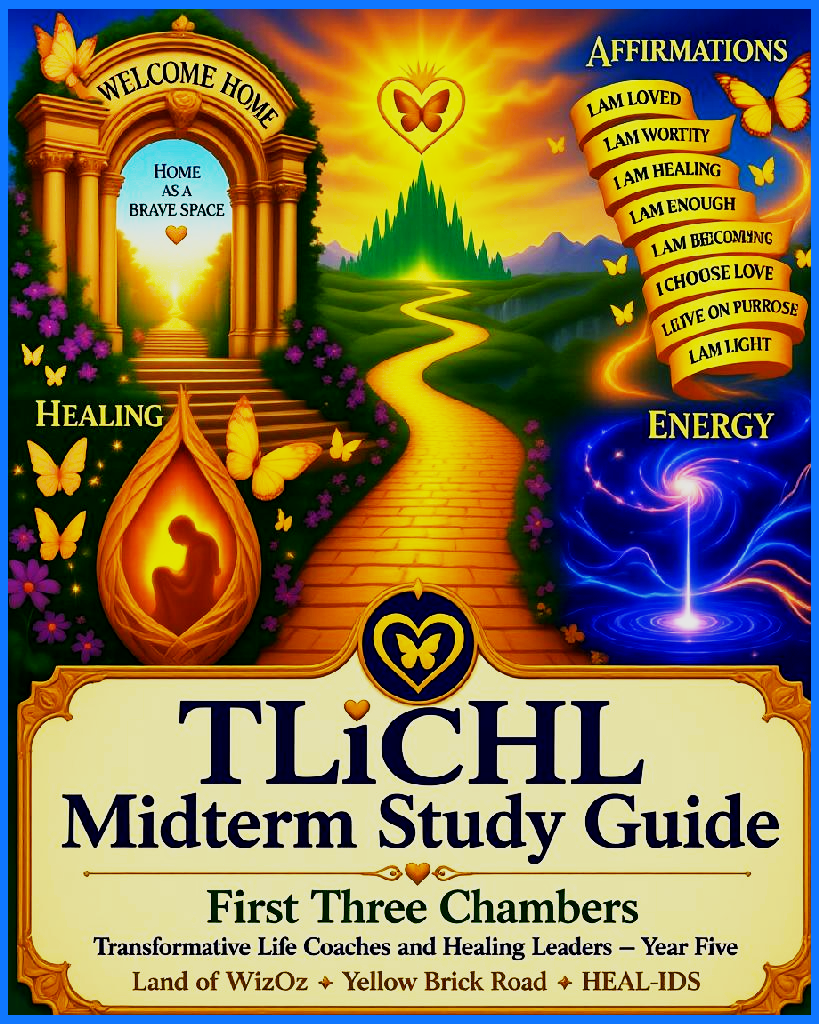
Navigating the Yellow Brick Road in the Land of WizOz
The Midterm will cover the Introduction and Chambers of Healing, Energy, and Affirmations
| A structured review of the foundations, frameworks, ethics, metaphors, and practices covered before the midterm examination. |
How to Use This Study Guide
This guide follows the architecture and language of the TLiCHL journey. Study for understanding, comparison, and ethical application – not only memorization. The midterm includes definitions, distinctions, framework sequences, and short scenarios asking which response best protects dignity, agency, truth, consent, and scope.
| LOVE MORE ASSESSMENT PRINCIPLE: This midterm measures content retention and application at a particular moment. It does not measure a Journeyer’s worth, healing, spiritual maturity, or capacity for transformation. |
Core Language to Carry Across Every Section
• People are the medicine, not the patients.
• No Shade on Survival.
• Ethics is the atmosphere.
• The Journeyer remains the primary decision-maker and interpreter of their truth.
• The Yellow Brick Road is traveled one meaningful brick at a time.
• Love More does not mean tolerating more harm.
• Healing is a continuing journey, not a rank or a finished human status.
• Metaphor is an invitation, not a diagnosis.
• The goal is increased choice, not emotional perfection.
WELCOME HOME
Introduction to TLiCHL, the Land of WizOz, and the Seven Chambers of Transformation
LOVE MORE ANCHOR
The journey does not begin when someone gives us a map. It begins when we decide that survival will no longer be the only country we are willing to inhabit.
What Is TLiCHL?
Transformative Life Coaches and Healing Leaders (TLiCHL) is a Love More approach to personal healing, focused on identifying and birthing gifts, practicing forgiveness, achieving intergenerational healing, reimagining Love as a sacred modality, providing ethical coaching, developing leadership, and transforming community. It prepares Journeyers to become healing-centered presences who help people reconnect with their stories, gifts, agency, relationships, purpose, and possibilities.
| Transactional Focus | Transformative Focus |
| Completes a task or improves immediate performance | Examines how the person understands the problem and what story shapes the response |
| Moves quickly toward a solution | Explores pain, possibility, values, Identity, and who the Journeyer is becoming |
| May focus primarily on the result | Protects dignity and agency throughout the process |
The Transformative Life Coach and the Healing Leader
• A Transformative Life Coach is a Cycle-Breaker committed to Turning the Station and Changing the Channel in personal, family, and community life.
• The coach serves as a disciplined listener, ethical questioner, witness to possibility, and accountability partner – not the owner of another person’s truth.
• A Healing Leader does not require a formal title. Healing leadership creates conditions in which people and communities can breathe, speak the truth, reclaim their dignity, and imagine a future beyond injury.
• The desired outcome is stronger self-trust, healthier interdependence, and a greater capacity to engage in healing and transformation—not dependence on the coach.
What TLiCHL Is Not
• A promise that every wound will disappear.
• A shortcut through grief or a requirement to forgive on demand.
• A substitute for psychotherapy, psychiatric care, medical treatment, substance-use treatment, legal assistance, or crisis intervention.
• A platform for spiritual superiority, toxic positivity, manipulation, or controlling another person.
• A belief that people suffer because they failed to think, affirm, or vibrate positively enough.
From Trauma-Informed to Healing-and-Transformation-Informed
TLiCHL respects the question, “What happened?” and expands it. Healing-and-transformation-informed practice also asks: How did you adapt? What did survival protect? What gifts remained alive? What stories became attached to the injury? What relationships or community conditions support healing? What future is now possible? The wound is honored without becoming the whole identity.
People Are the Medicine, Not the Patients
This principle does not reject clinicians, medicine, treatment, or appropriate services. It rejects reducing people to diagnoses, deficits, cases, or problems. Journeyers carry wisdom, culture, memory, relationships, gifts, survival intelligence, and the capacity to participate in their own healing. Professional and community supports become part of the medicine when they honor this humanity.
Role Clarity
| Role | Primary Contribution |
| Transformative Life Coaching | Reflection, agency, values, goals, narrative change, accountability, and future-oriented action; does not diagnose or treat mental illness. |
| Psychotherapy or Clinical Counseling | Assessment and treatment of mental-health conditions, trauma-related symptoms, and psychological distress within licensure and competence. |
| Mentoring | Experience, guidance, modeling, networks, and encouragement. |
| Spiritual or Pastoral Care | Faith, meaning, ritual, spiritual struggle, and religious community within the caregiver’s tradition and competence. |
| Peer Support | Mutuality and lived experience to strengthen hope, connection, self-determination, and recovery. |
Ethics Is the Atmosphere
Ethics surrounds every conversation, simulation, assessment, community project, and relationship. Knowledge without ethics can become manipulation. Influence without integrity can become control. Service without boundaries can become harmful.
| Ethical Principle | Love More Practice |
| Dignity | See the whole person. Do not reduce a Journeyer to a wound, diagnosis, charge, mistake, score, or crisis. |
| Autonomy and Consent | Explain the process, ask permission, respect the right to pause or decline, and avoid coercion. |
| Confidentiality | Protect private information and clearly explain legal, safety, or organizational limits. |
| Boundaries | Maintain clear roles, expectations, time limits, financial agreements, and relational boundaries. |
| Scope and Referral | Do not diagnose, treat, or promise outcomes beyond training. Consult, refer, and collaborate when needed. |
| Cultural Humility | Remain curious about culture, Identity, faith, history, power, and context. |
| Competence | Practice within training, prepare carefully, seek consultation, and continue education. |
| Accountability and Repair | Receive feedback, document responsibly, correct errors, address harm, and follow applicable law and policy. |
The TLiCHL Pause
• Do I have consent?
• Am I within my role and competence?
• Is there an immediate safety concern?
• Am I listening, or am I trying to rescue?
• Is my own story entering the room?
• What consultation, support, or referral may be needed?
• What response best protects dignity, agency, and well-being?
Land of WizOz: Metaphor Without Labeling
The Land of WizOz is an original Love More simulation populated by Journeyers, guardians, Elders, shadow figures, and reimagined cultural or mythical characters. Characters make complex patterns visible from a safe distance. Facilitators do not tell someone, “You are the Grinch” or “You are Medusa.” Instead, they ask what part of the story feels familiar, what the metaphor reveals, and what does not fit.
| Character or Symbol | Primary Introduction-Level Meaning |
| Manifest | The desire to become; inner potential seeking form; movement from performance toward alignment. |
| Hope | Grounded possibility, emotional wisdom, compassion, and trust before the full road is visible. |
| The Grinch | A wounded heart whose pain hardened into protective armor. |
| Wizzo | Illusion, external validation, false power, and the promise of transformation without inner work. |
| The Pied Piper | Influence, sound, charisma, and energy used without transparency or consent. |
| Medusa | Internalized pain, protective rage, distorted power, narrative, and reclamation. |
| Rudolph and Hermey | Difference, rejection, belonging, self-acceptance, and hidden gifts. |
| Shamu | Captivity, historical trauma, distorted Identity, and reclaiming true nature. |
| Butterfly | Metamorphosis, becoming, and outward ripple. |
| Caterpillar | The sacredness of beginning; potential before visible transformation. |
| Phoenix | Renewal, rising after devastation, and beginning again. |
Yellow Brick Road and Home B.A.S.E.
• The Yellow Brick Road symbolizes choices, truths, relationships, boundaries, repairs, practices, and acts of courage that enable transformation.
• The coach does not pull the Journeyer down the road; instead, the coach walks alongside as the Journeyer chooses the next aligned brick.
• Home B.A.S.E. stands for Brave, Affirming, Secure, Environment – a physical, relational, virtual, communal, or internal place where truth, accountability, belonging, healing, and transformation can be practiced.
• Bravery does not mean pressure to disclose. It means meaningful choice, loving challenge, dignity, and the right to pause or decline.
HEAL-IDS and F.E.V.E.R.S.
| Framework | Meaning |
| HEAL-IDS | Healing, Energy, Affirmations, Love, Identity, Dreams, and Success. The chambers are interconnected, circular, seasonal, and layered rather than a rigid staircase. |
| F.E.V.E.R.S. | Frequency of Loving More, Energy of Joy, Vibration of Hope, Elevation of Peace, Reflection of Divine Purpose, and Scope of Forgiveness. These are directions to return to, not performances to maintain. |
Healing Scale and Graduation
• The Community’s Scale for Healing Possibilities is a structured listening and conversation tool – not a diagnosis, clinical test, grade, rank, or declaration that someone is healed or unhealed.
• Numbers may point toward a story, but they must never replace the Journeyer’s interpretation, context, supports, barriers, or voice.
• Graduation marks completed coursework and ethical preparation, not the end of healing.
• Butterfly consciousness represents metamorphosis and new form; Phoenix consciousness represents rising, renewal, and beginning again after fire.
• A graduate is called to continue learning, stay within scope, protect confidentiality and boundaries, accept accountability, and serve with humility.
Introduction Mastery Checklist
| I can explain… | I can explain… |
| □ What makes TLiCHL transformative rather than transactional | □ The Yellow Brick Road and the next brick |
| □ Why people are the medicine, not the patients | □ Home B.A.S.E. |
| □ The difference among coaching, therapy, mentoring, spiritual care, and peer support | □ All seven HEAL-IDS chambers |
| □ All eight ethical principles | □ All six F.E.V.E.R.S. qualities |
| □ The purpose of the TLiCHL Pause | □ Ethical use of the Healing Scale |
| □ Why WizOz characters are mirrors rather than diagnoses | □ Butterfly and Phoenix consciousness |
CHAMBER 1: HEALING
No Shade on Survival: Moving From Trauma Response to Healing Response
LOVE MORE ANCHOR
Survival brought me here. Healing will help me become.
The TLiCHL Definition of Healing
Healing is an intentional, ongoing movement toward Love, Joy, Hope, Peace, Purpose, Forgiveness, greater wholeness, truth, connection, agency, liberation, regulation, meaning, and the capacity to choose one’s response. It may encompass emotional, psychological, relational, spiritual, physical, ancestral, cultural, and community dimensions. No single practice or timeline defines healing for everyone.
LOVE MORE LANGUAGE
Within Love More, we do not divide people into the healed and the unhealed. We speak of people as healing. No one is more healed than another, and needing support does not mean healing has failed.
Healing Is Not the Same as Being Unhurt
| Healing Is Not | Healing May Look Like |
| Forgetting, denying, excusing harm, or performing happiness | Naming what happened without accepting shame for it |
| Forced forgiveness or automatic reconciliation | Defining one’s own Scope of Forgiveness and maintaining necessary boundaries |
| Returning to danger or remaining silent to protect others’ comfort | Choosing distance, safety, support, or accountability |
| Never feeling grief, anger, fear, or pain again | Remembering without being required to relive the experience in the same way each time |
| Handling everything alone | Asking for and receiving appropriate help |
| Becoming responsible for healing everyone else | Participating in one’s own healing while honoring scope and mutuality |
No Shade on Survival
Survival is evidence that something within a person remained committed to life, protection, adaptation, dignity, or continuity. Fighting, fleeing, freezing, pleasing, numbing, isolating, controlling, overworking, caregiving, joking, distrusting, refusing help, remaining silent, or becoming highly successful may all have served a protective purpose. The healing-centered question is not “What is wrong with you?” but “What did this response do for you when you needed it?”
Resilience: A Bridge to Joy, Not the Destination
• Resilience can help a Journeyer take the next breath or step and remain connected to possibility.
• Resilience must never become a character grade, proof of healing, or a comparison between Journeyers.
• Visible functioning can reflect healing, but it can also reflect concealed pain, suppressed needs, or the performance of strength.
• Visible struggle is not evidence of weakness. It may reflect a large burden, insufficient support, or the decision to stop hiding pain.
• If resilience were the destination, trauma would remain at the center: the goal would be to endure the next crisis more efficiently.
• Love More honors resilience without worshiping it, strengthens it without confusing it with wholeness, and keeps traveling toward joy, peace, rest, reciprocity, purpose, and transformed conditions.
Survival Resilience and Healing Resilience
| Survival Resilience | Healing Resilience |
| Central question: How do I make it through? | Central question: How do I live, Love, and become after what I survived? |
| Endures, adapts, protects, remains functional, and responds rapidly to difficult conditions. | Integrates what happened, restores choice, seeks support, reconnects with gifts, and builds life beyond the emergency. |
| May preserve life in conditions with limited options. | Expands survival capacity into connection, agency, meaning, and transformation. |
| Can become exhausting when body and relationships continue acting as if the emergency is still present. | Helps the Journeyer become available to life, not only skilled at staying alive. |
From Protection to Possibility
| Survival Strategy | Protective Wisdom | Possible Healing Evolution |
| Hypervigilance | Notices possible danger quickly | Discernment, grounding, and realistic safety assessment |
| Emotional shutdown | Reduces immediate overwhelm | Paced emotional awareness and supportive expression |
| People-pleasing | May reduce conflict or rejection | Consent, authentic choice, and respectful negotiation |
| Hyperindependence | Protects from betrayal or disappointment | Healthy interdependence |
| Anger or aggression | Creates distance and signals a crossed boundary | Assertiveness, protection, accountability, and repair |
| Overachievement | Creates security, recognition, or control | Purposeful effort, rest, and worth beyond performance |
| Caretaking everyone | Preserves connection or prevents crisis | Mutual care and sustainable service |
| Avoidance | Provides temporary distance from pain | Safe, gradual engagement with appropriate support |
The Seven Movements of a Healing Response
1. Establish Enough Safety – create meaningful choice and support before deep reflection.
2. Notice Without Judgment – observe body, emotion, thought, and changes in energy.
3. Name the Experience – describe what is happening without turning it into permanent Identity.
4. Honor the Protective Intention – ask what the response was trying to protect and what gift it may contain.
5. Regulate or Co-Regulate – use practices and relationships that fit the Journeyer; do not prescribe one universal method.
6. Choose the Next Brick – identify one possible, supported action, boundary, conversation, or referral.
7. Integrate, Reflect, and Repair – learn from the moment, examine impact, and identify needed repair.
| HEALING RESPONSE PRINCIPLE: A healing response is not always calm, graceful, or immediately forgiving. The goal is increased choice, not emotional perfection. |
The Transformation and Healing Continuum
| Movement | Core Meaning | Guiding Focus |
| Atone | Return toward alignment through truth, responsibility, and possible repair without unnecessary shame. | What truth must I acknowledge? |
| Forgive | Examine release without automatically restoring trust, access, reconciliation, or removing consequences. | What might I release, and what must remain accountable? |
| Heal | Develop a new relationship with the wound so it no longer holds unquestioned authority. | What does the wounded part need for dignity, care, voice, and choice? |
| Grow | Develop new skills, insights, boundaries, relationships, habits, and possibilities. | What capacity is developing? |
| Thrive | Build a life that contains more than managing pain and crisis. | What becomes possible when survival does not lead every decision? |
| Love | Use Love as a way of seeing, choosing, protecting, correcting, serving, and becoming. | What would Love do if it included dignity, truth, justice, boundaries, and care? |
| Transform | Become more than a reaction to the past and create change in self, relationships, systems, and generations. | What is being born through me? |
Remember: the continuum is a map of possibilities, not a mandate, hierarchy, timetable, or measure of human worth.
Healing Efficacy
Healing efficacy is the developing belief that healing is possible and that the Journeyer can meaningfully participate in the process, use appropriate support, make choices, and return after setbacks. It is not radical self-sufficiency.
| Pathway | How It Strengthens Healing Efficacy |
| Experiences of Healing | Small successful actions become evidence: one boundary, call, grounding practice, difficult conversation, or return after a setback. |
| Witnessing Healing Possibilities | Seeing others heal can become permission to imagine, not pressure to copy their journey. |
| Affirming Relationships | Specific, truthful encouragement helps the Journeyer recognize actions and capacity. |
| Understanding the Body With Compassion | Interpret bodily responses as communication rather than weakness or betrayal. |
Healing Scale and Ethical Practice
• Explain purpose, voluntariness, confidentiality and its limits, data use, non-diagnostic status, emotional possibilities, and available support.
• Do not use scores to declare high or low healing, readiness, worth, stability, or coaching suitability.
• Ask the Journeyer what their responses mean rather than assuming meaning from a number.
• When a concern exceeds coaching scope, pause, consult, refer, and clarify what appropriate coaching support may remain.
• Referral is not rejection. It is an act of care, protection, and respect.
The Grinch as a Healing Archetype
The Grinch represents the pattern in which pain becomes protection, protection becomes personality, and personality becomes a prison. Visible behaviors may include isolation, cynicism, anger, contempt for joy, or resistance to connection. Beneath the armor may live sensitivity, observation, creativity, determination, and a desire for belonging. The coach does not rip away the armor; the coach helps the Journeyer understand what it protected, what it cost, and whether a new response can become safe.
Healing Mastery Checklist
| I can explain… | I can explain… |
| □ Why Love More says people are healing rather than healed | □ The seven movements of the Transformation and Healing Continuum |
| □ What No Shade on Survival means | □ Atonement versus shame |
| □ Why resilience is a bridge rather than the destination | □ Forgiveness versus reconciliation and restored access |
| □ Why resilience is not a character grade | □ Healing efficacy and its four pathways |
| □ Survival resilience versus healing resilience | □ Ethical use of the Healing Scale |
| □ The seven movements of a healing response | □ When and how referral protects the Journeyer |
CHAMBER 2: ENERGY: Energy Over Form: Becoming the Butterfly Effect
LOVE MORE ANCHOR
The body is the instrument, Spirit is the music, attention is the current, intention chooses the direction, action becomes the wingbeat, and Love determines what we leave in the air.
What Do We Mean by Energy?
Energy means different things in different conversations. A trustworthy Healing Leader clarifies which meaning is intended.
| Lens | Meaning | Ethical Caution |
| Physical | Measurable capacity to produce change or perform work | Do not treat physics terms as automatic proof of spiritual claims. |
| Physiological | The body’s available capacity and activation | Low energy is not a moral failure; persistent changes may need medical attention. |
| Emotional | The felt intensity and movement of emotion | Emotions are information, not evidence of spiritual worth. |
| Relational | The atmosphere co-created between people | Observe and ask rather than mind-read. |
| Environmental | The effects of surroundings, policies, and systems | Do not make individuals solely responsible for harmful environments. |
| Spiritual | Life force, consciousness, sacred presence, spirit, or connection beyond visible form | Offer as belief and reflection, not diagnosis or coercion. |
| Metaphorical | Language for patterns, influence, and impact | Clarify that metaphor is not a clinical or scientific measurement. |
Energy Is Not a Character Grade
• Grief, fatigue, anger, stillness, excitement, numbness, and high activation may all carry information.
• A calm person may be regulated or emotionally shut down. An energetic person may be joyful, frightened, angry, or overstimulated.
• High activation is not automatically healing. Stillness is not automatically peace. Fatigue is not laziness, and anger is not spiritual failure.
• The useful questions are: What am I noticing? What may it be communicating? What is influencing it? What does it need? What effect is it having? What choices are available?
The Body as a Living Machine or Instrument
TLiCHL presents the body-as-machine premise as a spiritual and philosophical contemplation: the body may be understood as the living instrument through which spirit or consciousness experiences the physical world. This is an invitation, not a required scientific conclusion or a belief test. Caring for the body becomes sacred stewardship: rest is maintenance, medical care is responsible stewardship, boundaries protect the instrument, and breath connects the inner and outer worlds.
Energy Over Form
• Human worth extends beyond appearance, title, possessions, age, body type, race, gender, ability, or social position.
• The body still matters and deserves care, respect, protection, and celebration.
• Saying “we are all energy” must never erase racism, sexism, colorism, ableism, ageism, transphobia, economic inequality, religious discrimination, or unequal treatment.
• Love More holds two truths: we share sacred humanity beyond form, and embodied differences shape how people are treated in the physical world.
Room Reading Without Mind Reading
Observe – What did you actually see, hear, or notice?
Sense – What happened in your body, emotion, or attention?
Interpret – What meaning did you attach to the experience?
Question – What else might be possible?
Ask – Is there a respectful way to check the interpretation?
Choose – What response protects dignity, boundaries, and purpose?
ENERGY AWARENESS PRINCIPLE
Intuition becomes wiser when it meets observation, curiosity, and respectful inquiry.
Metamorphosis and the Butterfly Effect
| Metamorphosis | Butterfly Effect |
| Inner change of the organism | Outward ripple of movement |
| Focuses on becoming | Focuses on influence |
| The cocoon represents inner engineering | The wingbeat represents an initiating action |
| Asks, “Who am I becoming?” | Asks, “What am I making more possible?” |
| Begins within the Journeyer | Moves through relationships and systems |
The butterfly effect comes from chaos theory and sensitivity to initial conditions in complex nonlinear systems. Love More uses it as a healing metaphor: a small aligned action may participate in a larger ripple. Journeyers are responsible for the integrity of the wingbeat, not for controlling the entire weather system.
Manifestation: Bringing Energy Into Form
LOVE MORE MANIFESTATION EQUATION
Affirming infinite possibilities through intention + imagination + emotional and values alignment + embodied action + affirmation, support, and resources + feedback and adaptation = a manifestation practice. It does not equal a guaranteed result.
Thoughts may influence attention, interpretation, behavior, persistence, planning, and relationships, but they do not control every condition.
TLiCHL never teaches that people attract abuse, illness, incarceration, poverty, grief, oppression, or injustice through a wrong vibration.
Manifestation means participating in possibility, not magically controlling reality.
The next brick may be one phone call, one application, one hour of rest, one paragraph, one boundary, one request, or one courageous conversation.
The Conservation of Energy
Core statement: “Why would I sacrifice the present for a future that I do not believe in?”
Reading Meaning
What the statement means: This is not simply laziness. It can be logic shaped by pain, disappointment, limited opportunity, and survival.
A Love More reading: When the future feels unbelievable, energy remains with the present moment, immediate needs, comfort, protection, status, and survival.
What healing requires: Do not shame the person for protecting the present. Help build a future that feels real, reachable, supported, and worth preparing for.
Transformational task: Make hope believable enough that energy can move toward purpose.
The Body Is Communicating, Not Betraying Us
A body responding to an old danger is not necessarily broken. It may be using earlier-developed patterns to protect the person. The healing questions are: What is the body communicating? What is happening now? What support can restore choice? Energetic language does not replace medical or clinical understanding, and persistent or concerning symptoms may require appropriate care.
Energy Ethics and the Pied Piper Test
Do not diagnose energy, auras, vibrations, dishonesty, illness, or healing resistance.
Do not confuse intuition with certainty. Offer impressions as questions and obtain permission.
Ask consent before meditation, music, breath practices, visualization, prayer, movement, touch, or cultural ritual.
Do not force positivity or blame the Journeyer for harm, oppression, illness, or tragedy.
Respect spiritual diversity and protect scope of practice.
Manage the coach’s fatigue, reactivity, bias, approval needs, rescue impulses, boundaries, and consultation.
A practice is not a Brave Space if the Journeyer cannot freely pause, question, refuse, or stop following the music.
Energy Mastery Checklist
| I can explain… | I can explain… |
| □ The seven meanings or lenses of energy | □ Responsibility without omnipotence |
| □ Why energy is not a character grade | □ The Love More manifestation equation |
| □ The body-as-machine premise as an invitation | □ Why manifestation is not magical control |
| □ Energy Over Form without erasing embodied inequality | □ The Conservation of Energy statement |
| □ Room Reading Without Mind Reading | □ The body as communication rather than betrayal |
| □ Metamorphosis versus the butterfly effect | □ The purpose of the Pied Piper Test |
CHAMBER 3: AFFIRMATIONS: The Language of Becoming: Creating Affirmations to Birth Our Gifts
LOVE MORE ANCHOR
An affirmation is not a lie we repeat until it sounds true. It is a truth we practice until our lives have room to embody it.
The Love More Definition of Affirmation
An affirmation is a truthful, intentional statement that restores dignity, recognizes gifts, strengthens agency, reflects values, creates possibilities, and supports aligned action. It may name who I am, what I value, what I am learning, what I am releasing, what I am protecting, what I am choosing, what I am becoming, what support I deserve, what gift I am developing, or what action I am willing to take.
Affirmations Are Not Magic, Denial, or a Measure of Healing
Affirmations may influence attention, meaning, self-talk, decisions, relationships, and behavior, but they do not automatically remove danger, end oppression, cure illness, create money, restore a relationship, erase consequences, or guarantee success.
A truthful affirmation does not contradict observable reality. If a Journeyer is unsafe, the statement should support recognizing safety needs and seeking protection, not declare the person completely safe.
No Journeyer is more healing, worthy, or evolved simply because they speak affirmations fluently.
When a statement feels unbelievable, the coach explores the discomfort and helps create language that is true enough to enter. The coach increases curiosity, not volume. TLiCHL does not use “healed” to rank people. The coach and the Journeyer have different responsibilities but share an ongoing human journey of healing and transformation.
Affirmations and Related Practices
| Practice | Primary Function | Example |
| Affirmation | Supports truth, dignity, values, agency, or becoming | My voice deserves room, and I can use it with clarity. |
| Bridge Affirmation | Connects present experience to an emerging possibility | I am learning that receiving support does not make me weak. |
| Intention | Names a quality or direction to carry | Today, I intend to listen without rescuing. |
| Goal | Defines an observable outcome | I will complete the application by Friday. |
| Mantra | Repeated phrase used for focus or spiritual practice | Love over fear. |
| Prayer | Communicates with or opens toward the Divine | Guide me toward truth, courage, and peace. |
| Declaration | Announces a commitment | I will no longer remain silent when my boundary is crossed. |
| Reframe | Develops a more complete interpretation | Needing support does not mean I am incapable. |
| Compliment | Positive feedback from another person | You showed courage in that conversation. |
| Affirmation Question | Opens curiosity when declaration feels inaccessible | What if my voice is worthy of being heard? |
Words, Labels, and the Inner Narrator
Some words came from family, schools, neighborhoods, institutions, faith communities, the media, relationships, systems, or earlier versions of self. Some labels helped people survive; others diminished them or became internal voices that persisted after the original speaker was gone.
Precise language separates behavior from identity: “You made a harmful choice” is different from “You are a harmful person.” Totalizing labels can trap a person in a moment; precise language creates room for accountability and change. The inner narrator may sound personal even when the words originate elsewhere.
No Shade on the Old Story and Word Archaeology
An old story may have protected the Journeyer. “I do not need anyone” may have shielded against disappointment. “I have to be strong” may have helped a family survive. “I must remain quiet” may have safeguarded safety. TLiCHL asks when the story began, what it protected, what it made possible, what it costs now, whether the original danger remains, and what language can honor the gift without remaining imprisoned by fear.
WORD ARCHAEOLOGY INSIGHT
Sometimes the first movement is recognizing: “This voice is familiar, but it may not be mine.”
The TLiCHL COCOON: Create Affirmations to Birth Our Gifts
The first letter of the TLiCHL COCOON is C: Create Affirmations to Birth Our Gifts. A gift may remain hidden because it was criticized, did not fit the environment, was associated with danger, lacked opportunity, threatened someone else, appeared in an undeveloped form, or was mistaken for a wound. The work is not to romanticize every behavior. It is to separate the gift from the way survival shaped its expression.
The Gift-Birthing Sequence
1. Recognize the Pattern – identify the behavior, reaction, label, or story that keeps appearing.
2. Honor the Protection – understand what the pattern was trying to accomplish.
3. Discover the Gift – locate the ability, value, sensitivity, strength, or wisdom beneath it.
4. Name the Gift – choose accurate, dignifying language.
5. Create the Affirmation – write a statement that helps remember and develop the gift.
6. Embody the Affirmation – give the words form through action, boundary, practice, relationship, or support.
7. Share the Medicine – consider how the developed gift may support family, community, purpose, or transformation.
T.R.U.T.H. Test
| Letter | Test | Core Question | |||
| T | Tells the Truth | Does the statement acknowledge present reality and avoid exaggeration or denial? | |||
| R | Restores Dignity | Does it separate worth from wound, mistake, label, achievement, or others’ opinions? | |||
| U | Unlocks Agency | Does it reveal a choice, capacity, boundary, resource, or next step? | |||
| T | Ties Words to Values and Action | Can it be practiced, and what behavior will give it credibility? | |||
| H | Honors Voice, Culture, and Readiness | Does the wording belong to the Journeyer and fit their language, culture, spirituality, development, and present capacity? | |||
THE T.R.U.T.H. QUESTION
Is this affirmation asking me to adopt a reality I do not believe in, or helping me practice a truth I am ready to grow into?
The Affirmation Ladder
1. Name the Current Sentence – “I am broken.”
2. Separate Identity From Experience – “I am carrying pain and disconnection.”
3. Add Compassionate Context – “My responses developed through experiences that affected me deeply.”
4. Create a Bridge – “Pain is part of my story, not the whole of who I am.”
5. Name Agency – “I can seek support and participate in healing.”
6. Embody the Statement – choose one action within reach.
7. Gather Evidence – notice what happened when the action was practiced.
8. Revise the Living Truth – update the statement as evidence and capacity grow.
Present tense is not required. TLiCHL accepts language such as: I am learning, I am willing, I am practicing, I am noticing, I am becoming, I can, I choose, I deserve, I intend, I give myself permission, and What if. The best tense protects truth while supporting movement.
Types of Affirmations
| Type | Primary Focus |
| Grounding | Orientation to the present, pause, and what is true now |
| Healing | Continuing participation in healing without performance |
| Identity | Worth, gifts, culture, ancestry, and self-definition |
| Boundary | Healthy access, choice, protection, and limits |
| Values | What matters and how it should shape practice |
| Action | A next behavior that gives words form |
| Relationship | Mutuality, listening, apology, trust, and repair |
| Joy | Permission to receive life beyond pain |
| Purpose | Gifts connected with service, sustainability, and calling |
| Community | Shared commitments that require collective evidence |
Ethics in the Chamber of Affirmations
The Journeyer owns the affirmation. The coach may ask, reflect, offer options, or help refine, but does not author another person’s truth.
Do not force positive language, gratitude, a growth story, forgiveness, or a declaration the Journeyer does not believe.
Do not use affirmations to override danger, delay safety planning, replace treatment, or encourage someone to remain in harm.
Do not promise outcomes such as wealth, a cure, restored relationships, guaranteed employment, or others’ controlled behavior.
Use precise, respectful language and honor person-first or Identity-first preferences expressed by the individual or community.
Respect culture and spirituality. Journeyers may prefer prayer, scripture, ancestral language, song, silence, poetry, a question, an action, or no spoken affirmation.
Group recitation requires consent and the right to speak, listen, write, adapt, remain silent, or pass.
Institutional affirmations are not credible without institutional behavior. “Every voice matters” cannot coexist with punishment for dissent.
Recognize when serious distress or clinical, medical, or crisis concerns require referral.
Examine whether the coach is offering language for the Journeyer or to make the coach feel effective.
Applied Example: Amara and the Label “Too Much”
Amara is prepared, direct, and committed to families not represented in the room. She is repeatedly labeled intense, difficult, aggressive, emotional, and too much. A shallow affirmation would simply tell her she is perfect or that others are intimidated. The TLiCHL response clarifies observable patterns, examines possible bias and power, honors silence as a survival strategy, identifies her gifts, co-creates a T.R.U.T.H.-aligned statement, connects that statement to action, and addresses the institution. The affirmation is not used to help Amara tolerate bias more quietly.
AMARA’S LIVING TRUTH
My voice carries wisdom and responsibility. I can speak with clarity, listen with openness, and refuse to shrink to make inequity comfortable.
Affirmations Mastery Checklist
| I can explain… | I can explain… |
| □ The Love More definition of affirmation | □ C in the TLiCHL COCOON |
| □ Why affirmations are not magic, denial, or measures of healing | □ The seven-step Gift-Birthing Sequence |
| □ A bridge affirmation | □ All five parts of the T.R.U.T.H. Test |
| □ Affirmation versus intention, goal, mantra, prayer, declaration, reframe, and compliment | □ All eight steps of the Affirmation Ladder |
| □ Behavior versus Identity | □ Why present tense is not required |
| □ The inner narrator | □ The ten types of affirmations |
| □ No Shade on the Old Story | □ The Affirmation Ethics Pause |
| □ Word Archaeology | □ How Amara’s case integrates personal and structural change |
Twenty Questions to Answer Without Looking
- What makes a coaching conversation transformative?
- Why is ethics described as the atmosphere?
- What does “People are the medicine, not the patients protect” mean?
- How should a facilitator use a WizOz character ethically?
- What does the Yellow Brick Road represent?
- What is the difference between Home B.A.S.E. and a space where no one is challenged?
- Why does Love More avoid ranking people as healed or unhealed?
- What does No Shade on Survival mean in practice?
- Why can visible functioning fail to prove healing?
- How do survival resilience and healing resilience differ?
- Why is the Transformation and Healing Continuum a map rather than a mandate?
- What strengthens healing efficacy?
- Why must the word energy be clarified?
- How can Energy Over Form support dignity without erasing inequality?
- How do metamorphosis and the butterfly effect differ?
- What makes manifestation ethical and reality-based?
- What does the Conservation of Energy statement reveal about motivation and hope?
- What makes an affirmation a living truth rather than positive denial?
- How does the T.R.U.T.H. Test protect the Journeyer?
- What should a coach do when an affirmation does not yet feel believable?
Final Readiness Check
I know the Love More Pillars: Leaders Affirmation, Prayer, Cocoon, Brave Space, Ten Commandments, Treasure Hunters, Brave Space Community Agreements, Symbolism connected to Logo
I can define the central concepts in my own words without losing Love More meaning.
I can compare commonly confused concepts and explain the ethical difference.
I can recall each required framework in order.
I can recognize when a response protects dignity and agency and when it becomes coercive, blaming, rescuing, or outside scope.
I can apply the content to a short coaching, family, organizational, or community scenario.
I understand that the examination is one learning checkpoint, not a judgment of my worth or healing.
CLOSING STUDY REMINDER
Do not study only to remember information. Study to recognize what each ethical principle protects, what each metaphor reveals, and what each chamber invites you to practice.

