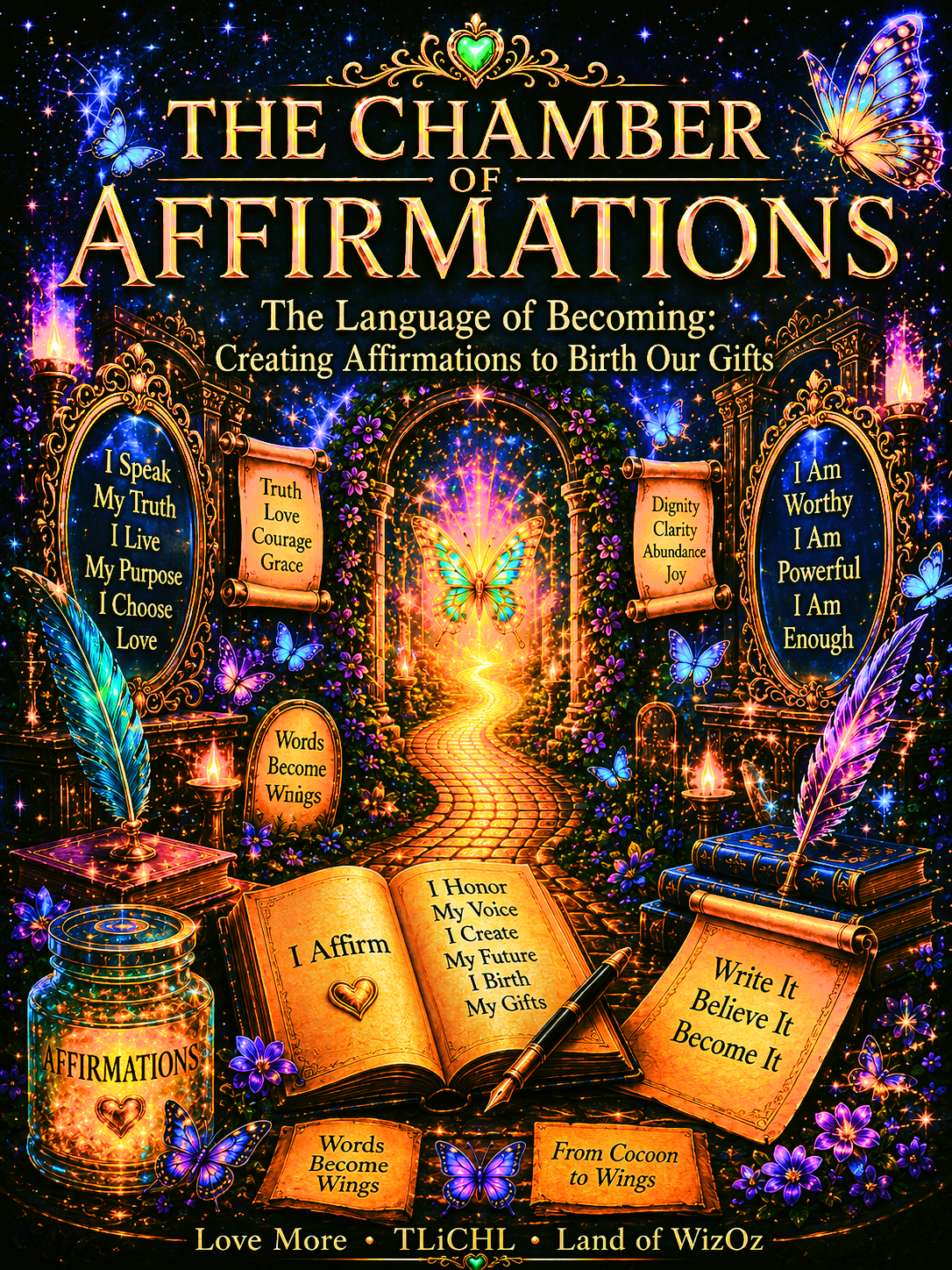
The Language of Becoming: Creating Affirmations to Birth Our Gifts
Transformative Life Coaches and Healing Leaders Certification, Monday, Aug 24, 6- 8 p.m. on the Healing Station Zoom: https://us02web.zoom.us/meeting/register/tZwude2tqz0pG9xJ6zFgGt58RxiHKEVI2PDr
My Words Become Wings by Dr. Bruce Purnell
My adopted names have had their say,
But they never changed the way I pray.
I honor truths my wounds have taught,
Yet choose the life my gifts have sought.
No label, nickname, or disguise
I affirm the bridge for my phoenix to rise.
I speak, I practice, step by step,
And birth the wings my silence kept.
My words find form in what I do,
Each yellow brick makes pathways new.
My Butterfly Dreams, My Butterfly Sings
I Affirm and Manifest, My Butterfly Wings.
Join us as we enter THE CHAMBER OF AFFIRMATIONS: The Language of Becoming: Creating Affirmations to Birth Our Gifts
Some words were spoken over us before we were old enough to decide whether they were true. Some became labels, some expectations, and some an inner voice that kept speaking long after the original speaker was gone. In Chamber 3, Affirmations: On Monday, TLiCHL Year Five enters Chamber 3: Affirmations – The Language of Becoming: Creating Affirmations to Birth Our Gifts. This session is not about masking pain with positive words. The Affirmation Chamber invites us to examine the language that organizes our lives and to create affirmations that are truthful enough to enter, strong enough to guide, and grounded enough to practice.
Together, we will explore:
• The difference between affirmation and denial
• The labels and inherited narratives that shape the inner narrator
• Why an old story may deserve understanding before it can evolve
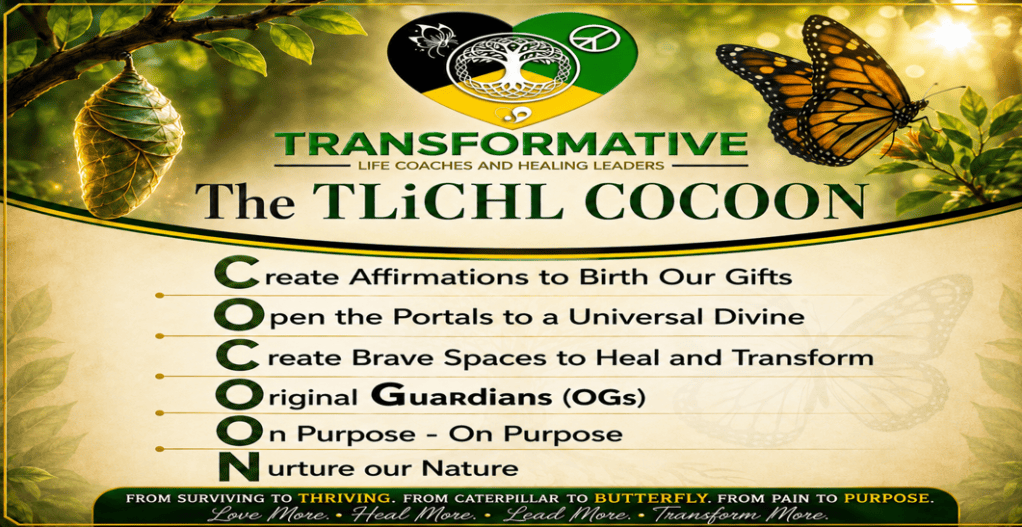
• The TLiCHL COCOON principle: Create Affirmations to Birth Our Gifts
• The T.R.U.T.H. Test for healing-centered affirmations
• Bridge affirmations for statements that feel too distant
• The Affirmation Ladder from old sentence to embodied living truth
• Ethics, consent, cultural humility, and the Journeyer’s ownership of language
Words Become Wings: Why Affirmations Must Be True Enough to Live
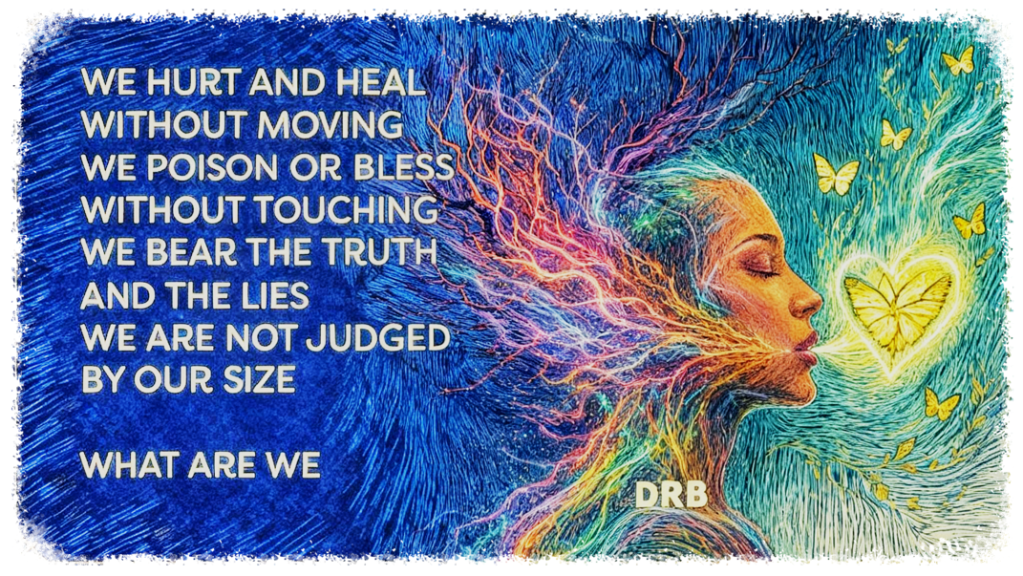
Some words enter our lives as descriptions and quietly become destinations. A child is called difficult, lazy, too sensitive, aggressive, strange, gifted, strong, or responsible. A person is reduced to a diagnosis, a charge, a mistake, a crisis, a case, or the worst thing that ever happened to them. A moment becomes a label, and the label becomes an inner narrator. After enough repetition, we may stop remembering that the sentence came from somewhere, and begin speaking it in our own voice.
The Chamber of Affirmations poses a deceptively simple question about the words we use to organize our lives, relationships, possibilities, and future. Within the Love More Movement, an affirmation is not a lie we repeat until it sounds true, but a truth we practice until our lives have room to embody it. That distinction is essential because many people have been taught that affirmation means covering difficult realities with positive language. Grief becomes “I am happy,” fear becomes “I am completely safe,” discrimination becomes “Nothing outside me can affect me,” and exhaustion becomes “I have unlimited energy.”
These statements may sound powerful, but they can become another form of pressure, asking the Journeyer to perform a reality their body, circumstances, or spirit cannot yet inhabit. Love More begins in a much more authentic place. An affirmation may say: I am learning, willing, practicing, choosing, and deserving support. I do not have to respond from the first emotion that arrives, and although what happened affected me, it does not own every possibility. These statements do not deny the wound, but they keep the wound from becoming the only author.
This is why we use bridge affirmations. A bridge does not pretend the gap is absent; instead, it provides a trustworthy way across. A Journeyer who cannot yet say “I am worthy” may be able to say, “I am willing to consider that my worth may be greater than what happened to me.” A person who has survived betrayal may not be ready to say, “I trust people,” but may be ready to say, “I can develop discernment and allow trust to be earned gradually.” The bridge preserves truth while making movement possible.
The first C in the TLiCHL COCOON calls us to Create Affirmations to Birth Our Gifts. A gift may be buried beneath the very label meant to diminish us. The person labeled too sensitive may carry empathy and emotional insight. The person labeled argumentative may carry courage, critical thinking, and a commitment to justice. The person labeled controlling may carry organization, foresight, and an unmet need for safety. The work is not to romanticize every behavior, because harm still requires accountability. The work is to separate the gift from the armor so the gift can develop in a healthier form.
An affirmation such as “I never need to change how I communicate” may protect pride while avoiding reflection. “I must make myself smaller so people will accept me” abandons dignity. A more complete living truth may be: “My voice carries wisdom and responsibility. I can speak with clarity, listen with openness, and refuse to shrink to make inequity comfortable.” That language tells the truth, restores dignity, unlocks agency, connects words to values and action, and honors the Journeyer’s voice. These are the five movements of the T.R.U.T.H. Test.
Words become powerful when they become embodied. “My voice matters” gains form when the Journeyer prepares one point and contributes it in the meeting. “I deserve rest” gains form when time is protected on the calendar. “Love does not require unlimited access to me” gains form when a boundary is communicated and maintained. “I can receive support” gains form when one request is made. The action does not prove the Journeyer worthy, but gives the affirmation a place to live.
We must also remember that affirmations are ethical work. The coach does not own another person’s words. A group recitation cannot become a loyalty test. Spiritual language cannot override danger or silence grief. An organization cannot say “Every voice matters” while excluding lived expertise, punishing disagreement, or taking credit for ideas without acknowledgment. Collective affirmations require collective evidence.
Within Love More, we also resist the hierarchy implied by labeling some people healed and others unhealed. We are always healing, and no coach stands above the Journeyer as a finished human being. We carry different responsibilities in a coaching relationship, yet we share the same humanity and the same need for reflection, boundaries, support, accountability, and ongoing transformation. The first words spoken over us may have shaped the story, but they do not own the final chapter.
The affirmation is not the wing but language spacious enough for the wing to take shape. Practice strengthens it, community protects it, evidence deepens it, and purpose carries it. One day, the statement that once felt distant begins to show in the Journeyer’s walk, rest, speech, leadership, love, choices, and service.
Core Teaching: What Is an Affirmation?
Love More Definition
An affirmation is a truthful and intentional statement that restores dignity, recognizes gifts, strengthens agency, reflects values, opens possibility, and supports aligned action.
Affirmations May Name
• Who I am
• What I value
• What I am learning
• What I am releasing
• What I am protecting
• What I am choosing
• What I am becoming
• What support I deserve
• What gift I am developing
• What action I am willing to take
Affirmations Are Not
• Magic words that control every outcome
• A denial of danger, grief, anger, discrimination, illness, or structural barriers
• A requirement to sound confident
• A test of spiritual maturity
• A substitute for therapy, medical care, safety planning, justice, or action
• Language a coach imposes upon a Journeyer
• A promise that another person will change
• A bright sentence placed over a wound
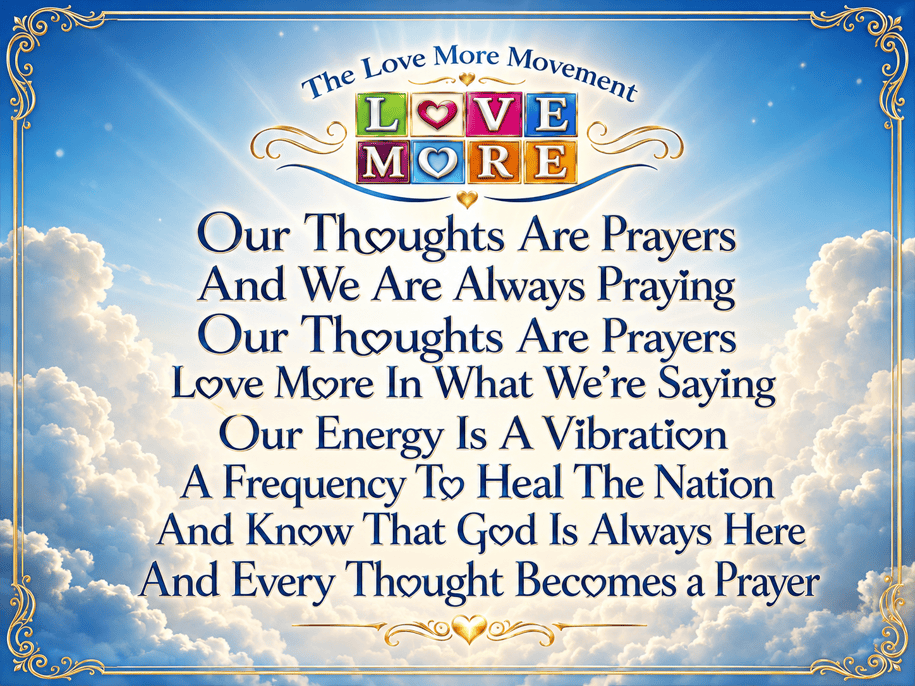
Love More uses “Our Thoughts Are Prayers” as a reflective metaphor: what we rehearse receives attention and may influence how we participate. It is not a claim that every thought controls reality.
Research and Practice Integrity
Self-affirmation research often focuses on reconnecting with important values, relationships, identities, and sources of meaning rather than on repeating exaggerated positive slogans. This broader view may help prevent a single threat or failure from defining the self. Highly positive statements can also create distance when they sharply contradict what a person currently believes. TLiCHL therefore uses bridge affirmations: language that acknowledges the present truth while creating a path toward what the Journeyer is ready to practice.
We Are Always Healing
Within Love More, we do not use “healed” as a rank or finished human status. A Journeyer may personally use that word within a faith or spiritual tradition, but TLiCHL does not divide the room into the healed and the unhealed. No coach stands above the Journeyer as the completed person.
| Living Language: I am healing. I am participating in healing. I am developing a new relationship with what happened. I am learning what supports my healing. I am walking a journey of healing and transformation. |
Labels, the Inner Narrator, and No Shade on the Old Story
External labels may become internal instructions. “Too sensitive,” “difficult,” “lazy,” “aggressive,” “not enough,” or “the strong one” can begin organizing expectation and behavior long after the original speaker is gone. An old story may have protected the Journeyer. “I do not need anyone” may have reduced disappointment; “I have to be strong” may have helped a family survive crisis, and “I must remain quiet” may have protected safety. We do not shame the sentence, but examine whether it still needs to lead.
An affirmation does not insult the story that helped us survive, but helps the story evolve.
Separating the Gift From the Armor
| Old Label or Pattern | Possible Gift | Healing Development |
| Too sensitive | Empathy, perception, emotional intelligence | Boundaries, regulation, discernment, and intentional use |
| Bossy or controlling | Leadership, organization, foresight | Shared power, delegation, listening, and trust |
| Quiet | Observation, depth, discernment | Voice, choice, and safe participation |
| Argumentative | Critical thinking, courage, justice orientation | Strategic advocacy, timing, and relational delivery |
| Takes care of everyone | Compassion, responsibility, service | Mutual care, receiving, boundaries, and sustainability |
| Overachiever | Discipline, ambition, capacity | Worth beyond performance, rest, and alignment |
The T.R.U.T.H. Test
| Element | Question | Example |
| T – Tells the Truth | Does the statement acknowledge present reality without exaggeration or denial? | I can act with courage while fear is present. |
| R – Restores Dignity | Does it separate human worth from the wound, mistake, label, or opinion of others? | My worth is larger than this outcome, and I can learn from what happened. |
| U – Unlocks Agency | Does it identify a choice, capacity, boundary, support, or next step? | I may not control the outcome, but I can choose my next aligned action. |
| T – Ties Words to Values and Action | Can the statement be practiced and supported by behavior? | My voice matters; I will prepare one point and contribute it to the meeting. |
| H – Honors Voice, Culture, and Readiness | Does the wording belong to the Journeyer and fit their language, culture, spirituality, and present capacity? | I am open to considering that receiving support can be a form of strength. |
The T.R.U.T.H. Question: Is this affirmation asking me to perform a reality I do not believe, or helping me practice a truth I am ready to grow into?

Realistic optimism doesn’t pretend the gap is absent, but helps us build a trustworthy bridge toward the future.
F.E.V.E.R.S. in the Chamber of Affirmations
| F.E.V.E.R.S. Dimension | Living Affirmation |
| Frequency of Loving More | I can tell the truth in a way that protects both dignity and accountability. |
| Energy of Joy | I am allowed to welcome joy before every problem has been solved. |
| Vibration of Hope | I cannot see the entire road, but I can remain open to the next brick. |
| Elevation of Peace | I do not have to answer from the first emotion that arrives. |
| Reflection of Divine Purpose | My gift deserves discipline, protection, and room to become medicine. |
| Scope of Forgiveness | I can release what no longer belongs in my spirit while maintaining the boundaries that protect my healing. |
F.E.V.E.R.S. affirmations are invitations, not required emotional performances. A Journeyer may also affirm: “I am not ready to define forgiveness today, and I can continue healing without forcing an answer.”
Optional Spiritual Lens: Affirmations Across the Body
Some Journeyers use chakra, prayer, ancestral, or other spiritual frameworks to connect language with the body. These may be meaningful reflective tools when offered with consent and cultural humility. They are not medical anatomy, diagnostic instruments, or requirements for participation.
Ethics in the Chamber of Affirmations
| Love More Ethical Practice | Application |
| The Journeyer Owns the Language | The coach may reflect, ask, and offer possibilities, but does not author another person’s truth. |
| No Forced Positivity | Grief, anger, doubt, exhaustion, and silence are not failures of affirmation. |
| Do Not Override Danger | Affirmations must never replace safety planning, medical care, clinical treatment, legal support, or protective action. |
| Do Not Promise Outcomes | Do not claim that words will cure illness, produce wealth, restore a relationship, or control another person. |
| Avoid Stigmatizing Labels | Describe behavior and context precisely rather than reducing a person to a diagnosis, charge, condition, or stereotype. |
| Respect Culture and Spirituality | Invite the Journeyer’s language, prayer, song, silence, poetry, ancestral expression, or other meaningful form. |
| Consent for Group Recitation | A group affirmation must never become a loyalty test. Journeyers may speak, listen, adapt, remain silent, or pass. |
| Institutional Words Require Evidence | An organization cannot affirm that every voice matters while punishing disagreement or excluding lived expertise. |
| Recognize Scope | Persistent or severe distress may require licensed clinical, medical, crisis, or other specialized support. |
| Examine Projection | The coach must notice when their discomfort, beliefs, or desire to feel effective is driving the wording. |
Affirmation Ethics Pause
Is the statement truthful enough to enter? Who created the wording? Does it preserve dignity and acknowledge context? Does it increase agency? What action or support belongs beside it? What happens if the Journeyer does not believe it yet?
Experiential Buildshops
Buildshop One: Word Archaeology
| Prompt | Journeyer Reflection |
| The repeated sentence is: | |
| The first voice or setting I associate with it is: | |
| What it taught me to expect: | |
| What it helped me survive or protect: | |
| What it may be costing me now: | |
| The gift hidden beneath it may be: | |
| What Love would say without denying the truth: |
Buildshop Two: From Label to Gift.
Choose one label or pattern. Identify the observable behavior, possible bias, protective function, hidden gift, accountability still needed, and more precise language. The goal is not to romanticize harm. The goal is to develop the gift without allowing the armor to lead.
Buildshop Three: Create a T.R.U.T.H. Affirmation
| Element | My Language |
| My current sentence: | |
| A more accurate experience statement: | |
| The compassionate context: | |
| My bridge affirmation: | |
| The value beneath it: | |
| One action within 24 hours: | |
| The support I will use: | |
| The evidence I will gather: |
Buildshop Four: Partner Witnessing
• Journeyer reads the statement only if they choose.
• Partner asks: Which word feels most like you? Which word needs revision? What action gives the statement form?
• Partner does not improve, correct, spiritualize, or claim ownership of the affirmation.
• Journeyer may accept, revise, reject, write, remain silent, or pass.
Buildshop Five: The Affirmation Jar
Objective: This exercise creates a tangible reminder of positive affirmations, helping us and those around us reimagine our lives and humanity, heal from past trauma, and cultivate a consciousness of joy. We will create an Affirmation Jar for ourselves and others, spreading positivity in our personal and professional spaces.
Materials Needed:
• A jar (any size)
• Creative materials for decorating (stickers, markers, paint, ribbons, etc.)
• Colorful paper for affirmation cards
• Pens or markers for writing affirmations
• Ready-made affirmations and personal affirmations you write for yourself and others
Directions: Incorporate Affirmations into Daily Life:
• At our workplace, ensure the entire team has an Affirmation Jar. Randomly place positive affirmations in their jars to uplift them throughout the day, and encourage team members to do the same for each other.
• In our family or friend group, share these jars as gifts. Please invite others to pick an affirmation when they need a boost or to add their positive statements to the jar.
• Use the affirmations as a daily practice. Start or end your day by drawing an affirmation from the jar, reflecting on its meaning, and allowing it to bring joy and positivity into your life.
Reflection:
• Reflect on the impact of having a tangible reminder of positivity in our daily environment.
• Notice how sharing affirmations with others enhances our connection and brings more joy into our interactions.
• Share your experience with the class, discussing how this exercise has helped you or others in your Journey to Joy (J2J).
Create Your Affirmation Jar:
• Choose a jar that will serve as our Affirmation Jar, and for others, if we are making more.
• Decorate the jar with designs, stickers, or anything that makes us feel good, unique, and loved. Make it personal and reflective of our journey.
Write and Design Affirmation Cards:
• Write several affirmation statements about yourself and others. These can be things like “I am worthy of love and joy,” “You are capable of amazing things,” or any positive statements that resonate with you.
• Include both personal affirmations you create and ready-made affirmations we find inspiring.
• Print these affirmations on colorful paper. We can design them with drawings, borders, or patterns to make them visually uplifting.
• Cut out the affirmation cards, ensuring they are small enough to fit in our jar.
Assemble the Jars:
• Place affirmation cards into our jar.
• If we’re making jars for others (friends, family, or colleagues), prepare additional jars with personalized affirmations for them.
• Consider creating a small tag or label for each jar, giving it a unique name or dedicating it to the recipient.
Create a Space for Your Jar:
• Designate a unique, creative space in our home, office, or other environment where we can place our Affirmation Jar. This space should feel calming and inspiring, and be somewhere we can visit regularly.
• Encourage others to create a similar space for their jars.
An affirmation is not a lie we repeat until it sounds true. It is a truth we practice until our lives have room to embody it.
Contact: Sonya Cooper: scooper@lovemoremovement.org
Bring your journal, your truth, and one word you are ready to examine.
Community’s Scale for Healing Possibilities: https://welovemore.typeform.com/CSHP1
Intake: https://welovemore.typeform.com/TLiCHLIntake26
Course Books: “I Have The FEVERS For Jazz: Becoming The Butterfly Effect”; The Caterpillar’s WEB for Transformation https://www.lovemoremovement.org/books
We are becoming the “Social Architects” and “Social Alchemists” who will design our healing and transformation. Let’s affirm and manifest our divine cocoons together.

