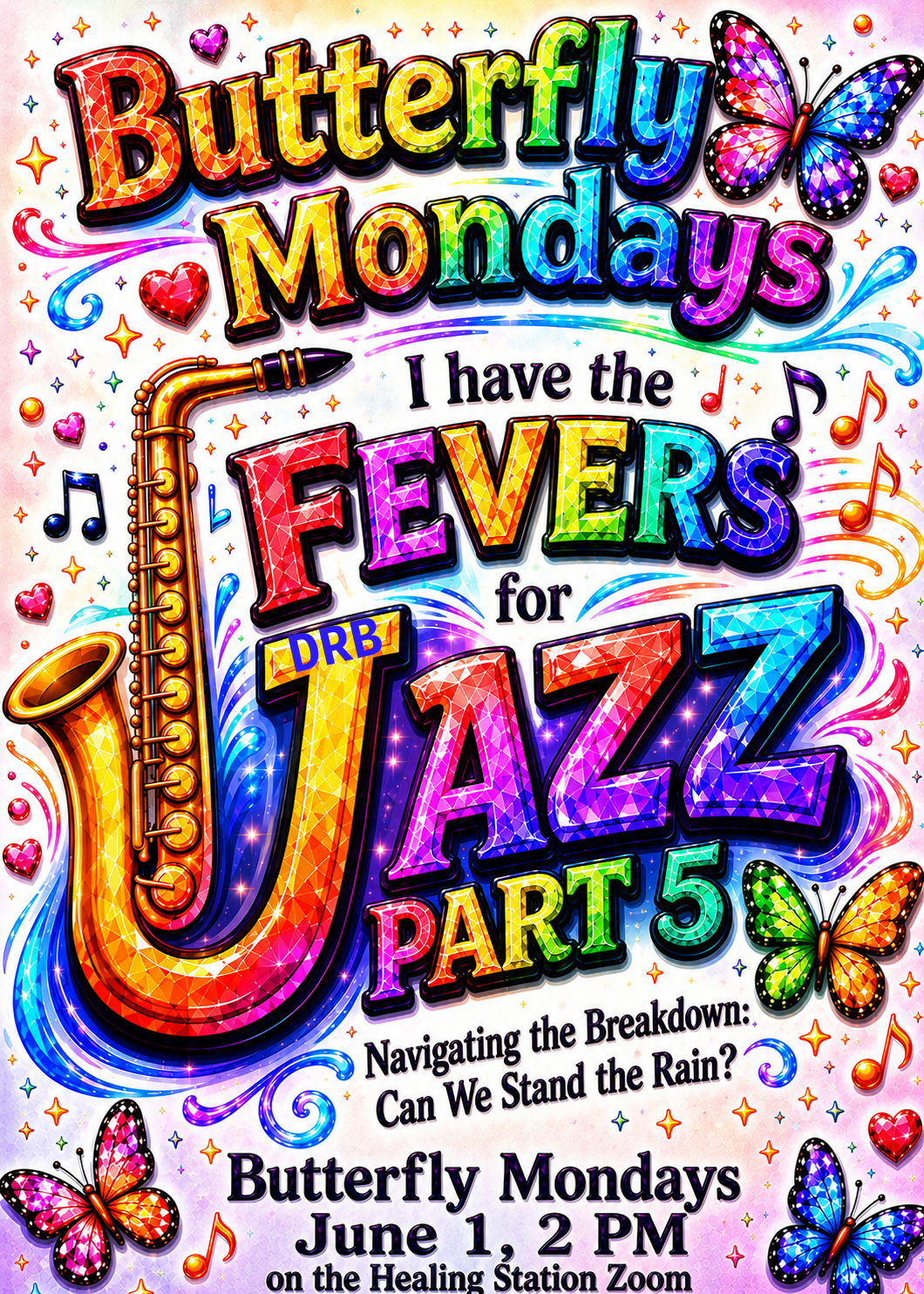
Butterfly Mondays – June 1, 2026
Healing Station Zoom: 6:00 PM EST
Join Here: https://us02web.zoom.us/j/88324556318?pwd=QlNsT3lLWnc0alo3K09nN0JoaFNxQT09
Can We Stand the Rain? By Dr. Bruce Purnell
The clouds may gather and hide the sun,
The race gets harder before it’s won.
The thunder speaks, and the winds complain,
The question remains, can we stand the rain?
Some storms arrive with tears we hide,
Some bring old wounds we keep inside.
Some shake the ground beneath our feet,
Some challenge the rhythm beneath the beat.
Yet Love still whispers through the night,
And Hope keeps searching for the light.
Peace reminds us we’re not alone,
And Purpose helps us find our sacred home.
For every storm eventually sings,
And every struggle can grow wings.
The rain may fall, but we remain,
Learning to dance while standing in the rain.
The goal is not to avoid the rain, but to remember our rhythm while standing in it
Every band eventually faces a breakdown, and the rhythm changes, the pressure rises, the uncertainty grows, and the music we carefully prepared is suddenly put to the test. The question is not whether storms will come, but “Can we stand the rain”?
This Butterfly Monday, we continue our journey through I Have the FEVERS for Jazz: Becoming the Butterfly Effect, exploring Step 3: Navigating the Breakdown.
Together, we will examine:
• How crisis reveals our default frequencies
• The difference between survival responses and transformational responses
• Fight, Flight, Freeze, and Fawn through the lens of healing
• Historical trauma, resilience, and adaptation
• How the FEVERS help us navigate life’s storms
• Why breakdowns are often invitations to breakthrough
• Because every butterfly must eventually discover whether its wings can carry it through the storm.
Join us as we learn how to navigate the rain without losing our rhythm.
There comes a moment in every healing journey when the music changes. The plan no longer works, certainty disappears, pressure rises, and emotions become louder. This is the breakdown. Most of us were taught to fear breakdowns. We associate them with failure, weakness, or losing control. But what if breakdowns are not failures? What if breakdowns are revelations? A breakdown often reveals what was already happening beneath the surface.
It exposes what we truly believe, what we trust when pressure rises, the wounds we still need to attend to, and the frequencies we default to when life becomes difficult. This is why breakdowns are so important to understand.
They show us the difference between the person we aspire to be and the person we become when we are overwhelmed. Many of us developed survival responses that helped us navigate difficult environments. Some of us learned to fight, run, disappear, and please everyone around us. None of these responses makes us broken; they actually make us human. The challenge comes when survival becomes our identity. Healing and Transformation require us to discover what happens when we learn to respond rather than react. This is where the FEVERS become essential.
• Love helps us stay connected.
• Joy helps us remain alive.
• Hope helps us keep moving.
• Peace helps regulate our nervous system.
• Purpose reminds us why we continue.
• Forgiveness helps us release what we can no longer carry.
The storm may still come, and the rain will fall, but healing changes how we move through it.
Navigating the Breakdown Deep Dive Material
Every band eventually reaches a moment when the music is tested, the lights shift, the rhythm changes, the audience grows restless, the pressure mounts, and suddenly instinct takes over. This is what we call the breakdown. In music, a breakdown is the moment when structure shifts, tension rises, and something deeper is revealed in the sound. In healing and transformation, breakdowns often serve a similar function.
Crisis has the potential to expose:
• What we truly believe
• What frequencies do we default to
• What parts of ourselves remain unhealed
• What tools do we actually trust under pressure
The breakdown is not simply about failure, but revelation.
“Navigating the Breakdown” explores how crisis, stress, trauma, and instability shape our emotional responses, relational patterns, and decision-making. It also examines how FEVERS can help us recognize when we are operating at survival frequencies rather than at transformational frequencies.
Can You Stand The Rain
Many people fear breakdowns because they associate them with weakness, instability, or collapse. But breakdowns often reveal what was already happening beneath the surface.
Sometimes a breakdown is:
• Emotional exhaustion is finally surfacing
• Suppressed grief demanding attention
• Trauma responses becoming visible
• Identity conflict reaching a tipping point
• A nervous system that can no longer maintain a constant survival mode
The breakdown interrupts performance, and the interruption can become an invitation.
The Nervous System and Survival Frequencies
The human body is designed to protect itself, and when we experience stress, danger, instability, or trauma, our nervous systems activate survival responses. Stephen Porges’ Polyvagal Theory explains that human beings continuously scan their environments for cues of safety or danger. This process, called neuroception, occurs automatically and often outside conscious awareness.
When danger is perceived, we may shift into:
• Fight
• Flight
• Freeze
• Fawn
These responses are not signs of weakness but adaptive survival strategies. The challenge arises when survival responses become chronic and begin to shape our identity, relationships, and worldview.
Fight responses may appear as:
• Anger
• Defensiveness
• Control
• Aggression
• Emotional intensity
“Fight” often develops when journeyers feel unsafe, powerless, unheard, or threatened.
Flight responses may appear as:
• Overworking
• Avoidance
• Constant busyness
• Emotional escape
• Perfectionism
Flight often disguises itself as productivity.
Freeze responses may appear as:
• Emotional numbness
• Disconnection
• Difficulty making decisions
• Feeling stuck
• Withdrawal
Freeze often develops when overwhelm exceeds emotional capacity.
Fawn responses may appear as:
• People pleasing
• Over-accommodating
• Fear of conflict
• Abandoning personal needs
• Seeking approval for safety
Fawn responses often emerge in environments where connection feels conditional.
The Breakdown and Historical Trauma
Many researchers have explained and confirmed that breakdowns do not occur in isolation from history. Joy DeGruy’s work explains how historical trauma creates adaptive survival behaviors that can be transmitted across generations. Kenneth Hardy highlights how racial trauma and chronic stress shape emotional responses, identity, and relational patterns, and William Cross reminds us that identity development often involves navigating crises connected to race, belonging, consciousness, and self-definition. There are many more theories that, in different ways, show how responses to trauma become wired into social programming.
This means our breakdowns may not only reflect personal experiences, but may also reflect:
• Generational pain
• Community stress
• Cultural conditioning
• Historical survival patterns
The Breakdown Exercise
Recognizing Our Default Frequencies
We now pause to examine what happens when pressure enters our lives.
Reflection Questions
When I experience stress or crisis:
• What emotion appears first?
• What do I try to protect?
• What do I avoid?
• What do I become more sensitive to?
• What happens to my relationships?
• What happens to my body?
Crisis Mapping Exercise
Think about a recent breakdown, conflict, or stressful situation.
Complete the following:
The situation was:
My first emotional reaction was: _________________________
My instinctive response was:
• Fight
• Flight
• Freeze
• Fawn
What was I trying to protect?
What frequency was weakest during this moment?
• Love
• Joy
• Hope
• Peace
• Purpose
• Forgiveness
The Band During the Breakdown
Now we return to our ensemble understanding that every band responds differently under pressure.
Some bands:
• Blame each other
• Collapse emotionally
• Avoid difficult conversations
• Perform strength while disconnecting internally
Other bands:
• Communicate honestly
• Adjust together
• Slow down intentionally
• Support regulation and healing
Band Reflection Exercise
Questions
• How would my band respond during a crisis?
• Which member would try to take control?
• Which member would withdraw?
• Which member would try to restore hope?
• Which member would focus on protecting peace?
The Sixth Sound During Crisis
The Sixth Sound often becomes most visible during breakdowns because what was missing in calm moments may become obvious under pressure.
REFLECTION QUESTIONS for Navigating the Breakdown
How might this breakdown actually be preparing me for a breakthrough?
What situations most often trigger stress or overwhelm in my life?
Which survival response do I recognize most in myself?
Fight
Flight
Freeze
Fawn
What am I usually trying to protect during difficult moments?
Which FEVERS bandwidth becomes weakest when I am under pressure?
Which FEVERS bandwidth becomes most important during a crisis?
What storm am I currently navigating?
What has that storm taught me about myself?
QUIZ
How Do I Navigate the Rain?
What frequency would most help me right now?
A. Loving More
B. Joy
C. Hope
D. Peace
E. Purpose
F. Forgiveness
When stress appears, my first instinct is to:
A. Take control
B. Stay busy
C. Shut down
D. Focus on others
During difficult times, I struggle most with:
A. Love
B. Joy
C. Hope
D. Peace
When I am overwhelmed, people often describe me as:
A. Intense
B. Busy
C. Distant
D. Accommodating
Which statement feels most true?
A. I try to fix everything.
B. I stay moving so I don’t have to feel.
C. I sometimes disconnect emotionally.
D. I often put others before myself.
We are becoming the “Social Architects” and “Social Alchemists” who will design our healing and transformation. Let’s affirm and manifest our divine cocoons together.
See the Full Sessions and Subscribe to the Blog: https://welovemoredrbruce.com/
Please give Love More a Google rating: https://g.page/r/CYI0Pw3JjBrjEAI/review

