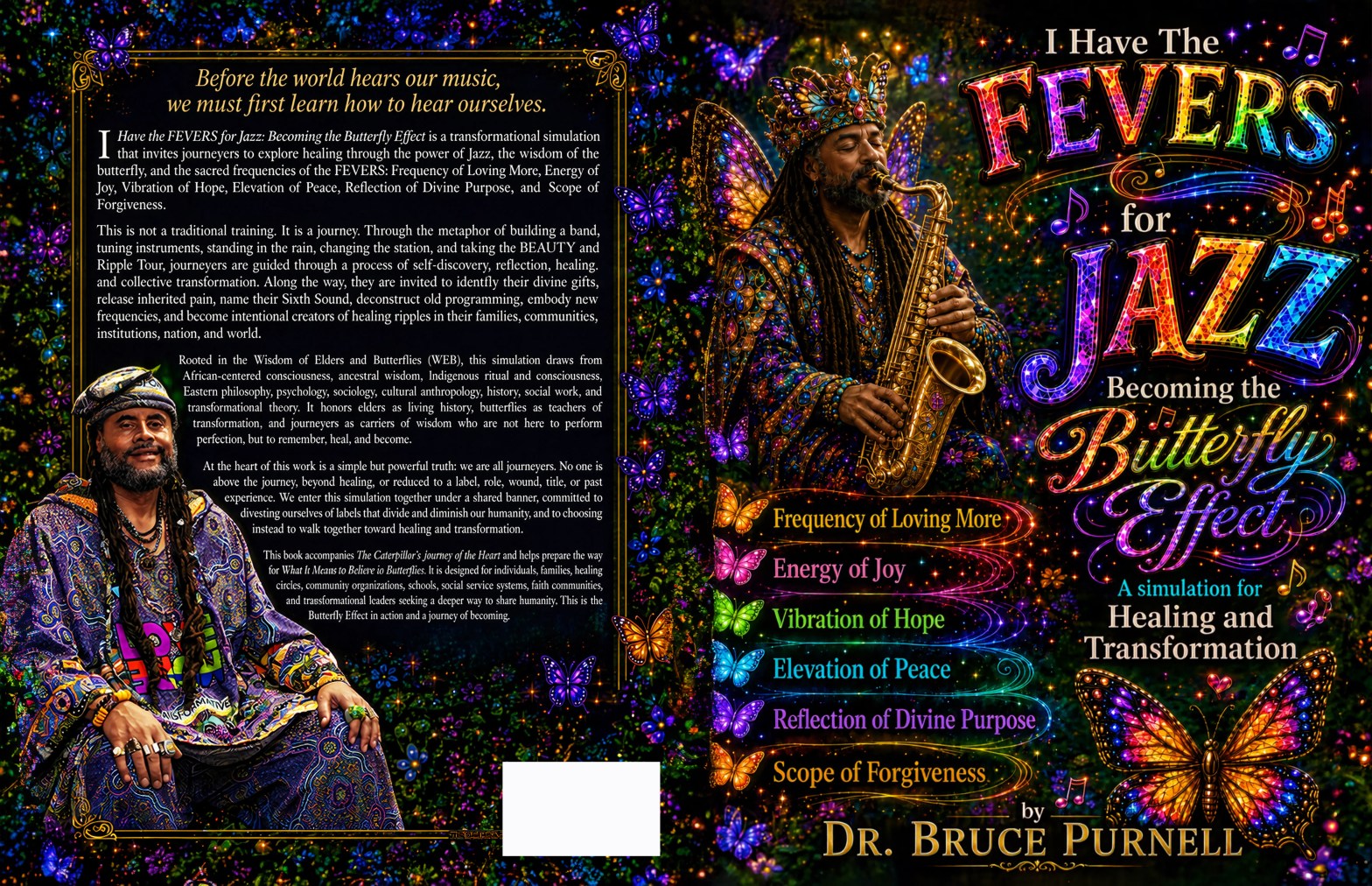
The Final exam will be on Monday, July 6th, at 6pm at the Healing Station Zoom. There will be no Butterfly Monday meeting tomorrow, 6/29. Be sure to purchase the book and study https://a.co/d/0dA8sjQl
I Have the FEVERS for Jazz: Becoming the Butterfly Effect Final Exam Study Guide
Final Examination
Journeyer: __________________
Band Name: _________________
Sixth Sound: ________________
Date: ______________________
Instructions
The test will be a 50-question, open-book examination. Use this study guide with the book, and take next week to study. You will take the physical exam on Monday, the 6th.
This assessment measures understanding and application of the simulation. It does not measure how healed or transformed you are.
Part I, Foundations of the Simulation
- What is the primary purpose of I Have the FEVERS for Jazz?
A. To identify the person who is most healed
B. To reveal patterns, beliefs, instincts, and possibilities that influence healing and transformation
C. To replace counseling and other professional services
D. To provide one correct answer for every life situation - How does the simulation primarily frame healing?
A. As a private process that should remain separate from the community
B. As the removal of all difficult emotions
C. As personal, relational, systemic, and collective
D. As a spiritual process without psychological or social dimensions - Why does the simulation refer to everyone as a journeyer?
A. To place everyone under a shared banner while honoring that we are all becoming
B. To suggest that everyone is at the same stage of healing
C. To remove the value of professional knowledge and lived experience
D. To determine which journeyers are more transformed than others - Why is this experience presented as a simulation rather than a traditional training?
A. Because it avoids research and theory
B. Because it focuses only on imagination
C. Because journeyers are not expected to reflect on their choices
D. Because it emphasizes experience, reflection, application, and embodied learning - What does WEB represent?
A. Wellness, Energy, Belief, and Wisdom
B. Wisdom of Elders and Butterflies
C. World Evolution through Butterfly consciousness
D. Wisdom, Experience, Balance, and Belonging - Why are elders described as living history?
A. Because they have completed the healing journey
B. Because age automatically makes every person a healer
C. Because they carry stories, memory, culture, survival wisdom, and lived experience
D. Because their role is to preserve the past without questioning it - What does the butterfly teach within this simulation?
A. Transformation involves process, patience, surrender, reorganization, and eventual flight
B. Transformation happens instantly when we think positively
C. Healing requires us to avoid periods of darkness and uncertainty
D. The goal of healing is to become independent of everyone else - Why is Jazz the guiding metaphor for the simulation?
A. Jazz allows one musician to control the entire composition
B. Jazz eliminates structure so everyone can play whatever they choose
C. Jazz values technical skill more than relationships
D. Jazz balances structure and improvisation, individual sound and collective harmony - What is social alchemy?
A. Designing profitable businesses without considering community impact
B. Avoiding pain by focusing only on positive experiences
C. Transforming pain, struggle, and limitation into wisdom, healing, purpose, and possibility
D. Studying social problems without attempting to change them - Which statement best distinguishes social architecture from social entrepreneurship?
A. Social architecture focuses on emotions, while social entrepreneurship focuses only on money
B. Social architecture designs healing-centered environments and relationships, while social entrepreneurship builds sustainable responses to social problems
C. Social architecture is individual, while social entrepreneurship is always governmental
D. Social architecture studies the past, while social entrepreneurship predicts the future
Part II, Theoretical and Cultural Roots - Na’im Akbar’s work most strongly supports which part of the simulation?
A. Transformational consciousness and reclaiming identity beyond imposed narratives
B. Measuring economic productivity
C. Treating culture as separate from psychological health
D. Understanding healing only through biological processes - Wade Nobles’ contribution is most closely connected to:
A. Behaviorism and punishment
B. Financial entrepreneurship
C. Individual achievement without community
D. African-centered cultural grounding, worldview, and collective identity - Joy DeGruy’s work helps journeyers understand:
A. Why positive emotions eliminate trauma
B. Why are all family patterns caused by individual choices
C. How historical trauma can shape adaptive behaviors across generations
D. How nervous systems function without cultural context - Barbara Fredrickson’s broaden-and-build theory suggests that positive emotions can:
A. Prevent all future stress
B. Expand creativity, resilience, connection, and possible responses
C. Replace the need for accountability
D. Make difficult emotions unnecessary - C. R. Snyder’s Hope Theory emphasizes:
A. Goals, pathways, and belief in our ability to move forward
B. Waiting for circumstances to change on their own
C. Avoiding difficult realities
D. Repeating affirmations without action - Stephen Porges’ Polyvagal Theory helps explain:
A. How names shape identity
B. Why communities need shared rituals
C. How people select band members
D. How the nervous system responds to safety, danger, connection, and defense - Albert Bandura’s work supports the Band metaphor because it emphasizes:
A. Learning through isolation
B. The belief that personality cannot change
C. Learning through observation, modeling, interaction, and self-efficacy
D. The idea that healing depends entirely on experts - Urie Bronfenbrenner’s ecological systems theory helps explain why:
A. Healing should focus only on childhood
B. Individuals are influenced by interconnected systems such as family, school, community, culture, and policy
C. Every system affects people in exactly the same way
D. Individual behavior is unrelated to the environment
Part III, FEVERS and Tuning the Instruments - Which option correctly identifies the six dimensions of FEVERS?
A. Faith, Energy, Vision, Empathy, Resilience, and Spirit
B. Freedom, Empowerment, Voice, Equity, Reflection, and Safety
C. Frequency, Emotion, Value, Evolution, Renewal, and Service
D. Frequency of Loving More, Energy of Joy, Vibration of Hope, Elevation of Peace, Reflection of Divine Purpose, and Scope of Forgiveness - Consistent with the work of bell hooks, the Frequency of Loving More treats Love as:
A. A practice involving care, responsibility, trust, truth, and accountability
B. A feeling that requires no action
C. Agreement with everything another person does
D. The avoidance of boundaries and difficult conversations - The Energy of Joy is powerful because Joy can:
A. Distracts us from all social problems
B. Guarantee that pain will not return
C. Expand aliveness, creativity, connection, and resilience
D. Replace the need to acknowledge grief - The Vibration of Hope is best understood as:
A. Expecting good outcomes without developing pathways
B. Believing in possibility while identifying goals and ways to move toward them
C. Denying that obstacles exist
D. Waiting for someone else to create change - The Elevation of Peace primarily invites us to develop:
A. Silence in every conflict
B. Agreement with everyone around us
C. Distance from all emotional experiences
D. Grounding, regulation, safety, and the ability to respond intentionally - The Reflection of Divine Purpose helps us ask:
A. Whether our choices align with our gifts, meaning, values, and who we are becoming
B. Whether other people approve of every decision
C. Whether we have achieved more than everyone around us
D. Whether our careers provide status without meaning - The Scope of Forgiveness is best understood as:
A. Forgetting that harm occurred
B. Removing accountability from the person who caused harm
C. Creating room for release, repair, freedom, and future possibility
D. Returning to every relationship regardless of safety - What does tuning the instruments represent?
A. Eliminating differences among band members
B. Bringing our beliefs, emotions, actions, relationships, and Purpose into greater alignment
C. Becoming emotionally positive at all times
D. Avoiding difficult people and environments - What does the continuum from distortion to harmony teach us?
A. Every person is either completely healed or completely unhealed
B. Harmony requires everyone to sound the same
C. Distortion means an instrument has no value
D. Healing involves movement, and different parts of our lives may require different levels of tuning - What is the primary purpose of the FEVERS Healing and Transformation Litmus Test?
A. To help us assess whether people, places, things, and situations support healing and transformation
B. To diagnose mental health conditions
C. To divide people into positive and negative categories
D. To determine whether someone deserves forgiveness - What is the sacred pause?
A. A way to avoid making decisions
B. A requirement to remain silent when harm occurs
C. An intentional moment to stop, listen, discern the frequency, and choose a response
D. A period in which we ignore our feelings - What do the acoustics represented by people, places, and things teach us?
A. Our inner condition is the only influence on our sound
B. Environments and relationships can amplify, distort, support, or muffle our authentic sound
C. The same environment affects every journeyer identically
D. Healing requires us to control every surrounding condition
Part IV, Building the Band and Navigating the Breakdown
- What does selecting our healing and transformation ensemble primarily reveal?
A. What we trust, value, prioritize, include, and sometimes avoid
B. Which people are objectively best
C. Whether we are qualified to become musicians
D. How many friends do we have - What is the Sixth Sound?
A. The most powerful member of the Band
B. The instrument that plays the loudest
C. A replacement for the five selected roles
D. A role, gift, presence, or energy that was missing from the original options but feels essential - Why do we name the Band after the Sixth Sound?
A. To make the exercise easier to market
B. To explore the power of language, labels, identity, Purpose, and intention
C. To rank one role above the others
D. To prevent the Band from changing - What is our ideal song?
A. A performance without mistakes
B. A song everyone else already knows
C. The larger healing-centered vision that helps guide our choices and improvisation
D. A way to avoid adjusting when life changes - When we recognize that another musician or we may be out of tune, the most aligned response is to:
A. Pause, listen with compassion, use discernment, and determine what tuning, support, boundary, or accountability is needed
B. Shame the musician until the sound changes
C. Pretend the distortion is not affecting the Band
D. Remove the musician before understanding the situation - Which option correctly matches the four common survival responses?
A. Fight means withdrawing, Flight means controlling, Freeze means pleasing, Fawn means escaping
B. Fight means resting, Flight means repairing, Freeze means planning, Fawn means leading
C. Fight means pleasing, Flight means shutting down, Freeze means confronting, Fawn means leaving
D. Fight may involve control or aggression, Flight may involve escape or overworking, Freeze may involve shutdown, and Fawn may involve people-pleasing - A journeyer stays constantly busy, so they do not have to feel grief or uncertainty. Which survival response is most evident?
A. Fight
B. Flight
C. Freeze
D. Fawn - Why is a breakdown described as a revelation?
A. It proves that the healing process has failed
B. It identifies which journeyer is weakest
C. It can reveal our default responses, unresolved wounds, beliefs, and frequencies under pressure
D. It guarantees an immediate breakthrough - What does “Can We Stand the Rain?” invite us to understand?
A. Healing helps us move through storms without losing connection to our rhythm, wings, and FEVERS
B. Strong journeyers never experience storms
C. The goal is to control every condition around us
D. Rain represents only failure and loss - When an entire Band is out of tune, the simulation invites us to:
A. Focus on correcting only one individual
B. Ignore the shared culture and continue performing
C. Replace the Band’s name without changing its practices
D. Examine shared beliefs, leadership, relationships, expectations, and environmental conditions
Part V, WizOz and the D.E.A.R. Process - What is WizOz?
A. A physical place that journeyers must visit
B. A musical genre used by the Band
C. A condition, consciousness, frequency, and system of beliefs that encourages people to forget who they are
D. A final stage of complete transformation - What does the Pied Piper symbolize?
A. The Band’s most talented musician
B. The manipulation of sound, frequency, attention, and programming
C. An elder who protects the community
D. The healing power of silence - Which sequence correctly identifies the D.E.A.R. process?
A. Deconstruction, Evolution, Affirmation, Reconstruction
B. Discernment, Energy, Awareness, Restoration
C. Deprogramming, Education, Action, Reflection
D. Development, Expression, Alignment, Renewal - Why does D.E.A.R. begin with Deconstruction?
A. Because everything inherited from the past should be rejected
B. Because change begins by criticizing ourselves
C. Because new beliefs can be added without examining old ones
D. Because we must understand inherited programming, beliefs, and survival patterns before intentionally reconstructing our sound - What happens during Evolution?
A. We return to the old station because it feels familiar
B. We repeat the proclamation without changing our behavior
C. We adapt and embody the FEVERS as a way of being, an ideology, and a strategy for sharing humanity
D. We eliminate all memories of our past - Why is Affirmation an important part of D.E.A.R.?
A. Affirmations immediately remove every limiting belief
B. Repetition and practice help strengthen the new frequency, belief system, and way of being
C. Affirmation allows us to avoid taking action
D. Affirmation is meant to impress other people - What is Reconstruction?
A. Building new practices, relationships, environments, identities, and systems around the healing frequency we intend to manifest
B. Returning to the original programming with a different language
C. Destroying every relationship connected to our past
D. Completing the healing journey permanently
Part VI, BEAUTY, The Ripple Tourz, and Healing Possibilities - What does BEAUTY represent?
A. Butterflies Evolving Across Universal Transformational Years
B. Building Energy and Unity Through Yourself
C. Becoming Every Authentic Understanding Through Youth
D. The Butterfly Effect Affirms Unity and Transformation in You - Which statement best describes the Ripple Tourz?
A. The tour begins internationally and eventually reaches the individual
B. The tour focuses on public performance rather than personal healing
C. The ripple begins within us, then moves through families, social institutions, communities, the nation, and the world, while encouraging shared humanity and planetary stewardship
D. The tour is complete once the Band creates a name and a proclamation - Which option correctly describes the Community’s Scale for Healing Possibilities?
A. It is a diagnostic instrument that labels people as healed or unhealed
B. It is a community-rooted resource that opens dialogue around Getting to the Core, Reclaiming Possibilities and Hope, Faith in the Healing Process, and Trusting the Community in Healing
C. It measures only trauma symptoms and crisis incidents
D. It replaces the FEVERS, reflection, dialogue, and lived experience


Blessings LOVE More ❤️ Dr.Bruce enjoy the rest of your day.
Thank you
Timika Galloway Liverpool
LikeLiked by 1 person