Butterfly Mondays – July 27, 2026
Healing Station Zoom: 6:00 PM EST Join Here: https://us02web.zoom.us/j/88324556318?pwd=QlNsT3lLWnc0alo3K09nN0JoaFNxQT09
Forgiveness becomes revolutionary when it moves beyond a private idea and becomes a shared culture of freedom.
Release to Rise by Dr. Bruce Purnell
Forgiveness does not hide the pain,
It helps the heart breathe free again.
It keeps the truth, protects the gate,
And lifts the soul from heavy weight.
We keep the wisdom, break the chain,
Let Love flow through each blocked vein.
No longer bound to yesterday,
We rise in Love and walk away.
So let forgiveness start within,
Where healing learns to breathe again.
We release, reclaim, and with purpose we rise,
With freer hearts and clearer eyes.
Forgiveness is not forgetting, forced reconciliation, restored access, or the abandonment of justice. Forgiveness is the sacred practice of reclaiming the emotional energy that pain has kept attached to the past. This Butterfly Monday, we launch The Love More Forgiveness Challenge, a healing and transformative practice designed to help us release what no longer deserves a permanent place in our spirits. Together, we will explore how to tell the truth, forgive ourselves, protect our boundaries, release emotional contracts, and send ripples of freedom through our families and communities.
This challenge invites us into seven sacred movements: seeing what we carry, telling the truth fully, returning mercy to the mirror, protecting what Love is growing, releasing emotional contracts, reassigning our energy, and sending the ripple forward. When one Journeyer forgives themselves, shame loses a messenger. When one family chooses repair over retaliation, the next generation inherits a new language. When one community chooses accountability with compassion, freedom begins to spread.
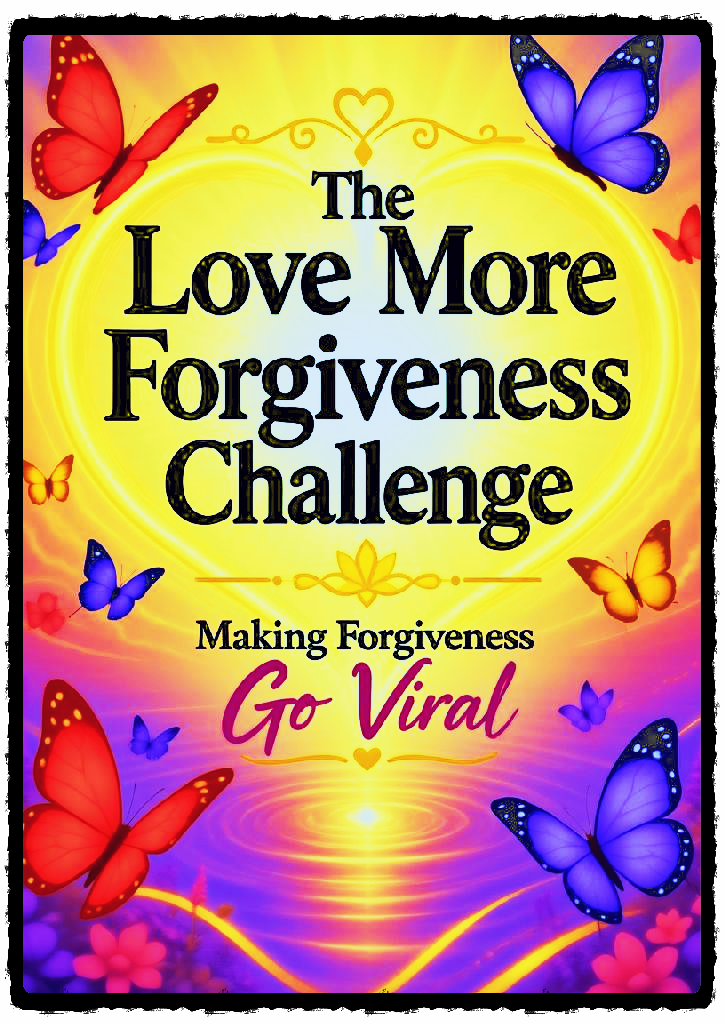
The Love More Forgiveness Challenge: Making Forgiveness Go Viral
Forgiveness becomes revolutionary when it moves beyond a private idea and becomes a shared culture of freedom. In “The Scope of Forgiveness,” we have explored forgiveness as emotional release, spiritual reclamation, accountable Love, and a pathway to healing and transformation. We have distinguished forgiveness from forgetting, reconciliation, restored access, and the abandonment of justice. We have learned that boundaries can remain, accountability can continue, and relationships may end even as resentment begins to loosen. Now the invitation moves beyond understanding, and it is time to practice.
The Love More Forgiveness Challenge is a collective commitment to interrupt cycles of resentment, retaliation, shame, self-punishment, and inherited pain. Its purpose is not to pressure people into premature forgiveness or to encourage them to publicly reveal private wounds. It is not a campaign asking survivors to protect the comfort of those who harmed them. It is an invitation for Journeyers to reclaim the emotional energy that injury has continued to drain. When we say we want forgiveness to go viral, we are not speaking only about social media. We are describing a ripple of consciousness.
One person releases self-condemnation, and their children experience a gentler parent. One family ends a cycle of retaliation, and the next generation inherits a new language for conflict. One community chooses restoration with accountability over endless revenge, and its emotional atmosphere begins to shift. One Journeyer says, “This pain reached me, but it will not move through me unchanged.” That is how forgiveness becomes contagious, and freedom goes viral.
What We Are Making Viral
We do not intend for silence, forced reconciliation, or spiritual bypassing to go viral. We do not ask people to pretend that everything is fine, erase injustice, or invite unsafe people back into their lives. We are reimagining a consciousness in which forgiveness can coexist with accountability, boundaries can be set without an apology, can begin with forgiving ourselves, and can release emotional captivity without restoring access. Forgiveness is not surrendering our truth but refusing to surrender our future. The viral message is not, “Get over it.” The message is: Your freedom is sacred.
The Spirit of the Challenge
The Love More Forgiveness Challenge is grounded in several commitments.
Truth Before Release
We do not release a softened or edited account of the injury. We tell the truth about what happened, how it affected us, and what it cost.
Safety Before Reconciliation
If harm is ongoing, the first step is protection, not renewed contact. The challenge never requires contact with the person who caused the harm.
Self-Forgiveness Before Self-Sacrifice
We begin by examining the punishment we have inflicted on ourselves. We release false guilt and accept appropriate responsibility with compassion.
Accountability Without Condemnation
Where we caused harm, we acknowledge it, make repair where possible, learn the lesson, and change our behavior. We do not use forgiveness to escape responsibility.
Freedom Without Performance
Participants do not have to announce whom they are forgiving or share the details of their trauma. The process can remain private and still create a powerful ripple.
Love With Boundaries
Love More does not mean tolerate more harm. Forgiveness guided by wisdom protects the sacred garden of our healing.
The Seven Movements of the Love More Forgiveness Challenge
The challenge can be completed over seven days, seven sessions, or seven weeks. Each movement may also be revisited whenever another layer of healing emerges. The goal is sacred movement, not speed.
Day One: See What You Are Carrying
Naming the Wound
The first movement is awareness. Many of us know we are angry, guarded, disappointed, or distant, but we have not clearly named the injury beneath those feelings. The pain may have become so familiar that it feels like part of our personality. Today, we pause and ask: What am I still carrying, and whose action, absence, betrayal, rejection, or judgment continues to occupy space within me? What emotion arises when I remember what happened, and where do I feel it in my body? The purpose is not to relive every detail, but to give the wound enough language so it no longer has to hide within our reactions.
Day One Practice
Write one honest sentence:
What happened was __________________________________________.
Then write:
What it cost me was _________________________________________.
Day One Affirmation
I honor my truth without allowing the injury to become my entire identity.
Optional Public Ripple
We may share only:
Today, I chose truth over silence.
No private details are required.
Day Two: Tell the Truth More Fully
Honoring the Impact
Forgiveness does not begin with minimizing what happened. It begins with recognizing how the injury shaped our inner and outer lives. Perhaps betrayal made trust difficult, abandonment bred a fear of being left, criticism became the inner voice that speaks whenever we try something new, or violence trained the body to stay on constant alert.
Today, we ask:
• How has this experience influenced the way I see myself?
• How has it influenced my relationships?
• What belief did I form because of it?
• What did I need at the time that I did not receive?
Day Two Practice
Complete the following:
Because of what happened, I began to believe ____________________.
What I needed then was ______________________________________.
What I can begin giving myself now is ___________________________.
Day Two Affirmation
My pain deserves acknowledgment, and my future deserves possibility.
Optional Public Ripple
Today, I gave language to what my heart had been carrying.
Day Three: Return Mercy to the Mirror
Forgiving Ourselves First
Before releasing another person, we turn toward the one who has accompanied us through every part of the journey.
• We forgive ourselves for not knowing what we know now.
• We forgive ourselves for trusting.
• We forgive ourselves for staying, leaving, returning, freezing, numbing, reacting, or surviving with the tools available to us at the time.
Where we caused harm, we do not evade accountability. We name what is ours, make amends where possible, and release the belief that endless self-punishment will create transformation. Today, we ask:
• What have I been using against myself?
• Am I carrying responsibility that belongs to someone else?
• What choice do I regret?
• What would accountable Love say to the person I was then?
Day Three Practice
Write a short message beginning with:
Dear Me, I have been punishing you for __________________________.
Continue with:
I now understand ____________________________________________.
The lesson I will carry forward is ______________________________.
I release you from ___________________________________________.
Day Three Affirmation
I hold myself accountable without abandoning myself. I am worthy of another chapter.
Optional Public Ripple
Today, forgiveness began H “OM” E.
Day Four: Protect What Love Is Growing
Establishing the Boundary
Forgiveness without boundaries can become self-abandonment. Today, we identify what our healing requires to stay safe. A boundary might include maintaining distance, limiting contact, ending a conversation when disrespect begins, refusing financial involvement, seeking legal protection, or removing someone from a position of access or authority. A boundary is not revenge but the architecture of healing.
Today, we ask:
• What behavior can no longer enter my sacred space?
• What does my nervous system need in order to feel safer?
• What access have I continued granting because I feared appearing unforgiving?
• What action is within my control?
Day Four Practice
Complete this boundary statement:
When __________________________________ happens, I feel or experience ________________________________.
I need ________________________________________________.
If the behavior continues, I will ________________________________.
Example:
“When our conversations turn insulting, I feel emotionally unsafe. I need respectful communication. If the insults continue, I will end the conversation and reconnect at another time.”
Day Four Affirmation
My Love includes my protection. My boundary gives healing somewhere safe to grow.
Optional Public Ripple
Today, I learned that forgiveness can have a gate.
Day Five: Release the Emotional Contract
Choosing Freedom
Pain can create invisible contracts. We may unconsciously promise to remain angry until an apology arrives. We may believe that continued suffering is the only proof that the harm mattered. We may decide never to trust again because distrust feels like protection. Today, we identify the contract and ask whether it still serves us.
• What do I believe I must continue feeling because of what happened?
• What am I waiting for the other person to do before I allow myself peace?
• What do I fear forgiveness will take away from me?
• Can I keep the wisdom without carrying the captivity?
Day Five Practice
Write:
The emotional contract I have been carrying says _________________.
Then write:
I release my obligation to ____________________________________.
Close with:
My truth, my boundaries, and my healing are evidence enough.
Participants may choose to tear the paper, place it beneath a stone, fold it into a private forgiveness box, or safely burn it as part of a release ritual.
Day Five Affirmation
I release what no longer deserves permanent space in my spirit.
Optional Public Ripple
Today, I kept the wisdom and released part of the weight.
Day Six: Reassign the Energy
Returning to Joy and Purpose
Forgiveness creates space, but empty space can invite the old story to return. Today, we give reclaimed energy a new assignment. The hours once spent rehearsing the injury can move toward creativity. The energy once consumed by resentment can move toward rest, and the attention once fixed on the offender can return to Love, family, healing, service, music, prayer, dreams, and divine purpose.
Today, we ask:
• What has this injury distracted me from?
• What dream has been waiting for my attention?
• What deserves the energy I am reclaiming?
• How can I use that energy to create life?
Day Six Practice
Choose one act of reclamation:
• Write.
• Sing.
• Rest.
• Dance.
• Walk.
• Create art.
• Serve someone.
• Reconnect with a trusted person.
• Return to a dream.
Complete:
The energy I reclaim today will circulate toward _________________.
Day Six Affirmation
My energy belongs to my becoming. I return it to Love, Joy, Peace, and Purpose.
Optional Public Ripple
Today, I gave reclaimed energy a new assignment.
Day Seven: Send the Ripple
Making Freedom Contagious
On the final day, we do not ask Journeyers to reveal whom they forgave or what happened. Instead, we ask them to share what they learned about release, boundaries, self-forgiveness, or freedom. The challenge goes viral when wisdom is passed forward without sacrificing privacy.
Today, we ask:
• What has changed in the way I understand forgiveness?
• What do I want my family or community to inherit instead of resentment?
• What sentence could encourage another Journeyer without pressuring them?
• What act of Love can carry the ripple forward?
Day Seven Practice
Create one shareable expression:
• A short affirmation.
• A poem.
• A photograph.
• A song.
• A drawing.
• A brief reflection.
• A boundary statement.
• A statement of self-forgiveness.
• A message of hope.
End it with:
I forgive because my freedom is sacred.
Then invite one trusted person to begin their own journey, while making it clear that participation is voluntary and private disclosure is never required.
Day Seven Affirmation
I release to rise. My healing becomes a ripple, and my freedom becomes part of the Butterfly Effect.
The FEVERS of the Forgiveness Challenge
Each day of the challenge restores part of our spiritual circulatory system.
The Frequency of Loving More allows us to approach the wound without hatred toward ourselves.
The Energy of Joy gives reclaimed emotional energy a life-giving destination.
The Vibration of Hope reminds us that the future does not have to repeat the injury.
The Elevation of Peace helps the nervous system recognize that danger is not always present.
The Reflection of Divine Purpose redirects attention toward who we are becoming.
The Scope of Forgiveness allows us to see the harm, the accountability, the boundary, the lesson, and our freedom within the same frame.
Together, the FEVERS transform forgiveness from an isolated decision into a way of living.
The Forgiveness Challenge Pledge
Participants may read this pledge privately or together in a Brave Space:
• I enter this challenge without denying my pain or abandoning my truth.
• I will not use forgiveness to excuse harm, erase accountability, or restore unsafe access.
• I will honor my emotions, protect my boundaries, and begin with compassion for myself.
• I will release what I am ready to release and respect the parts of me that still need time.
• I will keep the wisdom without allowing the injury to remain the author of my future.
• I forgive, not because the harm was acceptable, but because my freedom is sacred.
• I release to rise.
• I Love More.
Making the Challenge Social Without Making Trauma Performative
The Love More Forgiveness Challenge can use social media to spread freedom, but it must never turn personal wounds into public entertainment. Journeyers should never feel pressured to name the offender, describe the injury, or announce reconciliation. The public message should center on the healing principle rather than on private trauma.
Safe shareable prompts include:
• “Today, I chose peace without surrendering my boundary.”
• “Forgiveness does not require restored access.”
• “I am releasing self-punishment and choosing accountable Love.”
• “I can keep the wisdom without keeping the captivity.”
• “My pain is part of my history, not the author of my future.”
• “I forgive because my freedom is sacred.”
This allows the challenge to become visible without violating anyone’s privacy or dignity.
Suggested Social Media Caption
The Love More Forgiveness Challenge begins within. Forgiveness is not forgetting, forced reconciliation, restored access, or the abandonment of justice. It is the sacred process of reclaiming the emotional energy that pain has tied to the past. Today, I choose freedom through truth, accountability, boundaries, and Love.
#LoveMoreForgivenessChallenge
#ForgivenessIsForMe
#ReleaseToRise
#ScopeOfForgiveness
#WeAreTheButterflyEffect
Bringing the Challenge into Families
Families may complete the challenge without requiring anyone to disclose private injuries. A family can identify patterns it wants to address, such as the silent treatment, harsh criticism, avoidance, retaliation, emotional shutdown, or refusal to apologize.
Family members can ask:
• What do we want forgiveness to mean in our home?
• How can we make apologies safer and more accountable?
• What boundary would protect connection?
• What cycle do we want to end with us?
• What new practice do we want future generations to inherit?
The family challenge might conclude with a shared statement: In this family, we tell the truth, take responsibility, make amends, respect boundaries, and choose not to pass pain forward unchanged.
Bringing the Challenge into Communities
Communities can use the Forgiveness Challenge to shift from punishment-centered responses to restorative and healing-centered practices. A community circle may explore:
• Which injuries remain active in our collective memory?
• Where has harm gone unacknowledged?
• What accountability is still required?
• Which retaliation cycles must end?
• What repair would allow trust to begin to grow?
• How can we hold justice and forgiveness together?
Collective forgiveness must never erase structural violence or require oppressed people to accept ongoing harm. The challenge should support truth-telling, restitution, protection, policy change, and shared accountability. The goal is not to make communities forget. The goal is to help communities remember without being permanently governed by the wound.
A TLiCHL Facilitation Framework
Transformative Life Coaches and Healing Leaders can guide the challenge through a healing-justice-centered, trauma-informed sequence:
Prepare the Brave Space
Clarify confidentiality, consent, emotional safety, and the difference between forgiveness and reconciliation.
Regulate Before Reflecting
Begin with breathing, grounding, music, movement, or another practice that supports nervous-system regulation.
Invite, Never Demand
Allow Journeyers to choose the depth of participation. No one must name an offender or share details.
Validate the Wound
Affirm that anger, grief, fear, and hesitation are understandable within the context of the person’s experiences.
Support Boundaries
Help Journeyers identify what safety requires before discussing release.
Center Self-Forgiveness
Explore false guilt, shame, accountability, repair, and compassionate understanding of the survival self.
Close with Reclamation
End each session by redirecting attention to agency, Joy, Love, Peace, and Divine Purpose.
The coach does not decide when someone should forgive. The coach helps create conditions in which freedom becomes imaginable.
Measuring the Ripple
The challenge is not scored by how many people say, “I forgive.” A declaration can be made before the heart is ready. Instead, participants can reflect before and after the challenge on questions such as:
• How much emotional energy does this injury currently drain?
• How often do I replay the event?
• How much control does the injury have over my current relationships?
• How much self-blame am I carrying?
• How clear are my boundaries?
• How achievable does emotional freedom feel?
• How connected do I feel to Joy, Peace, and Purpose?
Progress may look like less rumination, more self-compassion, a clearer boundary, willingness to seek support, reduced desire for revenge, a more truthful understanding of the injury, or simply greater openness to the possibility of release. The ripple begins before complete forgiveness. It begins with movement.
The Love More Forgiveness Challenge Closing Ritual
Release to Rise
Journeyers may gather in a circle or complete the ritual privately. Place one hand over the heart and one over the abdomen. Take a slow breath.
Say:
I acknowledge what happened.
Pause.
I honor what it cost me.
Pause.
I release the belief that I must continue suffering to prove that it mattered.
Pause.
I keep the wisdom.
I protect the boundary.
I reclaim the energy.
I choose freedom.
Then open the hands outward, as though releasing what has been carried.
Say:
What reached me will not move through me unchanged.
I release to rise.
I am the Butterfly Effect.
Closing: Making Freedom Contagious
The Love More Forgiveness Challenge is not an ending. It is a movement.
Every time a Journeyer forgives themselves, shame loses a messenger.
Every time someone establishes a boundary without hatred, Love gains structure.
Every time a family chooses repair instead of retaliation, the next generation inherits a different script.
Every time a community tells the truth while refusing to become imprisoned by revenge, healing expands its reach.
This is how forgiveness goes viral. Not through pressure, performance, or pretending, but
through witness, courage, accountability, release, and the quiet evidence of people becoming freer.
• One heart creates more room for Love.
• One boundary breaks a cycle.
• One released burden changes how a person enters a room.
• One act of self-forgiveness transforms a family’s emotional inheritance.
• One ripple meets another.
And soon, what began as an inside-out decision becomes a movement of liberated hearts.
• Let us make truth visible.
• Let us make accountability compassionate.
• Let us make boundaries sacred.
• Let us make self-forgiveness possible.
• Let us make freedom contagious.
• Let us make forgiveness go viral.
Course Books: “I Have The FEVERS For Jazz: Becoming The Butterfly Effect”; I Have the FEVERS for Jazz https://www.lovemoremovement.org/books
We are becoming the “Social Architects” and “Social Alchemists” who will design our healing and transformation. Let’s affirm and manifest our divine cocoons together. #WeAreTheButterflyEffect
See the full sessions on the Blog: https://welovemoredrbruce.com/ Please give Love More a Google rating: https://g.page/r/CYI0Pw3JjBrjEAI/review
The Love More Forgiveness Challenge: Making Forgiveness Go Viral
 We Love More Dr.Bruce