
Join us as we enter CHAMBER OF DREAMS: From the Impossible Dream to the Deferred Dream, the Achieved Dream, and the Embodied Dream
What future is asking you to believe in, prepare for, and help create? The Chamber of Identity helped us remember that the tank may have shaped how we learned to move without defining the size of our ocean. The Chamber of Dreams now asks what becomes possible when reclaimed Identity receives permission to imagine a future. We will enter the War Room of Unlived Tomorrows with Manifest, Hope, Hannibal Barca, and the Headmaster. Hannibal is a brilliant strategist whose imagination has been cultivated by conflict. He knows how to defeat, defend, cross mountains, and prepare for an enemy, but can he imagine a life not organized around war?
A fictionalized literary presence of Langston Hughes will join the conversation as we explore the sacred question of the deferred Dream. We will place that question alongside Dr. Bruce’s “What Happens to a Dream Achieved?” and ask what Healing and Transformation require within and around the Dreamer. Journeyers will explore survival Dreams, assigned Dreams, impossible Dreams, deferred Dreams, achieved Dreams, and embodied Dreams. We will identify what happened to imagination, which conditions keep possibility waiting, what gift the nightmare developed, and what first believable Yellow Brick can be placed beneath the future now.
Dreaming is not an escape from reality. It is a rehearsal for creating another reality.
Welcome H “OM” E, Journeyers.
We have just left the Chamber of Identity carrying Shamu’s self-directed call. Shamu taught us that the tank may shape how we learn to move without defining the size of our ocean. The Chamber of Dreams now asks what becomes possible when a reclaimed Identity receives permission to imagine a future.
A person can remember who they are and still struggle to imagine where that self can live. Trauma can make the future feel dangerous, oppression can make possibility feel dishonest, and repeated disappointment can teach the heart to stop wanting before wanting becomes another wound.
There is No Shade on a survival Dream. Dreaming of safety, escape, protection, financial stability, rest, or an end to pain may be the first bridge toward life. But the Chamber asks whether survival has become the architect of everything we are willing to imagine.
At this point of the journey, we will move through four connected questions. What makes a Dream seem impossible? What happens when we repeatedly defer a Dream? What changes when we achieve a Dream? And how does an achieved Dream become an embodied way of living, serving, building, and loving?
We will enter the War Room of Unlived Tomorrows with Manifest, Hope, Hannibal Barca, and the Headmaster. We will then welcome a fictionalized literary presence of Langston Hughes into the room, not to claim his personal approval, but to let his sacred question about the deferred Dream enter a healing and transformation conversation with Dr. Bruce’s question about the achieved Dream.
Our goal is not to pressure anyone to Dream bigger, but to understand what happened to imagination, what the Dream represents, which conditions have delayed it, what support is needed, and which next Yellow Brick is believable now.
| Before a Dream can be deferred, it must first be imagined. Before we can achieve it, we must believe it. Before it becomes a pathway, we must become brave enough to see beyond the present evidence. Love More Reflection |
Dream Temperature Check
• When I hear the word Dream, my body feels…
• The future currently feels close, distant, believable, confusing, exciting, frightening, or something else.
• One Dream I can name without explaining it is…
• One condition that helps me imagine possibility is…
PART I
The Impossible Dream: When imagination becomes a quest
“To dream the impossible dream…” Joe Darion and Mitch Leigh, Man of La Mancha
The song invites us to consider what happens when a Dream becomes more than a wish. A quest gives direction, organizes courage, and asks us to protect a value larger than comfort and to keep moving before success is guaranteed. Yet the Chamber of Dreams does not confuse dedication with self-erasure. A Journeyer does not have to tolerate abuse, ignore danger, exhaust the body, or carry alone what should be shared, repaired, or changed.
A Dream Becomes a Quest When It…
• Gives direction without demanding certainty.
• Connects to values, gifts, Love, Joy, Hope, Peace, Purpose, Liberation, Forgiveness, or Transformation.
• Can be translated into choices, relationships, supports, resources, and action.
• Leaves room for rest, revision, grief, and changing conditions.
• Helps create a world more humane than the one the Dreamer inherited.
| Dream Form | Central Question | Healing-and-Transformation Lens |
| Survival Dream | How do I reduce danger? | Honor it as a first bridge to safety. |
| Assigned Dream | What am I expected to want? | Ask who authored it. |
| Impossible Dream | What calls beyond present evidence? | Protect imagination; build a pathway. |
| Deferred Dream | What has been delayed or denied? | Name grief, barriers, and conditions. |
| Achieved Dream | What entered form? | Celebrate without erasing cost or support. |
| Embodied Dream | How does it live in daily choices? | Practice alignment, sustainability, contribution. |
When the Nightmare Has Trained the Dream
“Dream as if we have never had a nightmare” does not mean forgetting the nightmare, denying harm, or pretending the wound no longer matters. It means refusing to let the nightmare permanently control the future.
• Trauma may teach the imagination to scan primarily for danger.
• Poverty may train the Dream to seek only enough money never to feel unsafe again.
• Rejection may train the Dream to seek approval rather than belonging.
• Powerlessness may train the Dream to seek control rather than purpose.
• Violence may train the Dream to seek victory over an enemy rather than a life beyond war.
| THE CHAMBER’S QUESTION |
| What would we Dream if fear were not writing the entire script? What would we build if our gifts, not only our wounds, were allowed to imagine the future? |
| PART II: The War Room of Unlived Tomorrows Hannibal Barca and the Dream organized around war |
Why Hannibal?
Within WizOz, Hannibal Barca is an imaginative archetype rather than a historical reconstruction. He represents strategic intelligence, inherited conflict, battle readiness, ambition shaped by opposition, and the difficulty of imagining peace after living through war consciousness.
Hannibal knows how to cross mountains, organize resources, anticipate threats, and remain focused when the road appears impossible. The Chamber does not ask only whether he can pursue a difficult Dream. It asks what he has been taught to Dream about.
• Can he imagine a future not organized around defeating someone?
• Can strategy cultivate a garden as carefully as it prepares a battlefield?
• Can brilliance serve belonging, community, Love, Joy, and Divine Purpose?
• Can a person trained for battle Dream when no enemy is present?
• What gift is developed through survival, and what happens when the gift receives a new assignment?
| The gift belongs to you. War does not own it. The Headmaster |
A deferred Dream may become a battle plan. Healing invites it to become a life plan, and transformation asks whether we can envision something beyond the conditions that made the battle necessary.
WizOz Field Note
Hannibal Barca was a real historical military leader. His appearance in WizOz is an imaginative archetype, not a biographical reconstruction. Within this chamber, Hannibal represents:
• Strategic intelligence
• Inherited conflict
• Battle readiness
• Ambition shaped by opposition
• The difficulty of imagining peace after living through war consciousness
• The possibility of redirecting strategy toward building rather than only defeating
The Fifth-Year character guide describes Hannibal as a Dreamer whose imagination has become organized around war, struggle, pressure, and opposition. The Headmaster represents guidance that expands the Journeyer’s vision rather than dominating them. The blank parchment represents a future not yet colonized by fear, and the war map represents nightmare forecasting.
The seed represents a Dream in its earliest form, and the garden represents a future requiring cultivation rather than conquest. The armor represents protection that may remain available without controlling every decision.
The Butterfly represents a future form that cannot be fully understood from within the present condition.
The central coaching questions are:
• What future have you become skilled at preventing?
• What future have you not yet practiced imagining?
• What did the nightmare teach?
• What gift developed through survival?
• What happens when that gift receives a new assignment?
• What deserves the same planning that fear has received?
• What would your strategy build if it were no longer organized only around an enemy?
• What is the first believable brick?
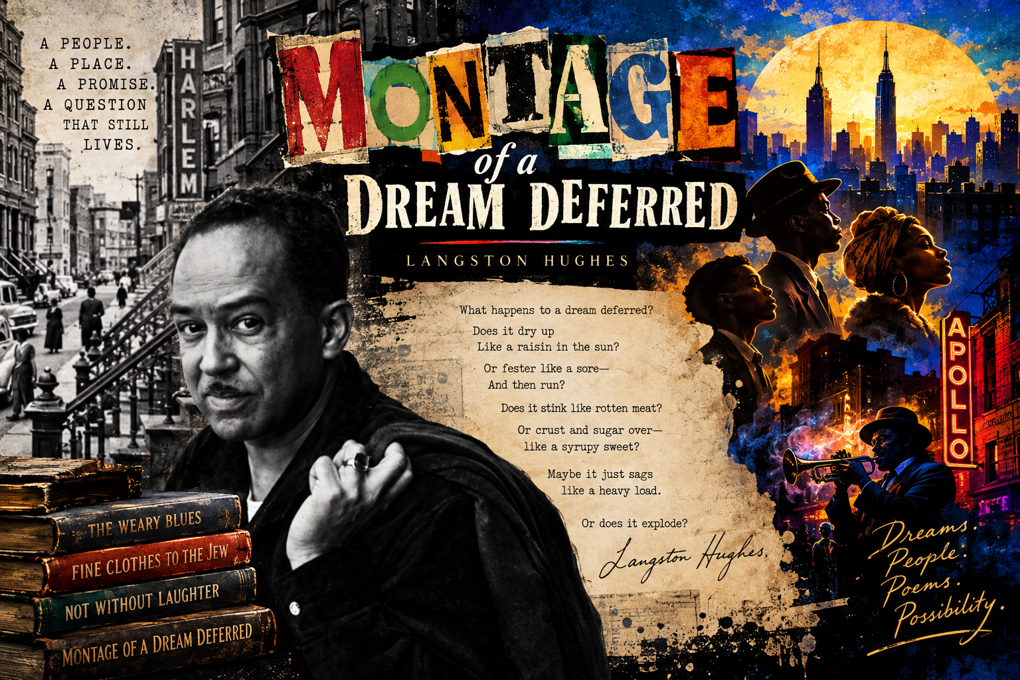
| THE LITERARY THRESHOLD Langston Hughes and the Sacred Question of the Deferred Dream What happens when a future is forced to wait? |
Langston Hughes titled the poem “Harlem,” although many readers know it through its opening question about a deferred Dream. In the class material, the poem is placed within the larger movement of Montage of a Dream Deferred, which explores Black life, labor, migration, desire, frustration, music, and possibility in Harlem. The question is not only what happens when one person postpones a private ambition, but what happens when a people are repeatedly promised freedom, opportunity, dignity, safety, and belonging while the conditions necessary to make those promises real remain withheld.
| “What happens to a dream deferred?” Langston Hughes, “Harlem” |
What happens to a dream deferred?
Does it dry up
like a raisin in the sun?
Or fester like a sore—
And then run?
Does it stink like rotten meat?
Or crust and sugar over—
like a syrupy sweet?
Maybe it just sags
like a heavy load.
Or does it explode?
Deferral is not neutral, and the Dream does not disappear because it has been postponed. Its energy may change form and become grief, exhaustion, shame, anger, resignation, conflict, resistance, a collective demand, or an explosion that appears sudden only because the history before it was ignored.
A Love More Reading of the Montage
| Image | Possible Meaning | Healing Leadership Question |
| Drying | The Journeyer disconnects from desire because caring has become painful. | What disappointment taught the Dreamer to stop wanting? |
| Festering | The deferred Dream becomes an unnamed or unhealed wound. | What grief remains beneath the surface? |
| Odor | The unresolved absence enters relationships, decisions, health, and leadership. | Where is the Dream’s absence showing up now? |
| Sugar coating | Performance, productivity, or positivity covers the wound. | Are we confusing visible functioning with fulfilled possibility? |
| Heavy load | The Dreamer carries the Dream without enough resources, community, or opportunity. | What support was missing, and what would make the load more shareable? |
| Explosion | The visible rupture follows a history of ignored pressure, denial, or exclusion. | What happened before the explosion, and what structural change is required? |
LOVE MORE COMPANION POEM
WHAT HAPPENS TO A DREAM ACHIEVED? By Dr. Bruce Purnell
What happens to a Dream achieved?
Does it shine like a mirror reflecting the sun?
Does it open our hearts to living,
as if being alive can truly be fun?
Does it fragrance the air like sweet apple pie,
or become a truth we no longer deny?
Perhaps it grows so rooted and bold
that it bends beneath pressure but never will fold.
Then it becomes part of the greatness
in the stories our lives have told—
a Butterfly born from believing,
a future our spirits were brave enough to hold.
| THE TRANSFORMATIONAL DIALOGUE |
| Hughes asks us to confront the cost of delay. Love More asks us to build the conditions for possibility. The Dream Achieved does not erase the Dream Deferred. It continues the Montage by asking what becomes possible when imagination, Healing, opportunity, support, preparation, and aligned action begin to meet. |
| READER’S THEATER A Montage in the War Room The Impossible Dream, the Dream Deferred, the Dream Achieved, and the Dream Embodied |
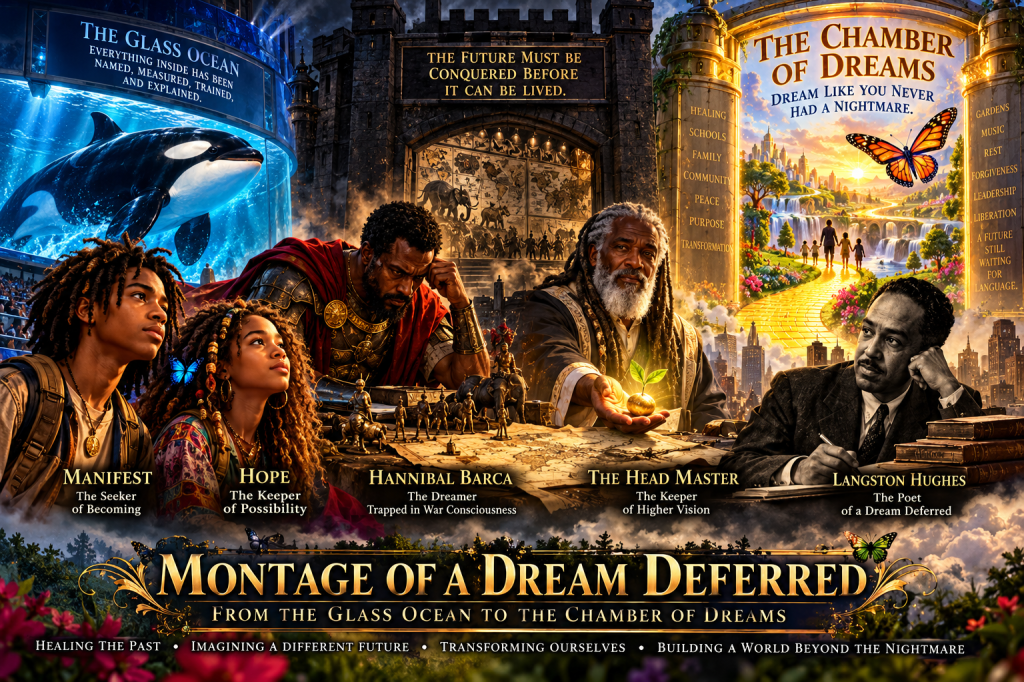
The War Room of Unlived Tomorrows
A Montage of the Impossible Dream, the Deferred Dream, the Achieved Dream, and the Embodied Dream
The Impossible Dream → The Dream Deferred → The Dream Achieved → The Dream Embodied. Creative Integrity Note
Langston Hughes appears below as a fictionalized literary presence in the Land of WizOz. The conversation is an imaginative educational interpretation—not a historical transcript, statement of his personal views, or claim that he endorsed this work. Manifest and Hope left the Glass Ocean carrying a sound Shamu had helped them remember. It was not a word, but the call of something larger than the tank. The sound had entered their bodies like a current and followed them even after the ocean disappeared from view. As they continued along the Yellow Brick Road, the smell of salt faded. The golden bricks climbed a steep hill until they ended at a black-stone fortress.
The walls rose high enough to block out the sky, with no windows, gardens, or music.
Above the gate were the words: THE FUTURE MUST BE CONQUERED BEFORE IT CAN BE LIVED. Manifest studied the walls. “This must be the Chamber of Success,” he said. “It looks like the home of someone who knows how to win.” Hope rested her hand against the gate. “It feels like a place that has forgotten how to rest.” The gate opened. Inside, an enormous room was filled with maps. Some maps showed territories, some showed relationships, and others showed families, institutions, communities, generations, and entire futures. Arrows, barricades, defenses, anticipated attacks, escape routes, enemy names, and places where betrayal was expected covered every map.
Some maps were for wars that had already happened, for wars that might happen, and for wars no one had declared. At the center stood Hannibal Barca with polished armor and weary eyes. He moved markers across the table, whispering: “If they move here, I move there.” “If they build this, I destroy that.” “If they become stronger, I must become stronger still.” “If I rest, they will advance.” “If I trust, they will betray me,” and “if I stop preparing for war, war will find me unprepared.” Manifest approached the table with admiration.
“You have planned for everything.” Hannibal did not look up. “I have planned for everything that could go wrong.” Hope studied the maps. The plans covered victory, retaliation, retreat, defense, survival, and protection of every wall. Yet no map showed a garden, children playing, music, rest, forgiveness, family, community, Healing Stations, or peace. “What happens after you win?” Hope asked. Hannibal moved another marker. “We prepare for the next enemy.” “And after that?” “We defeat the next enemy.” “And when there are no enemies?” Hannibal finally looked at her. “There are always enemies.”
A door at the far end of the room opened, and the Headmaster entered without armor. He held only a blank sheet of parchment, and had no weapon. “Hannibal,” he said, “you have become brilliant at planning for the future.” Hannibal’s hand moved toward his sword. The Headmaster continued: “But have you learned to plan for one?” The room fell silent. Manifest looked at the blank parchment. “What is that?” “A map,” the Headmaster replied. “There is nothing on it.” “That is because Hannibal has not yet imagined a destination that is not organized around an enemy.” Hannibal laughed without joy. “An empty map is not a strategy.” “No,” the Headmaster said. “It is permission.”
He laid the parchment over the war table. Immediately, the room filled with the sounds of battle. Drums, Horses, Commands, and metal striking metal filled the air. Smoke poured from the walls, and the maps revealed every defeat Hannibal feared and every betrayal he expected. Hannibal reached for the parchment. “I knew this would happen.” The Headmaster did not remove the images. He asked: “What is the nightmare trying to protect?” “My people.” “What gift did the nightmare develop?” “Strategy.” “What has strategy become when every future is treated as a battlefield?” Hannibal stared at the maps. “A prison.” The Headmaster placed a small golden seed in Hannibal’s hand. “The gift belongs to you,” he said. “War does not own it.”
“What am I supposed to do with a seed?” “Plan for something you want to grow.” “I know how to defeat.” “Then imagine what your intelligence could build.” “I know how to defend.” “Then imagine what deserves protection.” “I know how to survive.” “Then imagine a life worth surviving for.” Hannibal looked at the blank parchment. His hands began to shake. “I do not know what peace looks like.” Hope moved closer but did not touch him. “You do not have to know the whole picture.” Manifest added: “Maybe you only need the first brick.” The Headmaster nodded. “Dreaming does not require a completed map. It begins when we allow a future to ask something of us beyond fear.”
Hannibal placed the seed on the parchment. A small green circle appeared. “What is that?” Manifest asked. Hannibal looked at it as if it had spoken a language he had forgotten. “A garden,” he said quietly. Another image appeared. A school. Then a table surrounded by family. Then a place where leaders settled conflict without humiliation. Then a road traveled by people who were not fleeing. The sounds of battle did not disappear, but they became more distant. Hannibal looked at the Headmaster. “How do I “Dream” like I never had a nightmare when the nightmare taught me everything I know?”
The Headmaster replied: “You do not forget what the nightmare taught, but stop allowing it to teach every class.” The garden remained on the parchment. But before another image could appear, the green circle began to dry, and its leaves curled inward. The soil cracked, the school disappeared behind a locked gate, the family table became empty, and the road ended at another wall. Hannibal reached toward the parchment. “What happened?” The Headmaster did not answer.
A piano sounded somewhere beyond the fortress. One note, then another; a trumpet entered, and the battle drums changed rhythm. The sound of horses became the sound of a train moving above a city street, and the stone walls transformed into brownstones, fire escapes, storefronts, churches, theaters, kitchens, barbershops, apartments, and crowded sidewalks. The war room had become a montage. Children played beneath an elevated train, and workers returned home carrying the day’s weight; a woman sang through an open window, and a man held a newspaper whose promises had not reached the street. The green circle on the parchment dried and shrank, and from the shadows, a man entered carrying a notebook.
His expression was gentle, but his eyes held questions large enough to disturb the room.
The Headmaster welcomed him. “Journeyers, this is Langston Hughes.” Manifest stepped forward. “The poet?” Langston smiled slightly. “Tonight, perhaps I am only the Keeper of a Question.” Hope looked toward the drying garden. “What question?” Langston opened his notebook. “What happens to a Dream deferred?” The words entered the room, and the fortress changed again. The war table divided into six living images.
The First Image: The Dream That Dries
The garden seed shrank, dark and wrinkled. The green possibility that had briefly opened began losing its color. Manifest leaned closer. “Is the Dream dying?” Langston looked at Hannibal. “What happens when caring about a Dream becomes more painful than pretending it no longer matters?” Hannibal watched the seed. “You stop naming it.” “What else?” “You stop planning for it.” “What else?” “You begin calling desire unrealistic so disappointment cannot find you again.” Hope placed her hand above the parchment. “Sometimes the Dream disappears from language because the Journeyer is trying to protect it from another rejection.” Langston nodded.
“A Dream may dry up when the person disconnects from desire. Not because they lack ambition, but because hope has repeatedly been followed by harm.” Hannibal looked toward his war maps. “I stopped imagining peace because peace kept becoming another promise made before the next war.” The Headmaster asked: “What was the Dream before it dried?” Hannibal answered: “A place where my people did not need my armor.”
The Second Image: The Dream That Festers
The parchment opened like skin, and a wound appeared beneath the garden. It had been covered, but not treated. Hannibal drew back. Langston asked: “What happens when a Dream remains alive beneath the surface, but no one is willing to acknowledge the wound created by its delay?” Hope looked into the opening. “It may become grief.” “Or anger,” Manifest added. “Or shame,” said Hannibal. Langston nodded. “A deferred Dream may become an unhealed wound. The future that never arrived may continue hurting long after the Journeyer stops speaking about it.”
The wound pulsed, and inside it appeared unfinished educations, businesses that never received support, relationships violence interrupted, gifts hidden by survival, families divided by systems, and children who had learned to expect less than they once imagined. The Headmaster asked Hannibal: “What part of your war planning is unacknowledged grief?” Hannibal did not answer immediately. Finally, he said: “Every map contains someone I could not protect.” The room became quiet. “And every victory,” he continued, “contains someone who did not live long enough to see it.”
Hope said: “Then perhaps the Dream did not become a battle plan because you stopped caring.” Hannibal looked at her. “Perhaps it became a battle plan because I cared and did not know where to place the grief.”
The Third Image: The Dream That Carries an Odor
A smell moved through the room, and Manifest covered his nose. “What is that?” Langston looked around the fortress. “What remains unresolved eventually enters the atmosphere.” The smell traveled through the maps, armor, walls, and family table. It entered leadership, relationships, language, and the way Hannibal spoke about trust. Hope said: “A person may believe they have abandoned the Dream while continuing to live inside its absence.” Langston nodded. “The ungrieved Dream may show up as resentment, overwork, hopelessness, emotional distance, self-doubt, or the belief that possibility belongs to everyone except us.” Hannibal looked toward the words above the gate: THE FUTURE MUST BE CONQUERED BEFORE IT CAN BE LIVED. He read them again. “This fortress smells like every future I did not trust.”
The Fourth Image: The Dream Covered in Sweetness
The parchment became coated in shining syrup, and the wound disappeared beneath a golden crust. Music played, and a crowd entered praising Hannibal’s brilliance, strength, resilience, discipline, endurance, and victories. The Headmaster watched Hannibal. “How does the sweetness feel?” “Familiar.” “Does it heal the wound?” “No.” Langston looked toward Manifest and Hope. “Sometimes a deferred Dream hides beneath performance.” The crowd continued cheering, Hannibal stood straighter, and the praise grew louder. Yet beneath the golden crust, the parchment began to crack. Hope said: “The Journeyer may smile, stay productive, remain dependable, and tell everyone they are fine.” Manifest added: “They may accept a smaller life and call it contentment because naming the original Dream might reopen the wound.”
Langston nodded. “Visible functioning is not always fulfilled possibility.” Hannibal removed one piece of the sweet crust, and beneath it was the same unfinished garden. “They called me successful,” he said, “because I became excellent at surviving the world I did not want.” The Headmaster asked: “What would success mean if the Dream, not only the battle, helped define it?” Hannibal looked again at the garden. “I do not know.” “Then let the question remain open.”
The Fifth Image: The Dream as a Heavy Load
The maps were lifted from the table and landed across Hannibal’s shoulders. One map became his people’s expectations; one, responsibility; one, history; one, the pressure to remain strong; one, the fear of disappointing the dead; and one, the belief that if the future failed, the failure would belong to him alone. Hannibal fell to one knee, and Manifest moved to help him. The Headmaster raised his hand. “Ask before lifting.” Manifest stopped. “Hannibal, may I help?” Hannibal nodded. Manifest lifted one map, Hope lifted another, and the Headmaster lifted a third.
Langston remained beside Hannibal. “What made you believe the Dream had to be carried alone?” “If I gave part of it to someone else, they might drop it.” “And what has carrying it alone cost?” “My body.” “What else?” “My relationships.” “What else?” “My ability to experience the present without preparing for its collapse.” Hope said: “A Dream may become heavy when the Journeyer feels solely responsible for carrying it without resources, encouragement, safety, opportunity, or community.” Manifest looked around the room. “Then maybe the problem is not that the Dream is too large.”
Langston nodded. “Perhaps the support has been too small.” The Headmaster asked: “What have you been carrying?” “What support was missing?” “What would make this Dream more possible now?” For the first time, Hannibal began moving markers not toward enemies, but toward relationships, resources, shared responsibility, community, and rest.
The Sixth Image: The Dream That Explodes
The room shook, and a crack opened through the center of the war table. The maps ignited, the crowd vanished, walls trembled, and every deferred possibility entered the room at once. The garden that never grew, the school that never opened, the family that never reunited, the apology that never arrived, the freedom that was promised but delayed, and the community repeatedly told to wait. People expected to remain patient while the conditions around them stayed unchanged, and the explosion knocked Manifest to the ground.
Hope held onto the table, Hannibal reached for his armor, and Langston remained standing. Manifest looked toward him. “Is the explosion the failure?” Langston answered: “The explosion is rarely the beginning of the story.” Hope slowly stood. “It may be the visible consequence of a history no one was willing to hear.” The Headmaster asked: “What happened before the explosion?” “What was repeatedly deferred?” “Which warnings were ignored?” “Who benefited from the delay?” “What repair or structural change is now required?” The flames moved across the fortress walls, but did not consume the blank parchment. Hannibal studied the fire. “I thought the explosion proved I needed a stronger defense.” Langston closed his notebook. “What if it also proves that something legitimate could no longer survive indefinite denial?” Hannibal looked toward the shattered table. “My war room is a montage of Dreams deferred.” No one answered. He continued: “I called them threats because I did not know how to grieve them as possibilities.”
The Dreamer and the World Around the Dream
Manifest turned to Langston. “So what should the Dreamer do?” Langston looked at him. “You asked only about the Dreamer.” Manifest paused. “What else should I ask?” Hope answered: “What must change around the Dreamer so the Dream has somewhere to live?” Langston nodded. “One question belongs to consciousness.” The Headmaster added: “And the other belongs to conditions.” Langston walked around the table. “It is not enough to tell Journeyers to believe harder while violence, poverty, racism, exclusion, inadequate resources, unsafe environments, and institutional neglect keep blocking the pathway.”
Manifest looked toward the seed. “Then belief is not enough.” “Belief is essential,” Langston replied. “But a Dream should not have to survive indefinitely on belief alone.” Hope asked: “What must awaken within the Journeyer?” The Headmaster answered: “Imagination,” “Agency,” “Self-trust,” “Purpose,” “Preparation,” “Courage,” and “Hope.” Hannibal looked toward the fortress walls. “And what must change around the Journeyer?” Langston answered: “Opportunity,” “Safety,” “Resources,” “Relationships,” “Justice,” “Access,” “Accountability,” and “Institutions.” “Community conditions capable of receiving the future they keep asking people to imagine.” The Headmaster drew a line down the parchment’s center. On one side he wrote: WHAT MUST AWAKEN WITHIN THE DREAMER? On the other: WHAT MUST CHANGE AROUND THE DREAMER? Hannibal stared at both columns. “I have spent my life building defenses around my people.” The Headmaster nodded. “Now use the same strategic gift to build conditions around their Dreams.”
What Happens to a Dream Achieved?
Another sheet of parchment descended from the ceiling. Across the top were the words:
WHAT HAPPENS TO A DREAM ACHIEVED? By Dr. Bruce Purnell Langston, read the words aloud:
What happens to a Dream achieved?
Does it shine like a mirror reflecting the sun?
Does it open our hearts to living,
as if being alive can truly be fun?
Does it fragrance the air like sweet apple pie,
or become a truth we no longer deny?
Perhaps it grows so rooted and bold
that it bends beneath pressure but never will fold.
Then it becomes part of the greatness
in the stories our lives have told—
a Butterfly born from believing,
a future our spirits were brave enough to hold.
Manifest looked toward Langston. “How do you feel about Dr. Bruce’s poem?” Langston held the parchment for a moment and then looked toward the shattered war table, the dried seed, the unhealed wound, the heavy maps, and the small green garden still waiting beneath them. “In this imagined conversation,” he said, “I would not hear it as a contradiction of my question.” “What would you hear?” Hope asked. “A companion.” Langston set the two parchments side by side.
“One question asks us to confront what denial does to the Dream.” He pointed toward the other. “The second asks us to imagine what becomes possible when the Dream receives light, support, preparation, opportunity, and somewhere to live.” Manifest said: “One names the pressure.” Hope continued: “And the other asks what we will create with possibility.” Langston nodded. “My question warns that a deferred Dream does not simply disappear.” He looked toward Dr. Bruce’s poem. “This poem reminds us that a Dream may be remembered, reclaimed, revised, supported, achieved, and carried forward into another person’s possibility.”
Hannibal studied the poem. “Then achievement is the end?” Langston shook his head. “A Dream achieved may become another beginning.” The Headmaster added: “Achievement asks: Did the goal happen?” “Embodiment asks: What did the goal become within the person, the relationships, the community, and the world?” Hope looked at the garden. “Did the Dream protect dignity?” Manifest added: “Did it increase agency?” Langston continued: “Did it create room for someone else?” Hannibal asked: “Did it make the world around the Dreamer more capable of receiving the next Dream?” The Headmaster smiled. “Now you are planning for a future.”
From the War Map to the Garden Map
Hannibal returned to the blank parchment and placed the golden seed in the center again. This time, before the garden appeared, he began drawing conditions around it. He drew a well. “Resources,” he said. He drew a fence with a gate that opened from both sides. “Protection without imprisonment.” He drew a path wide enough for more than one person. “Access.” He drew benches beneath a tree. “Rest.” He drew a school. “Knowledge.” He drew a Healing Station. “Care.” He drew a council circle. “Conflict without humiliation.” He drew homes. “Belonging.” He drew a stage. “Creativity.” He drew a table. “Family and community.” He drew a road. “Movement that is not escape.” He drew bridges connecting the garden to other communities. “Shared possibility of humanity.” Manifest looked across the map. “You are still using strategy.”
Hannibal nodded. “But strategy has received a new assignment.” The armor stayed beside the table. He did not destroy it. “I may need protection again,” he said. The Headmaster nodded. “Protection is not the enemy of the Dream.” “Protection cannot become the whole Dream,” Hope added. The fortress walls began to open, and the maps of anticipated war remained visible, though they no longer covered every surface. Windows appeared, air entered, and beyond the fortress lay a sky filled with stars, roads, doors, gardens, homes, schools, Healing Stations, oceans, Butterflies, and futures still waiting for language.
A cocoon descended from the ceiling and settled above the garden map. Hannibal stepped back. “What is inside it?” The Headmaster replied, “A form the nightmare has never seen.” The cocoon opened, and a Butterfly emerged, resting briefly on the word POSSIBILITY. Then it opened its wings once, and the air moved across the parchment. New pathways appeared between the garden, school, family table, Healing Station, community circle, and road. The Headmaster pointed toward the Butterfly. “The nightmare trained you to predict danger,” and “The Butterfly invites you to imagine possibility.” “Strategy can serve either one.”
Above the doorway to the next chamber, golden words appeared: THE NIGHTMARE MAY TESTIFY, BUT IT DOES NOT RECEIVE THE FINAL VOTE.
Then another line appeared: DREAM LIKE YOU NEVER HAD A NIGHTMARE.
Manifest looked at Hope. “Does that mean pretending the nightmare never happened?” Hope shook her head. “It means dreaming something the nightmare could not imagine.” Another inscription appeared: A DREAM SHOULD NOT HAVE TO SURVIVE INDEFINITELY ON AFFIRMATION ALONE.
Then: HEALING ASKS WHAT HAPPENED TO THE DREAM. TRANSFORMATION ASKS WHAT THE DREAM MAY BECOME NOW.
Hannibal removed his armor, set it beside the old war map, and picked up the garden map. Langston prepared to leave. Before he reached the doorway, Hannibal called to him. “Will every Dream grow?” Langston turned. “No.” “Will every deferred Dream be recovered?” “No.” “Will every Dream still belong to the person who first imagined it?” “No.” “Then what is the purpose of this Chamber?” Langston looked toward the seed. “To tell the truth about what happened to the Dream.” “To grieve what was lost.” “To release what was assigned.” “To reclaim what remains alive.” “To revise what has changed.” “To confront the conditions that keep postponing possibility.” “And to help create a future where fewer people must explode before anyone listens.” He looked toward Dr. Bruce’s poem. “And when a Dream is achieved, do not just celebrate the arrival.” “Ask what light it reflects.” “Ask whose heart it opens.” “Ask what truth it makes possible.” “Ask what roots it develops.” “Ask what story it enters.” “Ask what future it helps another person become brave enough to hold.”
The trumpet sounded again. The Harlem streets, brownstones, elevated train, music, and voices began fading back into the fortress, but the rhythm remained. The Headmaster lifted the once-blank parchment, and it was no longer empty. It was no longer a war map. It had become a living map of possibility. “Welcome to the Chamber of Dreams,” he said. “Here, we do not ask only what you fear will happen.”
“We ask what you are willing to believe, prepare for, and protect.” We ask, “What must awaken within you?” and “What must change around you so the Dream has somewhere to live?” Manifest looked toward the Yellow Brick Road beyond the fortress, and Hope watched the Butterfly settle on Hannibal’s shoulder. Hannibal looked at the garden, the school, the family table, the Healing Station, the community circle, and the road people who were not fleeing.
For the first time, he did not ask where the enemy was but, “What do we plant next?”
And the Chamber of Dreams opened.
Love More Reflection
A deferred Dream is not automatically a failed Dream.
It may be a wounded Dream. A protected Dream. A Dream waiting for resources.
A Dream grieving its original form. A Dream that must be reclaimed from someone else’s expectations.
A Dream asking for another road.
Healing asks what happened to the Dream, and Transformation asks what the Dream may become now. The nightmare may have trained the imagination, but it does not own every future we can create.
Contact: Sonya Cooper: scooper@lovemoremovement.org
Bring your journal, your truth, and one word you are ready to examine.
Community’s Scale for Healing Possibilities: https://welovemore.typeform.com/CSHP1
Course Books: “I Have The FEVERS For Jazz: Becoming The Butterfly Effect”; The Caterpillar’s WEB for Transformation https://www.lovemoremovement.org/books
We are becoming the “Social Architects” and “Social Alchemists” who will design our healing and transformation. Let’s affirm and manifest our divine cocoons together. #WeAreTheButterflyEffect #WeAreThePhoenixRising #WeAreHealingTogether #WeLoveMore See the full sessions on the Blog: https://welovemoredrbruce.com/
Please give Love More a Google rating: https://g.page/r/CYI0Pw3JjBrjEAI/review

