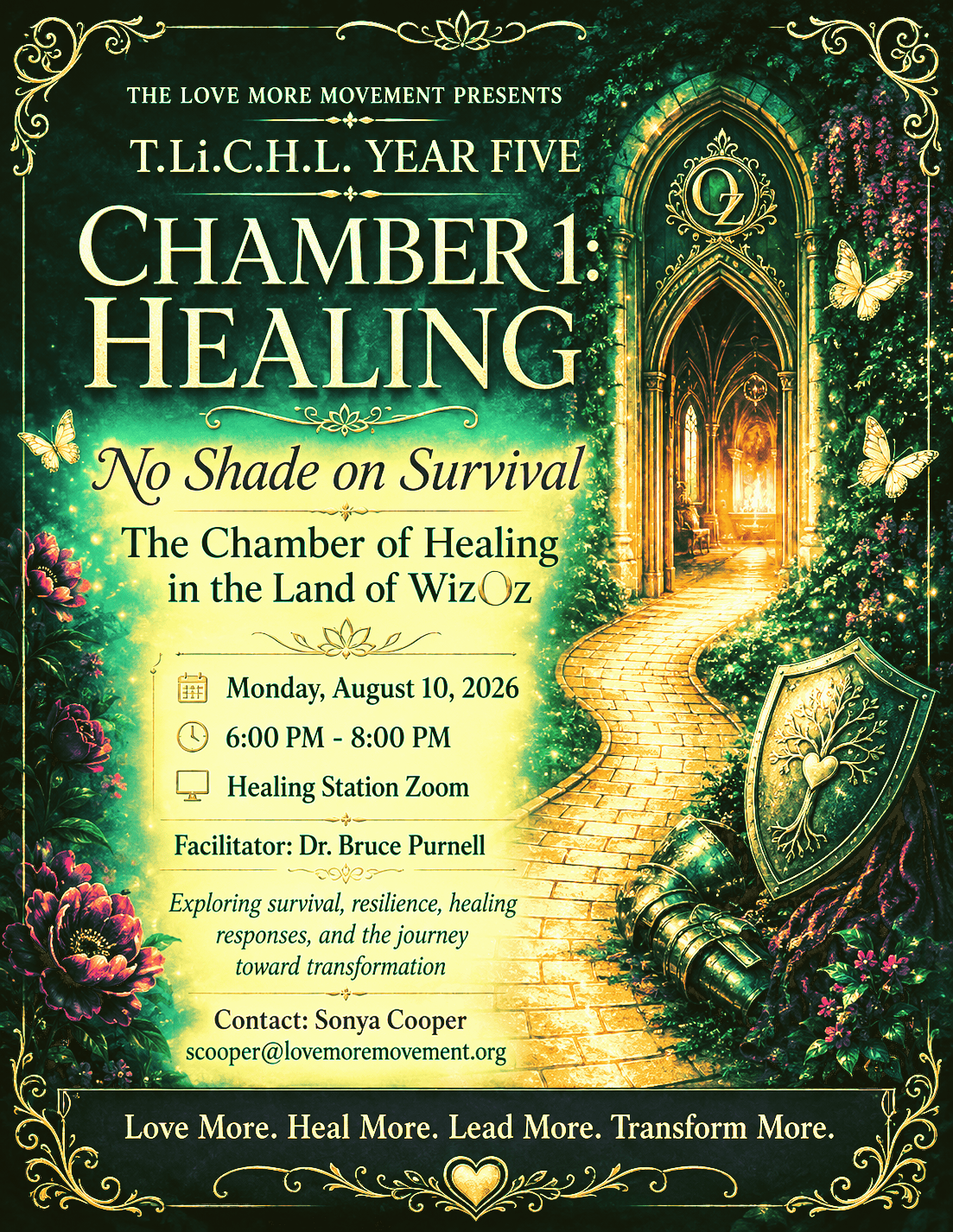
Transformative Life Coaches and Healing Leaders Certification Monday, Aug 10, 6-8 pm on the Healing Station Zoom
https://us02web.zoom.us/meeting/register/JbzP9w-wS3OHFStRPTYBZg
We are Journeyers walking together, learning how to honor what helped us survive while choosing what helps us heal, grow, love, and transform.
No Shade on Survival By Dr. Bruce Purnell
No shade on the strength that carried me through,
No shame on the armor that knew what to do.
It guarded my fortress and wrote my song,
Some knew it was wrong, but still sang along
But healing now whispers, “There is more to your name.
Your story is bigger than survival, protection, and pain.”
One Yellow brick at a time, I can rise, breathe, and see,
The road back to Love is still waiting inside of me.
So I honor the past, but I do not stay bound,
I listen for wisdom in what I have found.
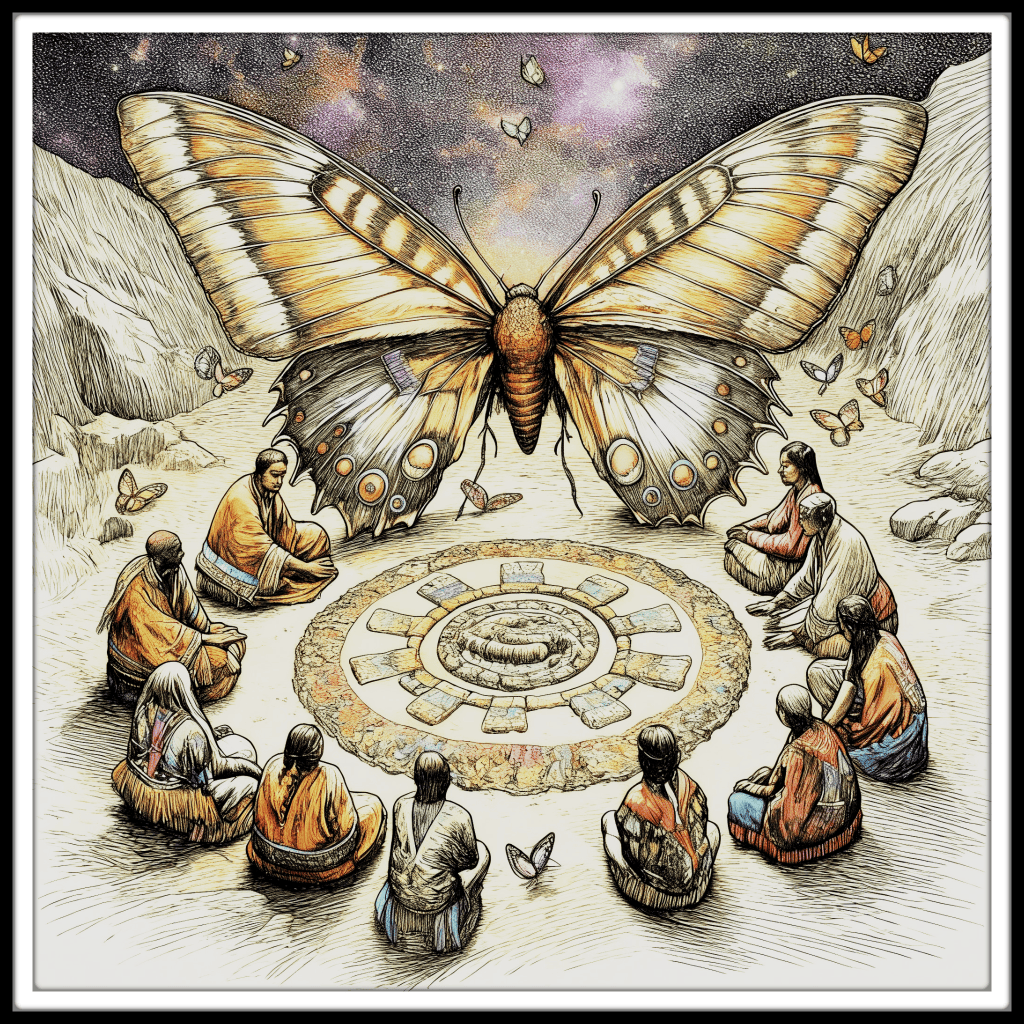
From caterpillar courage to butterfly light,
I heal as I journey from surviving to flight.
Dear Journeyers,
Today, we enter Chamber 1 of TLiCHL: Healing – No Shade on Survival. Last week, we entered the Land of WizOz and reviewed the foundations of TLiCHL, Home B.A.S.E., ethics, HEAL-IDS, F.E.V.E.R.S., and the Yellow Brick Road. This week, we begin the first chamber by exploring healing as a continuing journey and a shared consciousness.
We will discuss resilience from a Love More perspective, why resilience is a bridge to joy rather than the destination, how survival strategies may carry wisdom, and how a Transformative Life Coach can help a Journeyer choose the next brick of their healing journey without shaming the armor.
Please bring a journal, something to write with, and an open heart. If you received a scholarship and cannot complete the course at this time, please contact Sonya Cooper at scooper@lovemoremovement.org.
Community’s Scale for Healing Possibilities: https://welovemore.typeform.com/CSHP1
Intake: https://welovemore.typeform.com/TLiCHLIntake26
Course Books: “I Have The FEVERS For Jazz: Becoming The Butterfly Effect”; The Caterpillar’s WEB for Transformation https://www.lovemoremovement.org/books
No Shade on Survival: Entering the Chamber of Healing
This week, TLiCHL enters Chamber 1: Healing. The doorway into this chamber carries a message that is both gentle and revolutionary: No Shade on Survival.
Survival deserves respect. Many of us developed ways to move through pain before we had the language, safety, support, or resources to heal. Some of us became strong. Some became silent. Some became caretakers. Some became fighters. Some learned to disappear. Some learned to control every detail. These responses were not random. They often protected something sacred.
Within The Love More Movement, we do not shame what helped journeyers make it through. We also do not make survival our permanent address. What protected us in one season may begin to restrict us in another. The Chamber of Healing invites us to listen with compassion: What helped me survive? What did it cost? What wisdom is hidden in the response? What new role might it take as I continue healing?
This is also why Love More is careful with the word resilience. Resilience can be a powerful tool on the journey to joy, helping us take the next breath and the next step. But resilience is not the destination of healing. When resilience becomes the goal, we may unintentionally reward people who perform strength and vilify those whose pain is visible. We may teach Journeyers to become better at enduring harm instead of helping them imagine a life and consciousness no longer organized around responding to trauma.
In Love More language, no one is more healed than anyone else. We speak of people as healing because healing is a continuing journey. The coach is not a healed person guiding an unhealed one. We are Journeyers walking together, with different roles and responsibilities, yet sharing humanity.
A healing person may still remember, grieve, need boundaries, feel anger, and have difficult days. We may still need therapy, medication, prayer, rest, community, or support. Needing support does not mean healing has failed. It may mean that we are actively participating in our healing.
The Chamber of Healing introduces us to the Transformation and Healing Continuum: Atone, Forgive, Heal, Grow, Thrive, Love, and Transform. This continuum is not a rigid staircase, but a map of possibilities. No one is forced to forgive, disclose, reconcile, or move according to another person’s timeline.
In the Land of WizOz, Manifest and Hope arrive at a door with no handle and no lock. It will not open when pushed, but only when they are ready to look within. Inside, the Grinch sits near the fire, surrounded by mirrors that reflect the pain, rejection, anger, distrust, and decisions that shaped his armor. His story reminds us that healing does not begin by shaming the armor, but by understanding why it was needed.
This is the work of a Transformative Life Coach and Healing Leader: not to take away someone’s armor, not to perform healing for them, and not to decide what their journey should mean. The work is to create a Brave Space where dignity, agency, truth, boundaries, support, and Love make the next brick possible.
No shade on survival. No shame in the cocoon. No fear of the fire. No apology for the flight.
CHAMBER 1: THE CHAMBER OF HEALING
No Shade on Survival: Moving from Trauma Response to Healing Response
Survival carried us through what we could not yet heal. Healing invites us to honor what protected us, release what no longer serves us, and become the healing presence we once needed.
—Dr. Bruce Purnell
Chamber Overview
The Chamber of Healing is the first of the Seven Chambers of HEAL-IDS because every Transformative Life Coach and Healing Leader must begin with a willingness to examine healing, not as something we perform for others, but as a consciousness we practice within ourselves. This Chamber does not ask Journeyers to prove that they are healed, nor require anyone to disclose personal trauma, forgive before they are ready, reconcile with someone who caused harm, or turn pain into a public testimony.
Instead, the Chamber of Healing asks:
• What helped me survive?
• What did survival teach me?
• What is survival costing me now?
• What would healing make possible?
• What support do I need to take my next step?
• How can I guide others without projecting my unfinished work onto them?
In TLiCHL, healing is not defined as the absence of pain. Healing is the restoration of relationship with the body, the truth, the gifts, the community, the spirit, and the ability to choose.
This Chamber introduces the Transformation and Healing Continuum:
Atone → Forgive → Heal → Grow → Thrive → Love → Transform.
It also explores survival resilience, healing resilience, healing efficacy, the F.E.V.E.R.S. Framework, the Community’s Scale for Healing Possibilities, the ethical responsibilities of a Healing Leader, and the Grinch as a guiding character for understanding what happens when pain becomes protection and protection becomes identity.
Learning Objectives
By the conclusion of this Chamber, Journeyers will be able to:
- Define healing through a Love More, healing-justice-centered, trauma-informed lens.
- Distinguish survival resilience from healing resilience without diminishing the value of survival.
- Recognize common trauma responses and explore how they may evolve into healing responses.
- Explain the seven movements of the Transformation and Healing Continuum.
- Apply the F.E.V.E.R.S. Framework to personal and community healing.
- Define healing efficacy and identify ways to strengthen it.
- Understand the purpose and ethical use of the Community’s Scale for Healing Possibilities.
- Identify the ethical boundaries between life coaching, peer support, spiritual care, and clinical treatment.
- Practice healing-centered listening without rescuing, diagnosing, pressuring, or controlling.
- Develop a personal Healing Response Plan and identify the next brick on the Yellow Brick Road.
Key Terms
Atonement: The process of acknowledging impact, accepting responsibility, making repair where possible, and returning to alignment.
Brave Space: A relational environment in which people may speak honestly, reflect deeply, and experience loving challenge without being pressured into disclosure.
Healing Efficacy: A person’s perceived confidence and capacity to participate in their own healing process, use supportive resources, and continue moving toward healing after setbacks.
Healing Justice: An approach that understands healing as both personal and collective and recognizes that historical, cultural, institutional, and systemic conditions influence well-being.
Healing Resilience: The capacity to move beyond enduring adversity toward integration, connection, agency, meaning, and transformation.
Scope of Forgiveness: The lens through which a person examines what forgiveness means, what it does not mean, and what role it may or may not play in their healing.
Survival Resilience: The capacity to endure, adapt, function, or remain alive under threatening, painful, or oppressive conditions.
Trauma-Informed Practice: An approach that recognizes the impact of trauma, protects choice and dignity, avoids unnecessary retraumatization, and creates pathways toward recovery and healing.
Transformation: A sustained change in consciousness, identity, relationships, behavior, or systems that allows new possibilities to emerge.
Part I: Entering the First Chamber: At the Door of Healing
“No Shade on Survival Script”
Characters:
Narrator
Manifest
Hope
The Voice
The Grinch
Setting
The Yellow Brick Road in the Land of WizOz. At the end of the road stands a mysterious doorway leading into the Chamber of Healing.
Scene One: The Doorway
Lights rise slowly on the Yellow Brick Road. Manifest and Hope enter, walking side by side. They stop before a large and unusual doorway.
NARRATOR: Manifest and Hope followed the Yellow Brick Road until they reached a doorway unlike any other in the Land of WizOz. There was no lock or handle, and across the door were the words:
The words appear above the doorway.
NO SHADE ON SURVIVAL
Manifest steps forward and pushes against the door. It does not move.
MANIFEST: Come on. Open!
He pushes again, harder. Nothing happens.
Hope approaches the door and gently knocks.
HOPE: Hello? Is anyone there?
There is no answer.
NARRATOR: Manifest pushed against the door, but nothing happened. Hope knocked, but there was no answer.
They searched around the doorway until Hope discovered a smaller inscription near the bottom. Hope kneels and reads the inscription aloud.
HOPE: “This door does not open when you push against it, but it will release when you are ready to look within.”
Manifest steps back, visibly frustrated.
MANIFEST: I came here to learn how to help people. Why do I have to look at myself?
A voice speaks from the other side of the door.
THE VOICE: Because sometimes what we call helping is really rescuing. Sometimes what we call leadership is control, and sometimes what we call strength is fear wearing armor.
Manifest and Hope look at one another, and the door slowly begins to open. A warm light spills onto the Yellow Brick Road.
Scene Two: Inside the Chamber
Manifest and Hope cautiously enter the Chamber of Healing. A fire burns at the center of the room. The Grinch sits beside it, staring into the flames.
NARRATOR: Inside the chamber sat the Grinch. He was not hiding in darkness. He sat near a fire, looking at the walls. Each wall held a mirror, but none of the mirrors reflected his face. Instead, they reflected moments from his life: Rejection, Loneliness, Anger, Disappointment, Distrust, and all the other decisions he had made to protect himself.
Images begin to appear within the mirrors as the Narrator speaks. The Grinch slowly turns toward Manifest and Hope.
THE GRINCH: People remember what I became, but few ask what happened before I became it. Hope takes a careful step toward him, but does not touch him.
HOPE: What protected you?
The Grinch turns back toward the fire. He pauses before answering.
THE GRINCH: Distance protected me. Anger protected me. Not needing anyone protected me. Convincing myself that love did not matter protected me. Numbing my feelings and not expecting people to be kind, fair, honest, and loving protected me.
Manifest studies him for a moment.
MANIFEST: And did those things work?
THE GRINCH: Yeah, and it worked well
He pauses.
THE GRINCH: Until they became the very things keeping me from the life I wanted.
The room falls silent. Manifest and Hope look toward the mirrors. The Grinch continues staring into the fire. Slowly, another message appears above the flames.
HEALING DOES NOT BEGIN WITH SHAMING THE ARMOR. HEALING BEGINS WITH UNDERSTANDING WHY IT WAS NEEDED.
Hope reads the message silently. Manifest lowers his head, reflecting on what he has heard. The Grinch rises and turns to face them.
THE GRINCH: Welcome to the Chamber of Healing. You cannot take someone’s armor away before helping them determine whether it is safe to put it down.
The fire glows brighter as the lights slowly fade.
End Scene
WizOz Field Note
The characters of the Land of WizOz are not used to diagnose people or reduce human experiences to simple stories. They serve as mirrors, metaphors, and portals for reflection. The Grinch illustrates what can happen when pain is shielded by isolation, anger, rejection, and emotional distance. His healing does not begin when someone labels him as bad. It begins when the story beneath the behavior is finally heard. The central coaching question is not: What is wrong with the Grinch? It is: What happened, what protected him, what the protection cost, and what new possibility is now available?
Part II: What Is Healing?
The TLiCHL Definition of Healing
Within TLiCHL, healing is understood as an intentional, ongoing movement toward Love, Joy, Hope, Peace, Purpose, Forgiveness, greater wholeness, truth, connection, agency, liberation, regulation, meaning, and the capacity to choose one’s response. Healing may encompass emotional, psychological, relational, spiritual, physical, ancestral, cultural, and community dimensions. No single pathway, practice, belief system, or timeline defines healing for everyone. Healing may be supported by:
• Honest reflection
• Prayer and spiritual practice
• Counseling or psychotherapy
• Life coaching
• Peer support
• Community and cultural connection
• Rest
• Movement and body-based practices
• Medication and medical care
• Creative expression
• Storytelling
• Ritual
• Accountability
• Forgiveness
• Boundaries
• Advocacy
• Justice
• Love
The role of a Transformative Life Coach and Healing Leader is not to dictate which path a Journeyer must follow. Rather, it is to create the conditions for the Journeyer to listen to themselves, access appropriate support, identify their gifts, strengthen their agency, and choose their next brick.
Healing Is Not the Same as Being Unhurt
Within the Love More Movement, we do not use the word healed as if it were a destination someone permanently reaches. We speak of people as healing because healing is a living, ongoing process that unfolds through new experiences, relationships, losses, discoveries, choices, and stages of becoming. No one within Love More is more healed than anyone else. Healing is not a title, a rank, or a position of superiority. The Transformative Life Coach is not the “healed” person guiding someone who is “unhealed.” The coach and the Journeyer may have different roles and responsibilities within the coaching relationship, but they share the same humanity. Each is on a journey of healing and transformation.
A person who is healing may still remember, grieve, feel anger, need boundaries, and experience difficult days. They may still need therapy, medication, prayer, rest, community, spiritual care, medical support, or continued coaching. Needing support does not mean healing has failed. It may be one of the clearest signs that a person is actively engaged in their healing process. Healing is not demonstrated by pretending that something did not matter, nor does it require us to erase the past, deny the wound, or perform happiness so others will believe we have moved forward. Healing allows us to remember without being required to relive the experience the same way each time.
Healing is not an eraser but a developing relationship with what happened, what survived, what was lost, what remains, and what is now possible. Some days we may feel like the butterfly, moving with new perspective and freedom. On other days, we may need the cocoon’s protection and stillness. Neither position makes one person more evolved, more worthy, or more healed than another. We are not divided into the healed and the unhealed. We are Journeyers, walking, learning, remembering, releasing, growing, loving, and transforming together.
Within Love More, healing is not a status we attain. It is a journey we honor, a consciousness we cultivate, and a shared responsibility.
Healing is not:
• Forgetting the past
• Pretending the harm did not occur
• Excusing abusive or oppressive behavior
• Returning to an unsafe relationship
• Forgiving because someone else demands it
• Remaining silent to keep others comfortable
• Performing happiness
• Avoiding anger or grief
• Thinking positively about everything
• Handling everything alone
• Proving that pain made us stronger
• Reaching a permanent state where nothing affects us
• Becoming responsible for healing everyone around us
Healing may look like:
• Naming what happened without accepting shame for it
• Recognizing that a reaction has a history
• Setting a boundary without apologizing for having one
• Asking for help
• Receiving help without feeling weak
• Resting before the body demands a collapse
• Grieving what was lost
• Reconnecting with joy
• Making an honest apology
• Repairing harm where repair is possible
• Releasing responsibility for something that was never ours
• Choosing not to reconcile
• Choosing to reconcile with clear boundaries
• Returning to a dream that pain interrupted
• Reclaiming a gift that survival forced into hiding
• Discovering that a setback does not erase progress
The Love More Lens: People are the medicine, not the patients.
This idea that people are the medicine, not the patients, does not diminish the importance of clinicians, medicine, treatment, or professional services. It reminds us that people are more than collections of symptoms, diagnoses, deficits, or problems. Every person carries knowledge, a story, gifts, and medicine that may have been buried beneath pain, oppression, fear, rejection, or survival. The Healing Leader’s work is not to become someone else’s medicine but to help create a Brave Space where the medicine already within the person, within supportive relationships, and within community can be recognized, strengthened, and shared.
Part III: No Shade on Survival: Survival Deserves Respect
Survival is not a failure to heal but evidence that something within us remained committed to life, protection, adaptation, dignity, or continuity. Some survival responses are obvious, while others may seem socially acceptable or even rewarded.
Survival can look like:
• Fighting
• Fleeing
• Freezing
• Pleasing others to prevent conflict
• Becoming emotionally numb
• Isolating
• Distrusting everyone
• Attempting to control every detail
• Working constantly
• Becoming the caretaker for everyone else
• Using humor to avoid pain
• Remaining hyperalert
• Refusing help
• Minimizing personal needs
• Becoming highly successful to prove worth
• Remaining silent
• Becoming loud enough that no one can overlook us.
These responses should not be treated as defects by default because they often develop for a reason. A healing-centered question asks, “What did this response do for you when you needed it?” That question honors survival without requiring a person to remain organized around it forever. Trauma-informed approaches similarly emphasize safety, trust, peer support, collaboration, empowerment, voice, choice, and attention to cultural and historical context. These principles help shift practice away from controlling people and toward creating conditions in which dignity and agency can grow. Now, let’s look at resilience as a healing tool on our journey toward the vibration of joy.
Resilience From a Love More Perspective: A Bridge to Joy, Not the Destination of Healing
Resilience is often celebrated as the ability to endure adversity, recover from hardship, adapt to change, and keep moving after painful experiences. Within the Love More Movement, we honor resilience as a meaningful, sometimes life-preserving capacity. Resilience can help a Journeyer find the next breath, take the next step, imagine another possibility, and continue traveling toward joy. At the same time, we are careful in how we use the concept.
Resilience can become harmful when it is treated as a measure of strength, a requirement for healing, or evidence that one person has navigated trauma more successfully than another. When resilience becomes a standard by which people are judged, it may reward those who can appear strong, productive, calm, forgiving, or unaffected, while indirectly vilifying those whose pain is more visible. A Journeyer who continues to work, care for others, smile, achieve, and show up may be described as highly resilient. Another Journeyer who is grieving, exhausted, angry, withdrawn, uncertain, or struggling to function may be viewed as lacking resilience. Love More rejects that comparison.
Visible functioning is not always evidence of healing. Sometimes it is evidence that a person has become skilled at concealing pain, suppressing needs, or performing strength. Likewise, visible struggle is not evidence of weakness. It may be evidence that the Journeyer is carrying an extraordinary burden, has not received adequate support, no longer wishes to hide what hurts, or is finally allowing themselves to acknowledge what survival required.
Resilience should not be considered a character grade.
We do not divide Journeyers into the resilient and the non-resilient, nor do we use resilience to determine who is strong, worthy, committed, spiritually mature, or capable of transformation. We also do not assume that a person who is struggling to navigate the pain of the past has failed to develop sufficient strength. When resilience is presented as a personal virtue, a struggling Journeyer may begin to believe:
• Something must be wrong with me.
• Other people went through difficult times and handled them better.
• I should be further along by now.
• I am letting down the people who believe in me.
• I am not strong enough to heal.
• I need to hide my pain so others see me as resilient.
These beliefs can create shame precisely where compassion, support, truth, and community are needed. The Love More question is not: Why are you not resilient enough, but:
• What have you been carrying?
• What helped you survive?
• What support was available, and what was missing?
• What conditions continue to cause harm?
• What does your body, spirit, family, or community need now?
• What would make healing and joy more possible?
Resilience Is Not Proof of Healing
Resilience and healing are related, but they are not the same. A person may demonstrate extraordinary resilience while remaining deeply wounded. They may continue meeting responsibilities, solving problems, protecting others, and responding to crisis while never having the opportunity to grieve, rest, receive care, or examine the cost of always being the strong one. Resilience may help a person function within painful conditions, and healing invites us to question whether those conditions should continue. Resilience may help someone carry a heavy load, whereas healing asks whether the load can be shared, reduced, transformed, or put down. Resilience may help a Journeyer survive the storm, and healing asks whether they can eventually leave the storm, build shelter, experience peace, and live in a consciousness that is not permanently organized around preparing for the next storm.
For this reason, Love More does not treat resilience as proof that someone has completed healing. Resilience is one possible resource along the journey, not the final measure.
When Resilience Becomes the Destination
If resilience were the ultimate goal of healing, then trauma would remain at the center of our imagination. The goal would become:
• Be strong enough for the next crisis.
• Recover quickly from the next loss.
• Adapt to the next injustice.
• Endure the next betrayal.
• Function through the next wound.
• Return to productivity as soon as possible.
This would mean we are always expecting trauma to persist and preparing Journeyers to survive it more effectively. We would be teaching people to withstand repeated injury without also asking why the injury keeps occurring, who benefits from the harmful conditions, what must change, and whether a different life is possible. Love More does not aspire to make people endlessly adaptable to conditions that should be transformed.
We do not want Journeyers to become better at tolerating pain, inequity, violence, neglect, overwork, exploitation, or emotional abandonment. Instead, we want individuals, families, institutions, and communities to create conditions that expand people’s access to safety, love, rest, dignity, belonging, peace, purpose, and joy. The goal is not to become trauma-proof. Rather, it is to cultivate a life and consciousness in which trauma is no longer expected to organize every thought, relationship, decision, or possibility.
Resilience as a Tool on the Journey to Joy
Love More views resilience as a valuable tool and a bridge that may help a Journeyer travel from adversity toward hope, healing, transformation, and joy. A bridge is important, but it is not the destination. Resilience may help us cross difficult terrain and remain engaged with life long enough to discover support, reclaim agency, restore relationships, revisit dreams, and imagine a future beyond what happened. But we do not build our permanent home on the bridge. Our destination is not endless endurance, but includes:
• Joy that does not require permission
• Peace that is more than mere absence of conflict
• Rest that does not produce guilt
• Relationships grounded in reciprocity
• Love supported by boundaries and truth
• Purpose not defined solely by pain
• Communities that reduce harm rather than praise people for surviving it.
• Institutions that become accountable for the conditions they create.
• A consciousness in which thriving becomes possible
Resilience may help us reach joy, but it is not joy. Resilience may help us survive the fire, but healing allows us to examine the ashes, reclaim what remains, and decide what to build next.
The Love More Commitments Around Resilience
When discussing resilience, Transformative Life Coaches and Healing Leaders commit to the following principles:
We Do Not Rank Journeyers
No one is considered stronger, better, more worthy, or more evolved because they appear to navigate trauma more effectively.
We Do Not Reward the Performance of Healing
Journeyers are not expected to appear calm, positive, forgiving, productive, or inspirational for their healing to be honored.
We Do Not Vilify Visible Struggle
Grief, anger, uncertainty, exhaustion, tears, silence, or the need for support are not signs of failure.
We Honor Context
A Journeyer’s response is shaped not only by internal strength but also by relationships, resources, culture, history, safety, access to care, institutional conditions, and community support.
We Challenge Harmful Conditions
The responsibility for healing must not rest solely with the person who was harmed. Families, organizations, institutions, and communities may also need to repair, change, and be accountable.
We Make Room for Rest
Resilience is not the requirement to remain active, productive, or available at all times. Rest can be a healing response.
We Protect Choice
The Journeyer determines what strength, healing, joy, and transformation mean in their life. The coach does not impose a preferred outcome for healing.
No Shade on Resilience
Just as we say No Shade on Survival, we place no shade on resilience. Resilience has carried people through unbearable circumstances. It has preserved families, communities, cultures, movements, faith, memory, creativity, and hope. It deserves respect. However, what carries us through one season should not automatically become the only way we know how to live. Therefore, we intend to honor resilience without worshiping it, use it without allowing it to become a judgment, strengthen it without confusing it with wholeness, and appreciate the bridge while continuing toward joy.
Resilience says, “I can make it through,” and Healing says, “I can build a new relationship with what I went through.” Transformation says, “What I went through will not be allowed to define the limits of what comes next,” and Joy says, “I am no longer living only in response to pain.”
Love More Lens
Resilience is a tool, not a title. It can help us travel through adversity, but it is not the destination of healing. We are not preparing Journeyers to endure trauma forever. We are walking together toward a consciousness in which love, joy, hope, peace, purpose, equity, forgiveness, and transformation become possible. With this understanding, TLiCHL distinguishes between two expressions of resilience.
Survival resilience helps us endure, adapt, protect ourselves, and make it through threatening or painful conditions, and healing resilience helps us integrate what happened, restore choice, receive support, reconnect with our gifts, and participate in creating a life beyond the emergency. Neither expression is used to rank Journeyers, but both help us understand what may be needed at different points along the Yellow Brick Road. Survival resilience asks: How do I make it through? Healing resilience asks: How do I live, love, experience joy, and continue becoming after what I survived? Love More adds one additional question: What must change within us and around us so that enduring trauma is no longer mistaken for the highest expression of human strength?
Survival Resilience and Healing Resilience
Survival Resilience
Survival resilience is the ability to endure, adapt, protect oneself, remain functional, or continue moving in difficult conditions. Its central question is: How do I make it through? Survival resilience may involve courage, creativity, alertness, sacrifice, persistence, and rapid adaptation. It can carry individuals, families, and communities through circumstances with few resources or choices. Survival resilience is sacred, but it can become exhausting when the emergency has ended and the body, mind, relationships, or community continue to live as if it is still present.
Healing Resilience
Healing resilience is the capacity to integrate what happened, restore choice, seek support, reconnect with gifts, build healthier patterns, and participate in creating a life beyond the emergency. Its central question is: How do I live, love, and become after what I have survived? Healing resilience does not replace survival resilience. It expands it. Survival may teach us how to stay alive. Healing teaches us how to become available to life.
The Intelligence of the Survival Response
A survival response often forms before a person has the language, power, safety, or support to make a different choice. The response may continue because:
It once worked.It has been repeatedly reinforced.
- The threat has not fully ended.
- The current environment resembles the original environment.
- The body reacts before conscious thought catches up.
- A new response has not yet been practiced.
- The person does not have enough support to risk changing.
- The response has become connected to identity.
Healing is not the act of telling someone to stop reacting, but the process of creating enough awareness, safety, support, and practice to make a new response possible.
Part IV: From Trauma Response to Healing Response
The Healing Response Is Not the Perfect Response and is not always calm, graceful, or immediately forgiving. A healing response may be:
- Leaving the room before saying something harmful
- Asking for time
- Stating that a boundary has been crossed
- Crying
- Calling a trusted person
- Taking medication as prescribed
- Scheduling a therapy appointment
- Declining an invitation
- Correcting misinformation
- Making amends
- Choosing not to answer immediately
- Acknowledging that we do not yet know what to do.
The goal is not emotional perfection, but increased choice.
The Seven Movements of a Healing Response
1. Establish Enough Safety
Before deep reflection, assess whether the person is physically and emotionally able to remain present. Questions include:
- What would help you feel more grounded at the moment?
- Would you prefer to sit, stand, pause, write, listen, or step away?
- Is there anything about this conversation that needs to be changed?
- Would another form of support be more suitable?
“Enough safety” does not mean that all discomfort disappears, but the Journeyer has meaningful choice and support.
2. Notice Without Judgment
Invite awareness of what is happening.
- What are you noticing in your body?
- What emotion is closest to the surface?
- What thought keeps returning?
- What changed in your energy?
The coach does not rush to interpret.
3. Name the Experience
Language can reduce confusion and create distance between the person and the reaction.
There is a difference between saying:
“I am broken.”
and:
“I am noticing fear, exhaustion, and a belief that I have to handle everything alone.”
The first statement turns an experience into an identity. The second makes room for observation and choice.
4. Honor the Protective Intention
Ask:
- What was this response trying to protect?
- When did this response first become useful?
- What gift is hidden inside it?
- What does the protective part of you need to know now?
This is where “No Shade on Survival” becomes practice.
5. Regulate or Co-Regulate
Regulation may include:
- Slowing the breath without forcing it
- Feeling the support of the floor or chair
- Looking around the room
- Drinking water
- Walking
- Praying/meditating
- Listening to music
- Using a grounding object
- Sitting with a trusted person
- Pausing the conversation
The coach does not prescribe one method as universally effective. Journeyers should be invited to identify what works for them.
6. Choose the Next Brick
The Yellow Brick Road is traveled one brick at a time.
Ask:
- What is one option available to you now?
- What feels possible, not perfect?
- What support would make that step more feasible?
- What boundary, conversation, practice, or referral is required?
7. Integrate, Reflect, and Repair
After the immediate moment has passed:
- What did you learn?
- What helped?
- What would you change next time?
- Was anyone harmed?
- Is repair needed?
- What did this moment reveal about your healing?
Healing is strengthened when insight becomes practice.
A Healing Sequence
Trigger or Stressor
↓
Automatic Survival Response
↓
Pause and Awareness
↓
Support and Regulation
↓
Choice
↓
Action, Boundary, or Repair
↓
Reflection and Integration
The pause does not always happen immediately. Sometimes reflection occurs hours or days later. Returning to the moment with compassion remains part of healing.
Part V: The Transformation and Healing Continuum: A Map, Not a Mandate
The TLiCHL Transformation and Healing Continuum consists of seven movements:
- Atone
- Forgive
- Heal
- Grow
- Thrive
- Love
- Transform
The continuum is not a rigid staircase. Journeys may revisit stages, experience several simultaneously, follow a different order, or spend significant time in one area. No one should be pressured to forgive, reconcile, disclose, or demonstrate growth on another person’s timeline. The continuum is a map of possibilities, not a measure of human worth.
Buildshop One: The Survival Gifts Inventory
Complete the following reflections.
What I Learned to Do to Survive
What It Protected Me From
The Gift Hidden Within the Response
What the Response May Be Costing Me Now
What the Protective Part of Me Needs
How the Survival Gift Could Evolve
My Next Healing Brick
Buildshop Two: A Letter of Atonement to Self
This exercise is invitational. Journeyers may write in the first person, write about a fictional character, complete only selected prompts, or pass.
Begin with:
Dear Me,
I acknowledge that ____________________________________________.
At the time, I believed ________________________________________.
I was trying to protect ________________________________________.
I now understand _____________________________________________.
The responsibility that belongs to me is __________________________.
The responsibility that does not belong to me is ___________________.
I am ready to release _________________________________________.
The repair I can make is _______________________________________.
The support I need is _________________________________________.
From this point forward, I commit to ______________________________.
With Love and Truth,
Processing Questions
• What did you acknowledge?
• Where did shame attempt to enter?
• What responsibility is truly yours?
• What responsibility can be returned?
• What repair is possible?
• What compassion is necessary?
The letter does not have to be shared.
Buildshop Three: My Healing Response Plan
Situations That Commonly Activate Me
Early Signals in My Body
Thoughts or Stories That Appear
My Usual Survival Response that the Response Is Trying to Protect
Practices That Help Me Regulate
People or Resources I Can Contact
Boundaries I May Need
My Preferred Healing Response
One Sentence I Need to Remember
Part XVI: Chamber Summary
The Chamber of Healing teaches that:
• Healing begins with curiosity, not shame.
• Survival responses often developed as intelligent efforts to protect life, dignity, connection, or safety.
• “No Shade on Survival” honors what carried us without requiring survival to lead forever.
• Survival resilience helps us endure; healing resilience helps us integrate, connect, choose, and thrive.
• Healing is not forgetting, forced forgiveness, constant happiness, or the absence of pain.
• The Transformation and Healing Continuum is a map, not a mandate.
• Atonement requires truth and responsibility without unnecessary shame.
• Forgiveness does not automatically require reconciliation, restored access, or removal of consequences.
• F.E.V.E.R.S. creates an atmosphere for healing without requiring emotional performance.
• Healing efficacy is confidence that one can participate in healing and use support.
• The Community’s Scale for Healing Possibilities should create conversations, not labels.
• Ethical coaching requires consent, confidentiality, boundaries, role clarity, cultural humility, appropriate referral, and awareness of power.
• A Transformative Life Coach does not remove another person’s armor. The coach helps the Journeyer understand the armor and decide when, where, and whether it is safe to loosen it.
Chamber Reflection Questions
- What does healing currently mean to you?
- What is the difference between being healed and participating in healing?
- Which survival response has protected you most?
- What gift is contained within that response?
- What may that response be costing you now?
- Where do you notice survival resilience in your family or community?
- What would healing resilience look like in the same situation?
- Which movement of the Transformation and Healing Continuum feels most present in your life?
- What were you taught about forgiveness?
- Which parts of that teaching support healing, and which parts may restrict it?
- What increases your belief that healing is possible?
- How might a coach unintentionally pressure a Journeyer to perform healing?
- What are the signs that a concern may be outside the scope of life coaching?
- What is one boundary that would support your healing?
- What is the next brick on your Yellow Brick Road?
Knowledge Check - In TLiCHL, healing is best understood as:
A. The complete removal of all painful memories
B. A continuing movement toward wholeness, agency, connection, and choice
C. Reconciliation with everyone who caused harm
D. The ability to remain positive at all times - “No Shade on Survival” means:
A. Every survival response should continue forever
B. Survival responses should never be questioned
C. We honor what protected us while exploring whether a new response is possible
D. People should avoid discussing the cost of survival - Survival resilience primarily asks:
A. How can I transform an institution?
B. How do I make it through?
C. How do I forgive immediately?
D. How do I become a coach? - Healing resilience includes:
A. Increased choice, connection, integration, and support
B. Avoiding all discomfort
C. Handling every problem alone
D. Forgetting the past - Which statement best reflects the TLiCHL understanding of forgiveness?
A. Forgiveness always requires reconciliation
B. Forgiveness removes all consequences
C. Forgiveness may support release but does not automatically restore access
D. Forgiveness must occur before any other healing can begin - The Community’s Scale for Healing Possibilities should be used primarily to:
A. Rank Journeyers
B. Diagnose mental disorders
C. Create structured reflection and conversation
D. Decide who is worthy of certification - Healing efficacy is:
A. The belief that one will never struggle again
B. Confidence in one’s capacity to participate in healing and use support
C. The ability to heal without other people
D. Proof that someone has completed healing - Which action is most consistent with ethical coaching?
A. Diagnosing the Journeyer so they understand themselves
B. Requiring personal disclosure to demonstrate commitment
C. Clarifying role, confidentiality, choice, and scope
D. Promising that everything shared will always remain confidential under all circumstances - When a concern is beyond the coach’s competence, the coach should:
A. Continue so the Journeyer does not feel rejected
B. Offer a respectful referral and clarify what coaching support remains appropriate
C. End the relationship without explanation
D. Search online for a diagnosis - The central purpose of the Yellow Brick Road is to:
A. Reach perfection as quickly as possible
B. Follow the coach’s instructions without question
C. Recognize and take the next meaningful step toward healing and transformation
D. Avoid revisiting any earlier stage
We are becoming the “Social Architects” and “Social Alchemists” who will design our healing and transformation. Let’s affirm and manifest our divine cocoons together. #WeAreTheButterflyEffect #WeAreThePhoenixRising #WeAreHealingTogether #WeLoveMoreSee the full sessions on the Blog: https://welovemoredrbruce.com/
Please give Love More a Google rating: https://g.page/r/CYI0Pw3JjBrjEAI/review

